
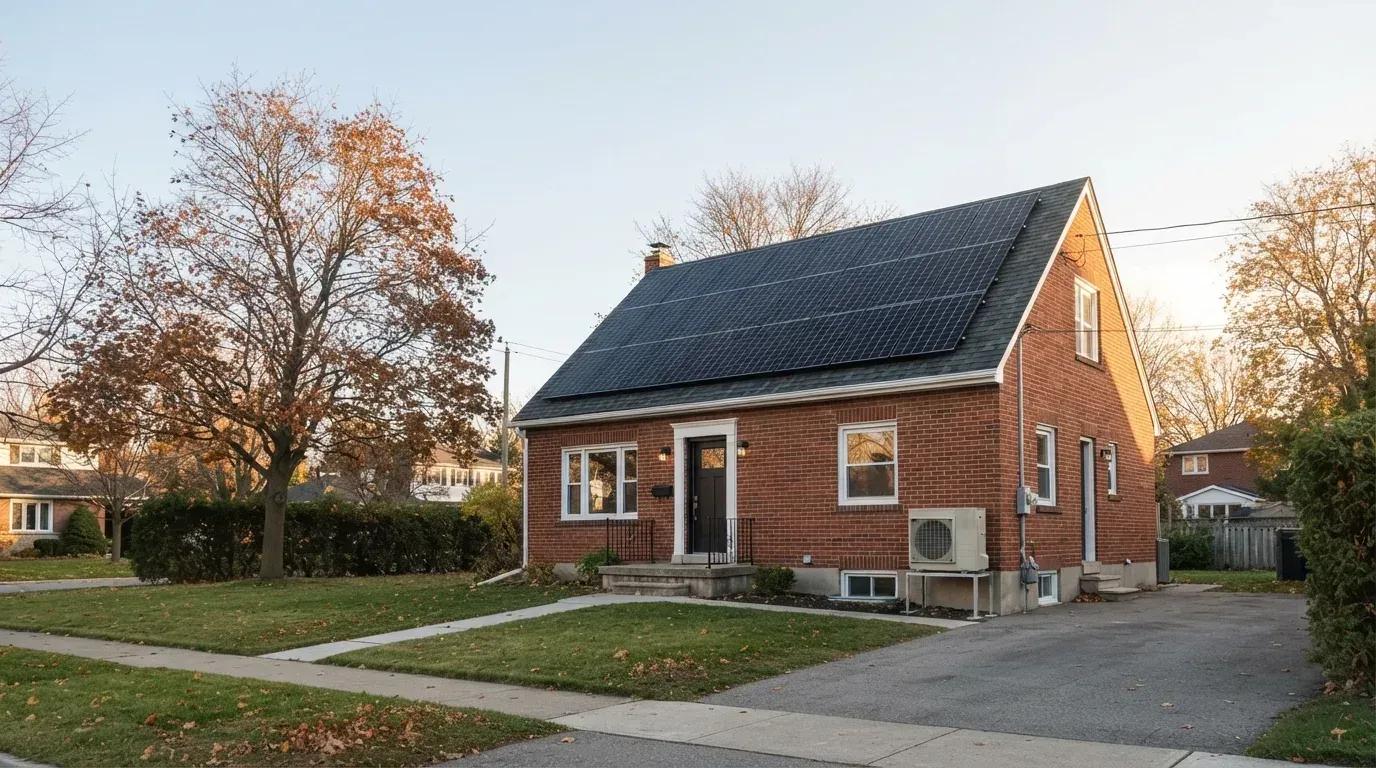
Quick answer: A net zero home in Ontario produces as much clean energy over a year as it uses. Getting there with solar means cutting demand, switching heating to electricity, then sizing panels to your yearly kWh. Whether your bill balances too depends on your program path: the rebate or net metering, not both.
Last updated . Program amounts and rules are set by each program and can change. Confirm them before you apply.
What is a net zero home?
A net zero home makes as much clean energy in a year as it uses, and the related terms each describe something narrower or different.
| Term | Plain meaning | Who defines or labels it |
|---|---|---|
| Net zero home | Produces as much clean energy as it consumes each year, using renewable systems on the property, after being built or renovated for high efficiency | Canadian Home Builders' Association (CHBA) labelling program. Natural Resources Canada describes it in similar terms. The CHBA label is based on a modelled energy rating, not on measured bills |
| Net zero ready | Meets the same efficiency requirements, with the renewable system not yet installed | CHBA |
| Net zero electricity | Solar output over a year matches the home's electricity use. Gas and other fuels are not counted | A plain description used in this guide, not an official label |
| Net zero emissions | Greenhouse gas emissions balanced by removals over a set period. This is Canada's national target for 2050 | Federal law, S.C. 2021, c. 22 |
| Off grid | No connection to the utility grid. A net zero home can stay connected | Save on Energy describes net zero homes as able to stay grid connected |
Under the CHBA labelling program, CHBA recognizes a home based on sign off from a CHBA Qualified builder or renovator, a qualified energy advisor and their Service Organization. Adding solar does not earn the label on its own.
Can a house in Ontario get there with solar alone?
Where the roof allows, solar can balance a home's electricity use over a year, but a net zero home counts all the energy it uses, not just electricity. Solar handles the production side. The use side has to come down too.
A gas heated home whose solar matches its electricity use is net zero on electricity, not on all energy. Switching the heating to a heat pump moves that load to electricity, where solar can help cover it.
Save on Energy describes net zero homes as designed to be up to 80 per cent more efficient than conventional homes. Using less energy means fewer panels are needed to balance it.
What order should the work go in?
The order that works is measure, cut demand, electrify, size solar, then decide on a battery.
- Measure. Gather 12 months of electricity and gas bills. A home energy assessment by a registered energy advisor shows where the home loses energy.
- Cut demand. Insulation, air sealing, windows and doors lower the energy the home needs. Under the Home Renovation Savings program assessment stream, these upgrades need an assessment before work starts, and at least two upgrades to qualify. Attic insulation also has its own stream.
- Electrify. Replace fuel burning heat with a heat pump where it suits the house. A licensed HVAC contractor's load calculation tells you the size and the expected electricity use.
- Size solar. Size the array after the new loads are known. The rebate program itself recommends finishing upgrades such as a heat pump or EV charger before sizing solar.
- Decide on a battery. A battery changes when you use your solar power. It does not change how much the panels make in a year.
How much solar does a net zero home need?
The array size is your yearly electricity use divided by how much one kW of panels makes in a year where you live.
Formula: yearly kWh ÷ yearly kWh per kW = array size in kW DC
The table uses 1,166 kWh per kW per year, the Ontario average the province reports from Natural Resources Canada data. The fact sheet gives no data year. Natural Resources Canada states its figures per kW of installed DC panel capacity, so the results are in kW DC.
| Yearly electricity use | Where the number comes from | Arithmetic | Array size |
|---|---|---|---|
| 8,400 kWh | The OEB's typical residential customer: 700 kWh a month × 12 | 8,400 ÷ 1,166 | 7.2 kW DC |
| 12,000 kWh | Illustration | 12,000 ÷ 1,166 | 10.3 kW DC |
| 18,000 kWh | Illustration | 18,000 ÷ 1,166 | 15.4 kW DC |
This is an illustration, not a design. Roof direction, pitch and shade change the result. Natural Resources Canada says most systems should land within about 10% of its estimates over their lifetime, for the roof direction and tilt it modelled.
Three size rules sit beside this table. Read each one on its own terms.
- The 12 kW connection line is not a panel size. Since May 1, 2026, a generation facility with a nameplate rated capacity of 12 kW or less is "micro" and follows the simpler connection process, under OEB code changes. The OEB's procedures use the inverter's AC nameplate rating when sizing a site. Panel capacity in kW DC can be a different number. Ask your utility how it will rate your system.
- Export limits can keep a larger system in the simpler process. A system with nameplate capacity up to 24 kW is processed as micro when a power control system approved by the utility limits export to 12 kW. The utility may take up to 30 extra days and may run a simplified assessment. See our guide to Ontario grid capacity.
- The solar rebate tops out at $5,000. It pays $1,000 per kW DC, up to 50% of eligible costs before HST, so the amount stops growing at 5 kW DC. A larger array earns no more rebate.
For a full sizing walkthrough, see how many solar panels you need.
How do a heat pump and an EV change the size?
A heat pump and an EV both raise your yearly electricity use, so both raise the solar needed to balance it.
Heat pump. This guide gives no typical kWh figure, because the sources we checked did not include an official one for an Ontario home. Ask a licensed HVAC contractor for a load calculation and the expected yearly kWh, then add that to your current use before sizing solar. Our heat pump and solar guide covers the pairing in detail.
EV. Multiply the car's rated kWh per 100 km by the km you drive in a year, then divide by 100. Add the result to your yearly use.
Rebates for the heat pump. The Home Renovation Savings program lists cold climate air source heat pump rebates of $1,250 per ton up to $7,500 for homes heated with electricity, oil, propane or wood, and $500 per ton up to $2,000 for homes heated with Enbridge natural gas. Amounts depend on the unit's rated capacity. The home's first heat pump qualifies, installed by a participating contractor.
Federal rebate, announced and not yet open. The National Heat Pump Rebate is $2,000, or up to $10,000 for low to median income households. The federal page says the portal opens in early 2027, that installs from November 1, 2026 can count, that there is one rebate per household, and that funding is not guaranteed until an application is approved. It also notes that switching from natural gas to a heat pump may not lower heating bills. See our guide to the federal heat pump rebate in Ontario.
Rebate or net metering: how do the paths compare?
You choose one path, and the choice decides what happens to solar power your home does not use right away.
Under the program's participant agreement, equipment that received the solar or battery incentive cannot be net metered at any time. If you enter net metering later, the program can require you to repay the rebate.
| What changes | Rebate path (Home Renovation Savings) | Net metering path |
|---|---|---|
| Rebate | Solar: $1,000 per kW DC, up to 50% of eligible costs before HST, maximum $5,000. Battery: $300 per kWh, up to 50% of eligible costs, maximum $5,000. Paid after installation, once the program approves your final application | None from this program |
| Surplus power | No net metering credit for surplus | Can earn a dollar credit on your bill |
| What the credit offsets | Not applicable | Charges based on the electricity you consume |
| Credit period | Not applicable | Credits can carry forward for up to 12 months, then are reduced to $0 |
| Sizing guidance | Must be sized for load displacement. The program says typical projects are 5 to 10 kW, depending on the home's use | Power must be generated primarily for your own use |
| Where panels go | Rooftop, including a garage or outbuilding roof. Ground mounts are not eligible | Subject to utility approval and local rules |
| Ownership | You must own the equipment | Leased or third party arrangements are allowed |
| Approval | Written approval from the program and your local utility before buying or installing | Utility agreement and connection approval |
Why this matters for net zero. There are two balances, and they are not the same thing.
- The yearly energy balance is kWh made against kWh used. The program path does not change the arithmetic.
- The bill balance is dollars. On net metering, summer surplus becomes dollar credits that can offset later consumption charges within the credit period. On the rebate path, surplus earns no net metering credit, so there is no credit to set against winter grid power.
On the rebate path, the program asks that the array match the home's typical consumption pattern. Owners of larger systems may be asked for more information at application.
Before you sign anything on the rebate path, check these conditions in the program terms:
- Do not make a binding commitment to buy the equipment before you apply.
- The quote must be dated within 60 days of the application.
- The work must be finished within 12 months of approval.
- Your contractor must file the final application within 30 days of installation.
- A home that already has solar or storage does not qualify. There is one solar and one battery rebate per home.
- The rebate cannot be stacked with other Ontario, Enbridge or Save on Energy incentives for the same equipment.
- The rebate is not guaranteed until the final application is approved in writing. The program documents we checked give no end date, rules can change, and the program can end a participant's eligibility.
Net metering credits are dollars, valued on the same basis as your consumption charges under O. Reg. 541/05. They are not a count of kWh held for later. An equal kWh count over a year does not by itself tell you the dollar result.
For the full comparison, read rebate or net metering and how net metering works in Ontario.
Do you need a battery?
No, a battery is not needed for the yearly balance, because that balance is about how much energy the panels make, not when you use it.
A battery does two different jobs. Keep them apart when you decide.
| Job | What it does | What it does not do |
|---|---|---|
| Shifting | Stores daytime solar for the evening and night | It does not move summer energy to winter |
| Backup | Can keep chosen circuits running in an outage, if the system is designed for it | It does not change your yearly balance |
On the rebate path, storing solar for later use matters more, since surplus earns no net metering credit. The battery must be paired with new solar and sized to it. The program says it should mainly store solar power and should not be designed for backup alone. On the net metering path, the regulation allows storage alongside solar.
See home battery storage in Ontario and the battery sizing guide.
What happens in winter?
In winter, solar output falls while an electrically heated home uses more power, so a net zero home draws from the grid. The yearly count allows for that.
Natural Resources Canada publishes solar potential by month. It notes that monthly values are indicative and do not account for snowfall or year to year variation.
Winter time of use hours run from November 1 to April 30. From November 1, 2026, the OEB prices include:
| Plan and period | When | Price per kWh |
|---|---|---|
| Time of use, off peak | Weekdays 7 p.m. to 7 a.m., weekends and holidays all day | 9.1 cents |
| Time of use, mid peak | Weekdays 11 a.m. to 5 p.m. | 14.6 cents |
| Time of use, on peak | Weekdays 7 a.m. to 11 a.m. and 5 p.m. to 7 p.m. | 18.9 cents |
| Ultra low overnight | Every day 11 p.m. to 7 a.m. | 3.7 cents |
| Ultra low overnight plan, on peak | Weekdays 4 p.m. to 9 p.m. | 37.7 cents |
Our winter bill planning guide goes deeper on the cold months.
Can older homes and new builds both be net zero?
Both can, depending on the house. An older home may need efficiency upgrades before the solar is sized.
Older homes. Save on Energy says an existing home can be retrofitted to net zero with planning. As of November 2, 2026, CHBA counted 4,098 labels across Canada, covering houses, units in multi unit buildings and renovations. 45 were renovations. That count covers homes labelled through CHBA, not every efficient home.
New builds. A net zero ready home meets the same efficiency requirements, with the renewable system still to come. For the Ontario solar and battery rebate, a new build must be occupied when the application goes in.
Two real Ontario projects
These two Solar X projects are net zero, or nearly net zero, on electricity over a year by design estimate.
| Project | System | Estimated offset |
|---|---|---|
| Stirling, ON | 21.08 kW DC ground mount, 34 panels at 620 W | Estimated 103% |
| Brampton, ON | 5.5 kW rooftop, 11 panels | Estimated 99% |
Both figures are design estimates. They are not measured results and not a certification. They describe electricity, not all energy the home uses.
What net zero does not mean
Net zero is a yearly energy count, and it leaves several things out.
- It does not mean no bill. Net metering credits apply to consumption charges. Charges not based on consumption stay on the bill.
- It does not mean solar runs the house at night. The home uses the grid, or a battery, after dark.
- It does not mean power in an outage. Backup needs a system designed for it.
- It does not ignore gas. A home that still burns gas for heat, with solar matched to its electricity use, is net zero on electricity and not on all energy.
- It is not a label by itself. A Net Zero Home label comes through the CHBA program, based on a modelled rating.
- It is not the same as net zero emissions. That is the term in federal climate law.
Steps to find out if your home can do it
Start with your own numbers, because every sizing decision follows from them.
- Pull 12 months of electricity bills and add up the kWh. Do the same for gas.
- Book a home energy assessment if you plan insulation, windows or air sealing.
- Get a load calculation from a licensed HVAC contractor if you plan a heat pump.
- Add planned loads, such as a heat pump or EV, to your yearly kWh.
- Have the roof assessed for direction, pitch and shade.
- Choose your program path before you sign anything. The rebate and net metering cannot be combined.
- Ask your local utility whether your address can connect the size you want.
- Get the design, the estimated yearly kWh and the assumptions in writing. Our guide to what a solar quote should include lists what to look for.
Solar X lists Net Zero Home Qualified Energy Advisor among its credentials. To talk through your home, contact us.
Frequently Asked Questions
What is the difference between net zero and net zero ready?
A net zero home produces as much clean energy over a year as it uses. A net zero ready home meets the same CHBA efficiency requirements, with the renewable system, such as solar, not yet installed.
Can an existing house be retrofitted instead of built new?
Often, depending on the house. Save on Energy says an existing home can be retrofitted to net zero with planning. The usual order is an energy assessment, then cutting demand, switching heating to electricity, and sizing solar to the new yearly use. As of November 2, 2026, CHBA counted 45 renovations among its 4,098 labels.
Will I still get a hydro bill?
Yes. Net metering credits only offset charges based on the electricity you consume. Charges not based on consumption stay on the bill. On the rebate path, surplus earns no net metering credit at all.
Does matching solar to my yearly use earn the label?
No. It makes a home net zero on electricity, but the label comes through the CHBA program, based on sign off from a CHBA Qualified builder or renovator, a Qualified Net Zero Energy Advisor and their Service Organization.
Who decides whether a house earns a Net Zero label?
CHBA recognizes a home through its Net Zero Home Labelling Program, based on sign off from three parties: a CHBA Qualified builder or renovator, a Qualified Net Zero Energy Advisor, and their Service Organization. CHBA says the label is not a warranty of actual energy use.
Can I take the solar rebate now and move to net metering later?
No. The participant agreement bars net metering for the rebated equipment at any time. If you net meter later, the program can require you to repay the rebate.
What happens to unused credits if I sell the house?
They are reduced to $0 when the final bill is issued on a closed account. Credits are not paid out.
Will rooftop panels raise my property assessment?
MPAC says that if you add rooftop panels and the property's main use has not changed, your property value may not change. For ground mounted arrays above 10 kW, MPAC says the assessed value may increase. Ask MPAC or your municipality about your own property.
Find out what net zero would take for your home
We will review your bills, your roof and your planned upgrades, and show you the estimate and the assumptions behind it.
Get a Free Solar AssessmentSources
Checked November 25 and 26, 2026.
- Ontario Energy Board (OEB), Electricity rates
- OEB, news release of October 16, 2026
- OEB, Net metering
- OEB, Notice of Amendments to the Distribution System Code, December 18, 2025
- OEB, Distributed Energy Resources Connection Procedures, Version 3, May 1, 2026
- Ontario, O. Reg. 541/05 Net Metering
- Ontario, Solar energy on farms fact sheet
- Home Renovation Savings, solar page
- Home Renovation Savings, help and support
- Home Renovation Savings, terms and conditions (Solar and Storage Program Stream Requirements and Participant Agreement)
- Government of Canada, National Heat Pump Rebate
- Natural Resources Canada, Photovoltaic potential and solar resource maps
- Natural Resources Canada, NetZero: future building standards
- CHBA, About the Net Zero Home Labelling Program
- Save on Energy, What is a net zero home
- MPAC, Solar panels on properties
- Justice Canada, Canadian Net-Zero Emissions Accountability Act, S.C. 2021, c. 22