
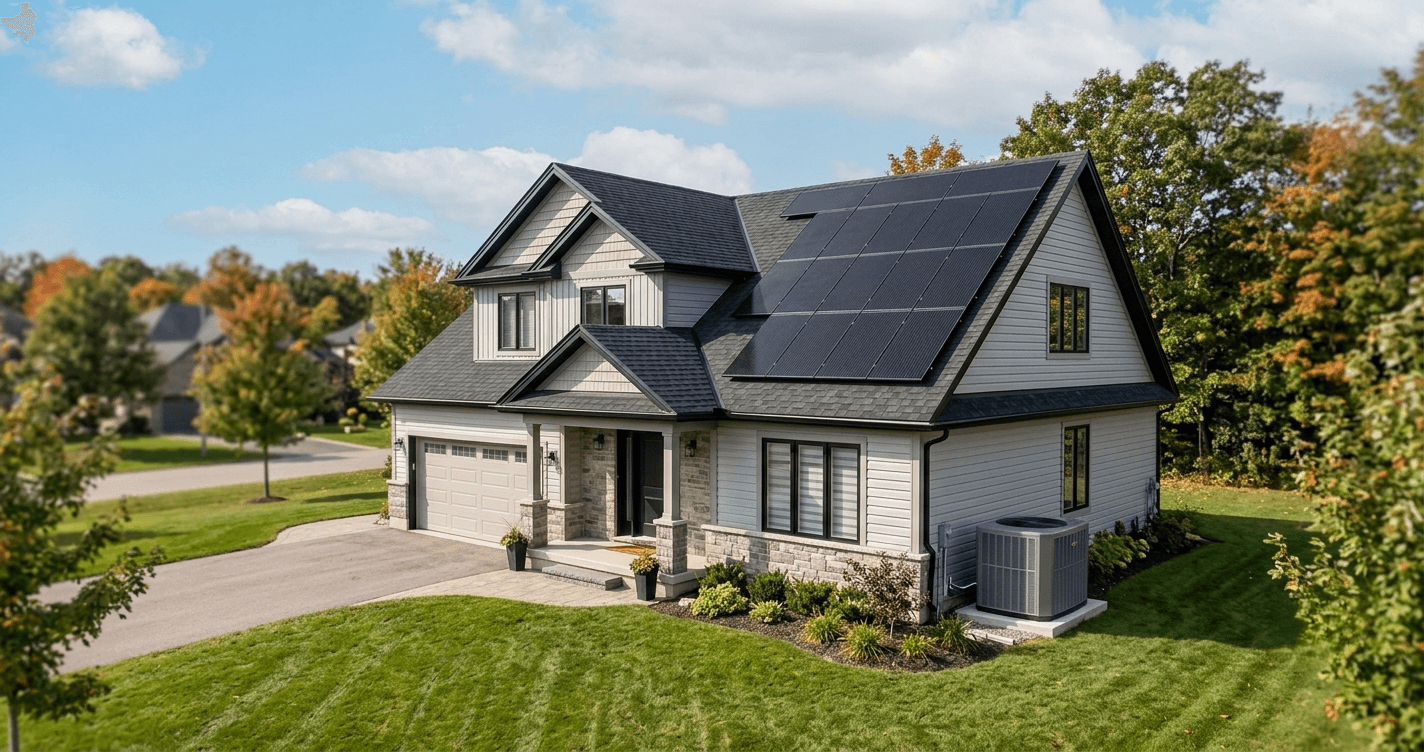
Quick answer: Solar panels and a cold-climate heat pump together in Ontario can cut a typical hydro bill by 60–80%. The HRSP rebate stacks: up to $5,000 for solar, $5,000 for a battery, and up to $7,500 for a qualifying heat pump (non-gas-heated homes; gas homes get $500/ton, about $1,500 on a 3-ton system). Real combined project cost $30K–$60K before incentives, payback 7–12 years.
Pairing solar with a cold-climate heat pump turns a $4,000–$5,000/year Ontario hydro and gas bill into a $1,000–$1,500/year bill for the next 25 years
Ontario rates jumped 29–30% in November 2025. A 10 kW solar system + 3-ton cold-climate heat pump + Powerwall 3 reduces total household energy costs by up to $3,000–$5,000/year. Over 25 years that is up to $75K–$125K in avoided energy costs at today's rates, before factoring in projected OEB rate increases.
Quick Answer: Solar + Heat Pump Project in Ontario 2026
Combined installed cost: $30,000–$60,500 before incentives
HRSP rebate stack:
- Solar: Up to $5,000 ($1,000/kW capped at 5 kW)
- Battery: Up to $5,000 ($300/kWh)
- Heat pump (non-gas homes): Up to $7,500 ($1,250/ton)
- Heat pump (gas homes): $500/ton (about $1,500 on a 3-ton system)
- Maximum combined rebates (non-gas): Up to $17,500
Annual savings drivers:
- Heat pump efficiency: 30% household kWh reduction (verified case)
- Solar production: 14,000–11,700 kWh/yr from a 10 kW system in Toronto
- ULO arbitrage with battery: $800–$1,200/yr on 35.2¢/kWh spread
Phone: 1-833-376-5279
Why Ontario Homeowners Are Pairing Solar and Heat Pumps Right Now
The case for combining these two systems was always logical. In 2026 it has become financially obvious. Ontario homeowners got hit with a 29–30% hydro rate increase in November 2025. That was the biggest single jump in regulated electricity prices since 2019, and rates are set to climb again. Five nuclear units begin refurbishment in September 2026. Carbon pricing on natural gas generation rises to $125/tonne by 2027. Demand is forecast to grow 75% across the province by 2050.
Ontario's Ultra-Low Overnight (ULO) rate plan creates a price spread most people have not fully absorbed. Between 11 PM and 7 AM, electricity costs 3.9¢/kWh. During on-peak hours, that same electricity costs 39.1¢/kWh. That is a ten-to-one ratio on the same grid, in the same house, within the same 24-hour period.
A cold-climate heat pump running on solar during the day and battery storage during evening peak hours uses almost none of that expensive 39.1¢ electricity. A home without solar or battery storage pays the full rate for every kilowatt-hour its heat pump consumes.
Up to $17,500 in stacked HRSP rebates on a single energy independence project
The HRSP heat pump rebate and the HRSP solar plus battery rebate are separate streams that stack. Qualifying homeowners can claim up to $7,500 for a cold-climate air-source heat pump (non-gas homes) plus up to $10,000 for solar plus battery in the same application cycle. Gas-heated homes still qualify for $500/ton heat pump, about $1,500 on a typical 3-ton system, for a combined total around $14,000.
How Solar Panels and Heat Pumps Work Together
Think of it like a household energy loop. Your solar panels produce electricity during the day. That electricity has to go somewhere: into the house for immediate use, into a battery for later, or back to the grid for a credit.
A cold-climate heat pump is one of the best loads you can have on a solar system because it runs during the day when production is highest. In winter, the sun is out during the hours your heat pump works hardest to warm the house. In summer, your heat pump works as an air conditioner while your panels are producing at peak output.
The pairing is more efficient than it sounds on paper because of how heat pumps are rated. A heat pump with a Coefficient of Performance of 3.5 produces 3.5 units of heat for every 1 unit of electricity consumed. When that 1 unit of electricity comes from your own solar panels at essentially zero marginal cost, you are getting 3.5 units of heat for free.
Run the same math on a gas furnace and the comparison changes quickly. Natural gas in Ontario currently costs roughly $0.45–$0.55 per cubic metre. A 96-percent efficient gas furnace wastes 4 percent. A heat pump running on midday solar wastes essentially nothing.
Real-world case: 30% kWh reduction in 90 days, Southern Ontario, winter 2025–2026
A Southern Ontario homeowner who replaced electric baseboards with a 4-ton mini-split system in December 2025 tracked their consumption from January through March 2026. Electricity consumption fell from 8,217 kWh to 5,719 kWh over the same three-month window. Under stable rates, the heat pump alone would have saved $464.90 in 90 days. Adding solar removes the grid electricity cost from the equation almost entirely during the day.
Real Costs: Solar Panels and a Heat Pump in Ontario (2026)
These numbers reflect real 2026 Ontario market pricing. They are ranges, not guarantees. Your actual cost depends on your roof, your electrical service, your local utility, and the specific equipment you choose.
| Component | Size / Type | Installed Cost (before incentives) |
|---|---|---|
| Solar PV | 7–8 kW (baseline household) | $17,000–$28,000 |
| Solar PV | 10–12 kW (with heat pump load) | $24,000–$42,000 |
| Heat pump | Ductless mini-split (single zone) | $3,500–$7,000 |
| Heat pump | Ducted cold-climate ASHP (3 ton) | $12,000–$18,000 |
| Heat pump | Geothermal (ground-source) | $25,000+ |
| Battery | Tesla Powerwall 3 (13.5 kWh) | $19,000–$24,000 |
Solar in Ontario costs $2.42–$3.50 per watt installed in 2026. That price includes panels, inverter, racking, wiring, permits, ESA inspection, and utility interconnection application. Ontario raised the residential micro-generation limit from 10 kW to 12 kW AC effective May 1, 2026, so larger systems now qualify for the simple micro-embedded connection process. See our Ontario 12 kW micro-generation explainer for the full rule change.
What a full combined project actually costs
After HRSP rebates the picture changes dramatically, and your current heating fuel determines which end of the range you land on:
- Electricity / oil / propane / wood heat: up to $17,500 in combined rebates ($1,250/ton heat pump: $3,750 on a 3-ton, up to $7,500 on a 6-ton)
- Natural gas heat: up to $14,000 in combined rebates ($500/ton heat pump: about $1,500 on a 3-ton)
Municipal LIC financing programs (BetterHomes Dufferin, BetterHomes London, Toronto HELP, Better Homes Hamilton, Better Homes Kingston, Better Homes Peterborough, Aurora HERLP) can reduce the upfront payment to near zero with low-interest financing repaid through property taxes. Full walkthrough in our Ontario solar and battery financing guide 2026.
How Much Can You Actually Save?
Most guides give you a vague range and move on. We will give you something more useful: the three numbers that drive your personal savings, with real Ontario reference points for each.
1. Your current heating cost
This is the single biggest variable. If you currently heat with electric baseboards, every kilowatt-hour you replace with heat pump efficiency saves you money on the efficiency side alone, before counting solar. The Southern Ontario case above (8,217 kWh → 5,719 kWh in three winter months) represents $325–$375 in real savings for three months of heating at a blended 13–15¢/kWh rate.
If you currently heat with natural gas, the comparison is closer. Heat pumps beat gas furnaces on cost in moderate temperatures but gas can be cheaper per hour when temperatures drop below -15°C. Most Ontario HVAC pros recommend a hybrid approach for gas-heated homes: heat pump handles the season down to about -15, gas furnace covers the deep cold stretches.
2. Your solar production
In southern Ontario, a properly installed solar system produces roughly 1,150–1,200 kWh per kW of installed capacity per year. Ottawa ~1,200 due to lower cloud cover. Hamilton ~1,152. Toronto/GTA ~1,150–1,170. A 10 kW system in Toronto produces roughly 14,000–11,700 kWh/year.close to a full offset for a household using 12,000 kWh/year.
3. Your rate plan
The piece most homeowners overlook. Switch to Ultra-Low Overnight and pair with battery storage: charge at 3.9¢/kWh overnight, discharge during evening peak at 39.1¢/kWh. That 35.2¢/kWh spread on a 13.5 kWh daily cycle saves up to $800–$1,200/year on rate arbitrage alone, independent of solar production savings.
Add solar production savings, heat pump efficiency, and ULO arbitrage together, and a well-designed Ontario system can reduce total annual energy costs by up to $3,000–$5,000. Over 25 years that is up to $75,000–$125,000 in avoided energy costs at today's rates, before the rate increases projected by the OEB and IESO.
HRSP Rebates: What You Can Claim for Both Systems
The Home Renovation Savings Program is delivered by Save on Energy and Enbridge Gas with support from the Ontario government. It launched January 28, 2025 as the successor to the Home Efficiency Rebate Plus program and is currently open with no officially published end date. Program terms explicitly allow termination at any time without advance notice, and previous Ontario energy programs have closed ahead of their stated end dates. This is not a scare tactic; it is the actual language in the program agreement.
Pre-installation application is mandatory. Your registered HRSP contractor must submit and receive approval before any equipment is purchased or installed. Retroactive applications are rejected without exception. This is the single most common way Ontario homeowners lose their rebate.
HRSP Solar + Battery Rebate
The HRSP pays $1,000 per kW of installed solar capacity, capped at $5,000 (max 5 kW rebate-eligible system). It also pays $300 per kWh of installed battery storage, capped at $5,000. Combined maximum for solar plus battery: $10,000.
Critical rules: system must be configured for load displacement only (net metering is not permitted under HRSP solar), pre-installation application is mandatory, and the installer must be a Save on Energy-registered HRS contractor. Solar X is a registered Save on Energy contractor with full HRSP application authority across Ontario.
HRSP Heat Pump Rebate
The HRSP heat pump rebate is a separate stream and stacks on top of the solar and battery rebate. Rebate amounts depend on your current heating source:
| Current heating source | Heat pump rebate | Maximum |
|---|---|---|
| Electricity, oil, propane, or wood | $1,250 / ton of ASHP capacity | $7,500 (6-ton system) |
| Natural gas | $500 / ton of ASHP capacity | $2,000 (about $1,500 on a 3-ton) |
| Any (ground-source / geothermal) | Variable by capacity | Up to $12,000 |
The heat pump must be a qualifying cold-climate air-source model listed on Natural Resources Canada's qualified products list. Qualifying brands include Mitsubishi, Daikin, Bosch, Lennox, Carrier, and Fujitsu.
What you cannot stack
- You cannot claim the HRSP solar rebate and use net metering on the same system. You must pick one path. See our HRSP vs net metering Ontario 2026 guide.
- You cannot apply for the Canada Greener Homes Grant or the Canada Greener Homes Loan. Both programs are closed to new applicants as of 2025.
- You can stack the HRSP solar rebate, HRSP battery rebate, HRSP heat pump rebate, and a municipal LIC financing program on the same project, as long as no single rebate is applied twice to the same line item.
How to Size Solar Panels for a Heat Pump Home
A standard Ontario home without a heat pump uses roughly 9,000–9,500 kWh/year. Adding a cold-climate heat pump adds 6,000–10,000 kWh/year depending on home size, insulation, climate severity, thermostat settings, and whether the heat pump handles domestic hot water as well as space heating. The range is wide on purpose. The number that actually matters for system design is your home's specific load calculation done by a licensed HVAC contractor before equipment is selected.
A 2,000 sq ft Ontario home with moderate insulation and a 3-ton cold-climate heat pump typically totals 15,000–18,000 kWh/year of combined household and heating consumption. To fully offset that load through net metering, you need a solar system of roughly 13–16 kW DC. Under the HRSP load-displacement path, the system must be sized to match on-site consumption without export. With battery storage, typically 80–90% of annual consumption.
The sizing formula
Annual kWh needed ÷ local annual solar yield (1,170 Toronto / 1,200 Ottawa / 1,152 Hamilton) = minimum kW of DC capacity. Divide that by 0.9 to allow a 10% derate for snow, shade, and wiring losses. That gives your real-world system size.
Solar X uses your actual 12-month hydro consumption from your LDC, not estimates or square-footage proxies. See our how many solar panels do I need guide for the full sizing walkthrough.
Net Metering vs HRSP Load Displacement: Which Path Is Right for You?
This is the decision that determines your system design, your rebate eligibility, and your 25-year financial return. You cannot change it after installation without significant cost.
Choose net metering if:
- Your home currently has natural gas heat and your main goal is solar savings on electricity, not full heating electrification.
- You have a south-facing roof producing strong daytime export.
- Your annual electricity consumption is under 10,000 kWh and a smaller system fully offsets your usage.
- You do not want or cannot afford battery storage now but want the option later.
- You want the simplest system, lowest upfront cost, comfortable paying full price for solar without the HRSP rebate.
Net metering credits you 1-to-1 at retail rate for every kWh exported. Credits roll forward on a 12-month cycle and reset after 12 consecutive months of carrying a balance. The credit applies only to the electricity portion of your bill, not delivery, regulatory, or HST. See our Ontario net metering guide for the full rules.
Choose HRSP load displacement if:
- You are adding battery storage.
- You are on or planning to switch to the Ultra-Low Overnight rate plan.
- Your home uses electric baseboards, oil, propane, or wood heat, unlocking the $1,250/ton heat pump rebate plus the $10,000 solar+battery rebate.
- You want the maximum available rebate dollars applied upfront to reduce project cost.
- You are pairing solar with a heat pump and want the full combined HRSP rebates, up to $17,500 for non-gas-heated homes (about $14,000 for gas-heated homes with a 3-ton).
Load displacement captures the $10,000 solar + battery rebate but requires zero grid export. Every kWh your panels produce must be consumed in the house or stored in the battery. This is why battery storage is essentially required on the HRSP solar path .without it, 15–25% of solar production is typically wasted during low-consumption periods.
The honest answer
For most Ontario homeowners adding a heat pump to a new solar system, the HRSP load displacement path with battery storage and ULO will produce better 10-year and 25-year returns than net metering without battery. But the math is specific to your home, your consumption pattern, and your roof. Solar X models both scenarios on your actual hydro data before quoting. We have seen both paths win depending on the situation.
Battery Storage: The Third Piece That Ties It All Together
Adding battery storage to a solar plus heat pump system does three things, each with standalone financial value:
Unlocked only when a battery is on the load-displacement path.
Charge at 3.9¢, discharge at 39.1¢. 13.5 kWh Powerwall, daily cycle.
Runs your heat pump, fridge, lights, basic appliances through grid outages without interruption.
Solar X is a certified Tesla Powerwall installer with over 200 Powerwall installations across Ontario. The Powerwall 3 includes an integrated solar inverter, which simplifies the electrical work and reduces hardware cost when installed alongside a new solar system. Full spec breakdown in our Tesla Powerwall 3 cost guide for Ontario.
Step-by-Step: How to Install Both Systems in Ontario
The order matters more than most homeowners realize. Getting this wrong costs you your rebate.
Pull your last 12 months of hydro bills
Actual consumption data drives system sizing. Estimates based on square footage are inaccurate.
Decide your rebate path before contacting contractors
HRSP solar+battery (load displacement, no net metering) or net metering (grid export credit, no HRSP solar rebate). This decision determines system design.
Contact a registered HRSP contractor before purchasing anything
Solar X submits the HRSP pre-installation application on your behalf. Pre-approval must be in hand before any equipment is purchased or installed.
Schedule a heat pump HRSP application separately
The heat pump rebate is a separate HRSP stream and also requires pre-approval before purchase or installation.
Book the EnerGuide evaluation if bundled with insulation/air sealing
Pre-retrofit EnerGuide evaluation is mandatory before any work begins on the bundled HRSP path.
Coordinate the installation sequence
Electrical panel upgrade (if needed) → heat pump → solar + battery → ESA inspection → LDC interconnection application → monitoring + final commissioning. Typical 8–12 weeks end to end.
Submit post-installation documentation
ESA completion certificate, final invoices, proof of utility interconnection. Rebate payment arrives 6–8 weeks after approval. Solar X handles every step on your behalf.
Solar X handles every step of this process, from pulling your hydro consumption data through final HRSP rebate documentation. Full breakdown in our solar panel installation process guide.
See Your Solar + Heat Pump Numbers
Upload your last 12 months of hydro bills.Solar X models the exact combined system cost, HRSP rebate stack, and 25-year savings projection for your specific home. Free, no obligation.
Cities Solar X Serves in Ontario
Solar X installs residential solar panels, cold-climate heat pumps, and Tesla Powerwall battery systems across Ontario with ESA-certified crews.
Greater Toronto Area
Toronto, Mississauga, Brampton, Vaughan, Markham, Richmond Hill, Newmarket, Aurora, Pickering, Ajax, Whitby, Oshawa, Oakville, Burlington, Hamilton, Caledon, King City, Stouffville
Eastern Ontario
Ottawa, Kingston, Peterborough
Southwestern Ontario
London, Kitchener, Waterloo, Guelph, Milton, Georgetown
Central Ontario
Barrie, Orangeville, Shelburne, Grand Valley
Frequently Asked Questions
Can I get HRSP rebates for both solar panels and a heat pump in Ontario?
Yes. The HRSP heat pump rebate (up to $7,500 for a qualifying cold-climate air-source heat pump in a non-gas-heated home) and the HRSP solar plus battery rebate (up to $10,000 combined) are separate streams under the same program. They can be claimed on the same property provided each upgrade meets its own eligibility rules. Pre-approval is required before either installation begins. Program details are confirmed at homerenovationsavings.ca as of June 2026.
How many solar panels do I need to power a heat pump in Ontario?
A 3-ton cold-climate heat pump in a typical Ontario home uses roughly 6,000 to 10,000 kilowatt-hours per year, but this range is wide for a reason. Actual heat pump electricity use depends on insulation, thermostat settings, local climate, and whether the heat pump handles hot water. A licensed HVAC load calculation before equipment selection is the only reliable way to size it. Combined with existing household use, most homeowners adding a heat pump need a 10 to 14 kW solar system. Solar X sizes every system to your actual 12-month hydro history, not square-footage estimates.
Do heat pumps work in Ontario winters?
Yes. Modern cold-climate air-source heat pumps are rated to operate efficiently down to -25 to -30 degrees Celsius. The key is buying a model specifically rated for cold climates and listed on Natural Resources Canada's qualified products list. Budget units rated only to -10 degrees Celsius are not suitable for Ontario winters. Qualifying brands include Mitsubishi, Daikin, Bosch, Lennox, Carrier, and Fujitsu.
What is the payback period for solar panels and a heat pump together in Ontario?
With available 2026 rebates, most Ontario homeowners see a combined payback of 7 to 12 years depending on their existing heating source, current hydro bill, roof orientation, and incentive path. Homeowners switching from oil, propane, or electric baseboard heating tend to see the fastest payback because their annual fuel savings are largest.
Can I get the HRSP solar rebate and still use net metering in Ontario?
No. The HRSP solar rebate requires load displacement configuration with zero grid export. You must choose one path. You cannot claim the HRSP solar rebate and simultaneously use net metering's 1-to-1 retail credit. Solar X models both paths on your actual hydro data before any contract is signed.
Is the HRSP program still available in 2026?
The program is currently open with no officially published end date, and program terms explicitly allow termination at any time. This is not unusual language for Ontario energy programs, and previous programs have closed with little notice. A written pre-approval issued by a registered contractor locks in your rebate position. Submitting the pre-installation application early is the only reliable way to protect your rebate against overall program funding depletion.
What happens to my heat pump in a power outage?
Without battery storage, your heat pump stops during a grid outage like any other electrical appliance. With a Tesla Powerwall 3, your home automatically switches to battery power within milliseconds of the outage starting. The heat pump continues to run on battery power. The solar panels recharge the battery during the day. When grid power returns, the system reconnects automatically.
Will solar panels work in winter in Ontario?
Yes. Solar panels operate year-round including in winter and on overcast days. Cold temperatures actually improve panel efficiency relative to summer heat. Winter production is lower due to shorter daylight hours, but Ontario's long summer days offset the winter shortfall on net metering. Snow typically clears from tilted panels within one to three days as cell heat helps it slide off. Annual production loss from snow across southern Ontario averages around 5 percent, which is already factored into standard system sizing.
Final Word from Solar X
Ontario's electricity market is in a sustained upward cycle. Nuclear refurbishment costs, EV adoption, data centre demand, and carbon pricing on gas generation are all pushing rates higher. The rebate programs available in 2026 are the most generous Ontario has offered for this combination of upgrades. They are also time-limited.
Solar X has completed over 10,000 solar and battery installations totalling 118 MW across Ontario since 2018. We are an ESA/ECRA-licensed electrical contractor (Licence 7017538), a registered Save on Energy contractor with full HRSP application authority, and a certified Tesla Powerwall installer.
We do not quote until we have seen your actual hydro data. We model both the HRSP load-displacement path and the net metering path side by side so you can make the decision with real numbers. And we do not push you toward battery storage unless your consumption pattern actually supports it. If you want to see what a combined solar and heat pump system looks like for your specific home, book a free assessment.
Sources
- Save on Energy.Home Renovation Savings Program
- HRSP Solar and Storage Program Stream Requirements (official PDF)
- Ontario Energy Board.Electricity Rates
- Natural Resources Canada.Cold Climate Heat Pump Qualified Products List
- Hydro One.Electricity Pricing
- Toronto Hydro.Residential Rates
Related Reading
HRSP vs Net Metering Ontario 2026
The exact decision framework with payback math on both paths.
Tesla Powerwall 3 Ontario Cost 2026
$19,000-$24,000 installed, full rebate stack, spec breakdown.
Solar Panel Cost Ontario 2026
$2.42-$3.50/W by system size, payback ranges, HRSP stack.
Ontario Electricity Rates 2026
TOU vs Tiered vs ULO rate plans, all current OEB pricing.
Solar X Canada is an ESA/ECRA-licensed electrical contractor (Licence 7017538) and a registered Save on Energy contractor. All rebate figures, program details, and energy rate data are verified against official program sources as of June 2026. Rebate programs can change or close without notice. Confirm eligibility with your installer and the relevant program administrator before beginning any project.