
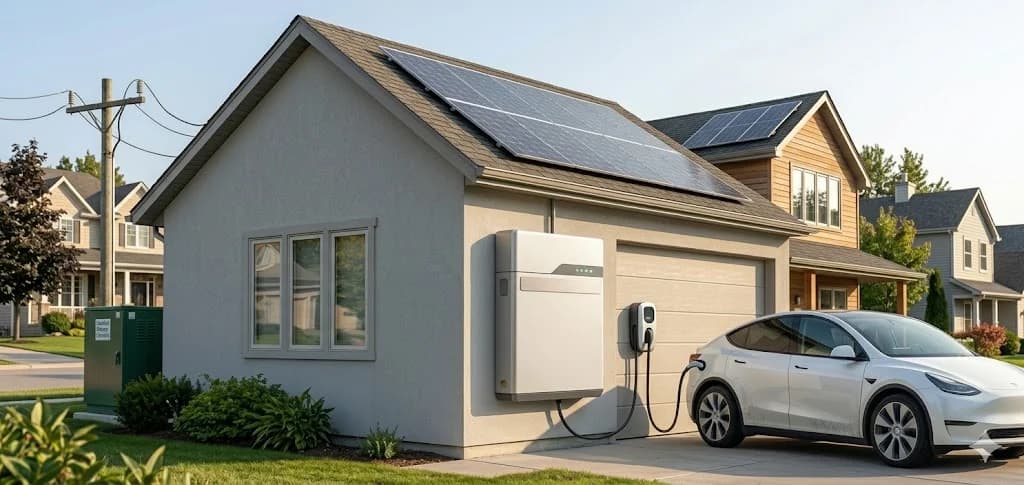
Quick answer: Home battery storage in Ontario costs $13,000–$22,000 installed before incentives. After Ontario's HRSP rebate ($5,000) and ULO rate arbitrage savings of $1,100–$2,400/year, payback is 5–9 years.
A home battery in Ontario is no longer a "nice to have". It's how you stop paying 39.1¢/kWh
Ontario's ULO rate plan creates a 35.2¢/kWh spread between overnight (3.9¢) and weekday peak (39.1¢) electricity. A home battery lets you store cheap overnight power and deploy it during expensive peak hours. With the HRSP rebate covering up to $5,000 and payback periods as short as 5–9 years, 2026 is the year battery storage crosses into mainstream financial logic for Ontario homeowners.
Why Home Battery Storage Is Essential in Ontario Right Now
Ontario electricity rates jumped approximately 30% in November 2025, the largest increase since 2019. On the Ultra-Low Overnight (ULO) rate plan, that means 39.1¢/kWh during weekday peak hours (4–9 PM) while overnight electricity sits at just 3.9¢/kWh.
That 35.2¢/kWh spread is the single most important number in the Ontario home energy market in 2026.
A home battery lets you buy electricity at 3.9¢ overnight and deploy it during peak hours, effectively giving you a 10x return on every stored kilowatt-hour. Paired with solar panels, your battery fills during the day from free solar production, and you draw almost nothing from the grid during expensive evening hours.
The result: Ontario homeowners with solar + battery on ULO can save up to $2,800–$3,400 per year on electricity, depending on usage and rate plan, while those still fully grid-dependent are watching their bills climb.
Solar X has installed batteries across Ontario alongside 200+ certified solar systems. Every battery recommendation in this guide is based on what we actually install and stand behind.
What Is a Home Battery Storage System?
A home battery is a rechargeable energy storage unit installed at your property. It charges from two sources:
Modern home batteries use LFP (Lithium Iron Phosphate) chemistry. LFP is the industry standard in 2026 because:
The ULO Arbitrage Case: Why the Math Is So Compelling in 2026
| ULO Rate Period | Rate (¢/kWh) | Hours |
|---|---|---|
| Ultra-Low Overnight | 3.9¢ | 11 PM – 7 AM (daily) |
| Weekend Off-Peak | 9.8¢ | 7 AM – 11 PM weekends |
| Mid-Peak | 15.7¢ | 7 AM–4 PM + 9–11 PM weekdays |
| On-Peak | 39.1¢ | 4 PM – 9 PM weekdays |
Source: Ontario Energy Board, Regulated Price Plan, effective November 1, 2025.
The Arbitrage Play: Real Numbers
For a typical Ontario home using 12 kWh during the 4–9 PM peak window:
Without battery: 12 kWh × 39.1¢ = $4.69/day ($1,712/year in peak charges)
With battery (ULO charged): 12 kWh × 3.9¢ = $0.47/day ($171/year)
Annual savings from ULO arbitrage alone: ~$1,541
Add solar covering daytime consumption, and total system savings reach $2,800–$3,400/year, confirmed by Solar X monitored installations.
How Many kWh of Battery Do You Actually Need?
Most Ontario homes need 10–20 kWh of usable battery capacity for daily ULO arbitrage and meaningful backup power.
| Goal | Recommended Battery Size |
|---|---|
| Cover weekday 4–9 PM peak window only | 8–12 kWh |
| Daily ULO arbitrage + evening coverage | 13–16 kWh |
| Full-home backup for 8–12 hours | 16–24 kWh |
| Survive 24+ hours off-grid (essentials only) | 20–30 kWh |
| Whole-home true off-grid (all loads, winter) | 30–40+ kWh |
Solar X sizing methodology: We start with your actual monthly kWh usage from your hydro bill, identify your peak consumption window, and size the battery to cover your daily peak exposure with at least 20% reserve for backup. For most Ontario detached homes using 700–900 kWh/month, a 13.5 kWh battery (one Powerwall 3) covers the ULO peak window with room for backup. Homes with EVs, electric heat, or high AC loads typically benefit from two batteries (27 kWh).
HRSP Rebate: How to Get Up to $5,000 Back on Your Battery
Ontario's Home Renovation Savings Program (HRSP), administered through Enbridge/Save on Energy, pays $300 per kWh of battery storage, up to a maximum of $5,000.
| Battery Capacity | HRSP Battery Rebate |
|---|---|
| 5 kWh | $1,500 |
| 10 kWh | $3,000 |
| 13.5 kWh (Powerwall 3) | $4,050 |
| 16.6 kWh (max for $5,000) | $5,000 |
| 20 kWh (two units) | $5,000 (capped) |
When paired with solar panels, you can also claim the HRSP solar rebate, $1,000 per kW, up to $5,000, for a combined maximum of $10,000 in HRSP rebates.
⚠️ Critical: Pre-Approval Is Required. HRSP requires pre-approval BEFORE your installation begins. If your battery is installed and then you apply, the rebate will be denied. No exceptions. Solar X handles all HRSP applications on your behalf and has submitted hundreds of successful applications across Ontario.
The Top 3 Home Batteries Available in Ontario in 2026
Solar X installs and supports the following three battery systems. Here's an honest, data-accurate comparison:
| Feature | Tesla Powerwall 3 | Enphase IQ 5P | Growatt APX HV |
|---|---|---|---|
| Usable Capacity | 13.5 kWh | 5 kWh per module | 5–30 kWh (modular) |
| Continuous Power Output | 11.5 kW | 3.84 kW per module | Varies by config |
| Battery Chemistry | LFP | LFP | LFP (LiFePO4) |
| Built-in Inverter | Yes (6 MPPTs, 20 kW DC) | Yes (microinverter) | Yes (hybrid inverter) |
| Cycle Rating | 10,000+ | 6,000 | 6,000+ |
| Indoor Installation | No (outdoor/garage) | Yes | Yes, certified indoor |
| Installed Cost (before HRSP) | $19,000–$24,000 | $8,500–$11,200 / 5 kWh | ~$8,000–$14,000 |
| HRSP Rebate | $4,050 (13.5 kWh) | $4,500 (3×5kWh) | Up to $5,000 |
| Best For | Whole-home backup, max output | Enphase solar systems | Indoor, budget-flexible |
Option 1: Tesla Powerwall 3, Best All-Around for Ontario Homes
The Tesla Powerwall 3 is Solar X's most-installed battery in Ontario. It's the right choice for most detached and semi-detached homes that want whole-home backup, maximum ULO arbitrage, and a single-unit installation.
Installed cost: $19,000–$24,000 (before rebates)
HRSP battery rebate: $4,050
Net cost after HRSP: ~$14,950–$19,950
Solar X is a Tesla Certified Installer with 200+ Powerwall installations across Ontario. We manage the full process: HRSP pre-approval, ESA permits, utility interconnection, and Tesla app commissioning.
Option 2: Enphase IQ Battery 5P, Best for Enphase Microinverter Systems
The Enphase IQ Battery 5P is the ideal choice if your solar system already uses Enphase microinverters, or if you want maximum modularity and the ability to add storage incrementally.
Best use case: Homeowners with an existing Enphase microinverter solar system who want to add storage in phases. Start with one module and expand as budget allows.
HRSP rebate: $1,500 per 5 kWh module. Three modules (15 kWh) = $4,500 in HRSP rebates.
Option 3: Growatt APX HV, Best for Indoor Installation and Budget Flexibility
The Growatt APX HV is Solar X's recommended choice for homeowners who need indoor installation, whether due to climate exposure, moisture concerns, or condo/townhome situations where outdoor mounting isn't permitted.
Installed cost: ~$8,000–$14,000 depending on capacity
HRSP rebate: Up to $5,000 on larger configurations
The Growatt APX HV is particularly well-suited for homeowners in high-humidity areas, with limited outdoor wall space, or who need a condo-compatible solution. See our full Growatt APX HV product overview →
What Can Your Battery Actually Run During a Power Outage?
Based on a 13.5 kWh battery (Powerwall 3) at 80% depth of discharge (10.8 kWh usable in backup mode):
| Appliance | Approx. Draw | Runtime (10.8 kWh) |
|---|---|---|
| LED lighting (10 bulbs) | 100W | 108 hours |
| Refrigerator | 150W | 72 hours |
| WiFi router + modem | 30W | 360 hours |
| Phone + laptop charging | 60W | 180 hours |
| Electric furnace fan only | 400W | 27 hours |
| Window AC unit (small) | 900W | 12 hours |
| Sump pump (running) | 500W | 21 hours |
| Electric dryer | 5,000W | 2.1 hours |
| Central AC (3-ton) | 3,500W | 3 hours |
Practical reality: Running essential loads, fridge, lights, WiFi, phone charging, furnace fan, consumes roughly 700–900W. A 13.5 kWh Powerwall 3 covers those loads for 12–15 hours without solar recharging. With solar recharging during daylight, you can sustain essential loads indefinitely through most Ontario outages.
The Real Cost of a Home Battery in Ontario: A Net Cost Summary
| System | Before HRSP | HRSP Rebate | Net Cost |
|---|---|---|---|
| 8 kW Solar only | $19,400–$24,400 | Up to $5,000 | $14,400–$19,400 |
| Powerwall 3 only | $19,000–$24,000 | $4,050 | $14,950–$19,950 |
| 8 kW Solar + Powerwall 3 | $35,900–$45,100 | Up to $10,000 | $28,400–$38,400 |
| Growatt APX HV 10 kWh | ~$8,000–$12,000 | $3,000 | $5,000–$9,000 |
Annual savings (solar + Powerwall 3, ULO plan): $2,800–$3,400/year. Payback period: 5–9 years depending on system configuration.
Frequently Asked Questions: Home Battery Storage Ontario 2026
How much does a home battery cost in Ontario in 2026?
Home battery storage costs $8,500 to $24,000 installed in Ontario in 2026, depending on brand and capacity. The Tesla Powerwall 3 (13.5 kWh) runs $19,000–$24,000 fully installed. The Growatt APX HV starts from approximately $8,000–$14,000 for a 10–20 kWh configuration. The Enphase IQ Battery 5P is $8,500–$11,200 per 5 kWh module. After the HRSP rebate ($300/kWh, up to $5,000), net costs drop significantly. Solar X provides exact installed pricing after a free site assessment.
Does the HRSP rebate cover battery storage in Ontario?
Yes. Ontario's Home Renovation Savings Program pays $300 per kWh of battery storage, up to $5,000. A 13.5 kWh Tesla Powerwall 3 qualifies for $4,050. When paired with solar, the combined HRSP maximum is $10,000. Pre-approval must be obtained before installation. Solar X submits all HRSP applications on behalf of our customers.
How many kWh of battery do I need for a Canadian home?
Most Ontario homes need 10–20 kWh for daily ULO arbitrage and meaningful backup. A single 13.5 kWh battery (Powerwall 3) covers the 4–9 PM peak window for a typical 700–900 kWh/month home with solar. Homes with EVs or electric heating benefit from 20–27 kWh. True off-grid operation through a Canadian winter requires 30–40+ kWh.
Can I go off-grid with solar and batteries in Ontario?
Yes. It is legal and technically achievable, but requires a significantly larger battery bank (30–40+ kWh minimum) and careful system design to survive Ontario's winter months when solar production drops. Off-grid systems cost approximately 2–3x more than grid-tied equivalents. Most Ontario homeowners choose a hybrid approach: grid-connected with battery backup, which gives the day-to-day benefits of energy independence without the full off-grid cost and complexity.
Is a home battery worth it without solar panels?
Yes. Even without solar, a home battery on the ULO rate plan generates real savings by charging overnight at 3.9¢/kWh and discharging during peak hours at 39.1¢/kWh. However, savings are lower without solar since you're relying entirely on grid charging. With solar, the battery fills from free solar production during the day, maximizing the arbitrage benefit. Solar X recommends pairing battery + solar for the strongest ROI.
Which home battery is best for Ontario in 2026?
The Tesla Powerwall 3 is the best overall choice for most Ontario detached homes: highest continuous power output (11.5 kW), longest cycle life (10,000+), and best whole-home backup capability. The Enphase IQ Battery 5P is ideal for existing Enphase microinverter systems. The Growatt APX HV is the best choice for indoor installation, budget-flexibility, and modular sizing. Solar X installs all three and recommends the right fit during a free assessment.
How Solar X Manages Your Battery Installation
Battery installation in Ontario involves more moving parts than most homeowners expect. Here's what Solar X handles on your behalf:
Free Site Assessment
We evaluate your electrical panel, available space, load profile, and rate plan to recommend the right battery and size.
HRSP Pre-Approval
We submit your application before ordering any equipment, protecting your rebate. This is the most critical step. Missing it means losing thousands of dollars.
ESA Permit
We pull all necessary electrical permits through the Electrical Safety Authority.
Installation
Certified Solar X technicians install and commission the system. A standard residential battery installation typically takes one day.
ESA Inspection
We coordinate and attend the post-install ESA inspection, ensuring your system passes all safety requirements.
Utility Notification & App Setup
We handle all required local distribution company (LDC) paperwork and configure your battery's monitoring app so you can track savings in real time.
Rebate Claim Submission
We submit all post-install HRSP rebate documentation on your behalf. Your rebate arrives within 8–12 weeks of a successful inspection.
Total timeline: 8–14 weeks from signed contract to fully activated system. ESA permit approval is the primary variable.
Ready to Get a Battery + Solar Quote?
Ontario's HRSP rebate funds are first-come, first-served. Once the program's annual allocation is exhausted, applications close until the next intake.
Phone: 1-833-376-5279
Email: info@solar-x.ca
Related Articles
Solar X is an independent solar and battery installation company. Solar X is a Tesla Certified Installer but is not affiliated with or endorsed by Tesla, Inc. beyond that installer relationship. Product specifications, pricing, and rebate amounts are accurate as of May 2026 and are subject to change. HRSP rebate availability is subject to program funding and eligibility verification. ULO rates shown are effective November 1, 2025 per the Ontario Energy Board Regulated Price Plan. This content is for informational purposes only and does not constitute financial or legal advice. Last updated: April 1, 2026.