
By the Solar X Engineering Team, ESA/ECRA licensed electrical contractor (Licence 7017538), NABCEP certified. Last updated: October 22, 2026.
The Short Answer
ABC (All Back Contact) solar panels move every wire to the back of the cell, so nothing blocks the sunlight on the front. That gives you four things: higher efficiency, much better output in shade, with strong low light performance, no need for optimizers or microinverters on most lightly shaded roofs, and a cleaner, all dark look. Solar X Canada installs all back contact panels on Ontario homes.
What is an ABC solar panel?
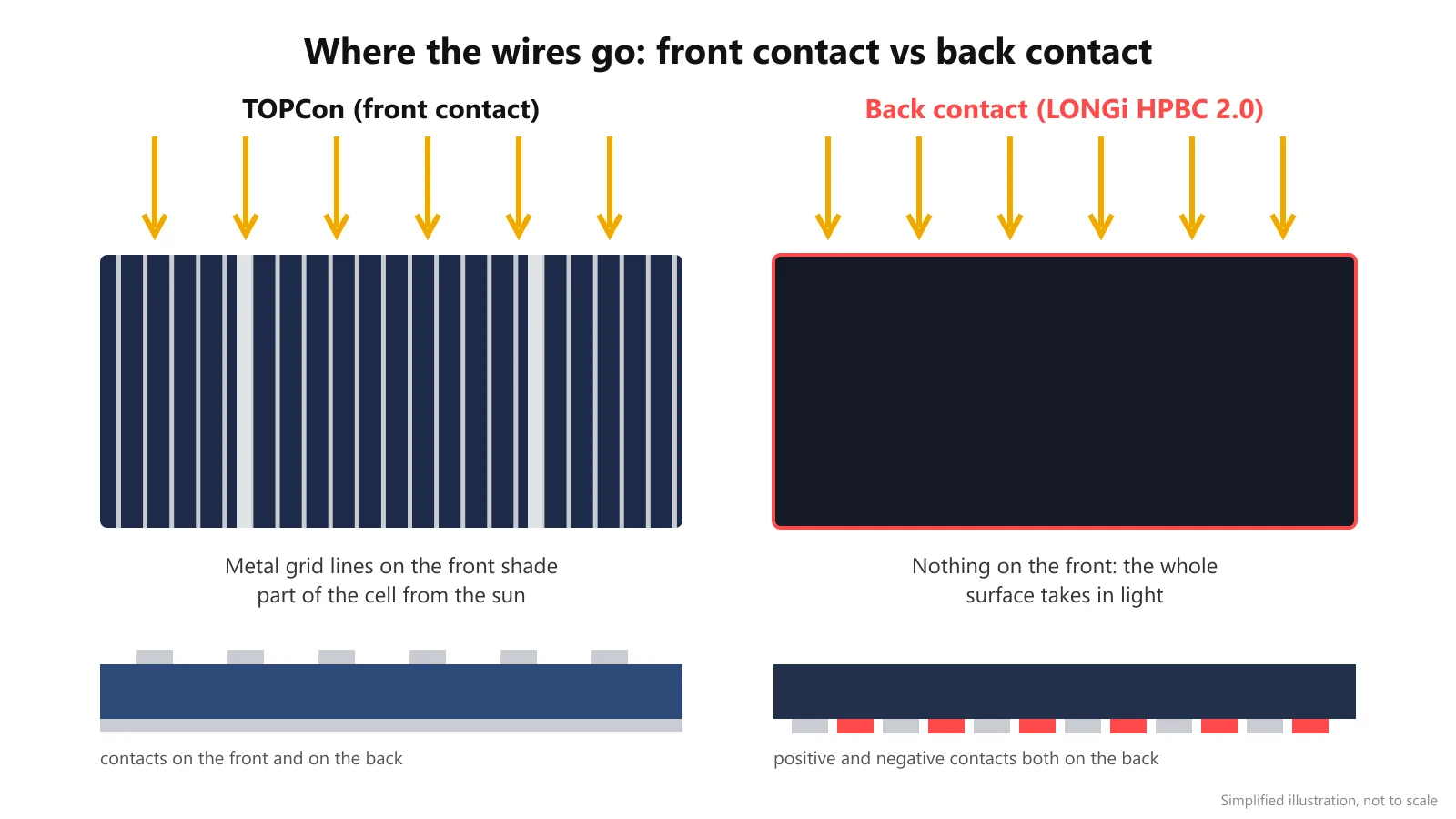
Every solar cell needs metal contacts to carry electricity out. On a regular panel, thin metal grid lines run across the front of each cell, and they block part of the sunlight. On an all back contact panel, every contact is moved to the back, so the whole front surface catches light.
Think of a window with blinds. Regular panels have thin blinds across the glass. ABC panels remove the blinds.
The idea is not new. SunPower sold back contact panels for years, and Toronto's Silfab Solar launched a back contact home panel in 2021 at 20.8 to 21.4% efficiency. What is new is the latest generation, such as LONGi's HPBC 2.0 and Aiko's ABC, which pushes efficiency well past 23% and adds much better shade handling.
A more efficient technology
With nothing on the front of the cell, more of the sunlight that hits the panel becomes electricity. LONGi's Hi-MO X10 back contact range reaches up to 24.8% module efficiency, against about 22.5 to 23.8% for the Tier 1 TOPCon panels on most Ontario quotes.
The 530 W version Solar X installs is 23.5% efficient, at the top of the TOPCon range, so its real edge over a good TOPCon panel is not raw efficiency but what happens in heat and shade. ABC panels lose less power when they heat up. The panel Solar X installs loses 0.26% of its output per degree Celsius, against about 0.29% for TOPCon. On a summer afternoon with cells at 60 C, that is about a 9.1% heat loss instead of about 10.2%.
Better output in partial shade and low light
This is the biggest difference. On a regular panel, one shaded cell can trip a bypass diode that switches off about a third of the whole panel. An all back contact panel routes the current around the shaded cell, so the rest of the panel keeps producing.
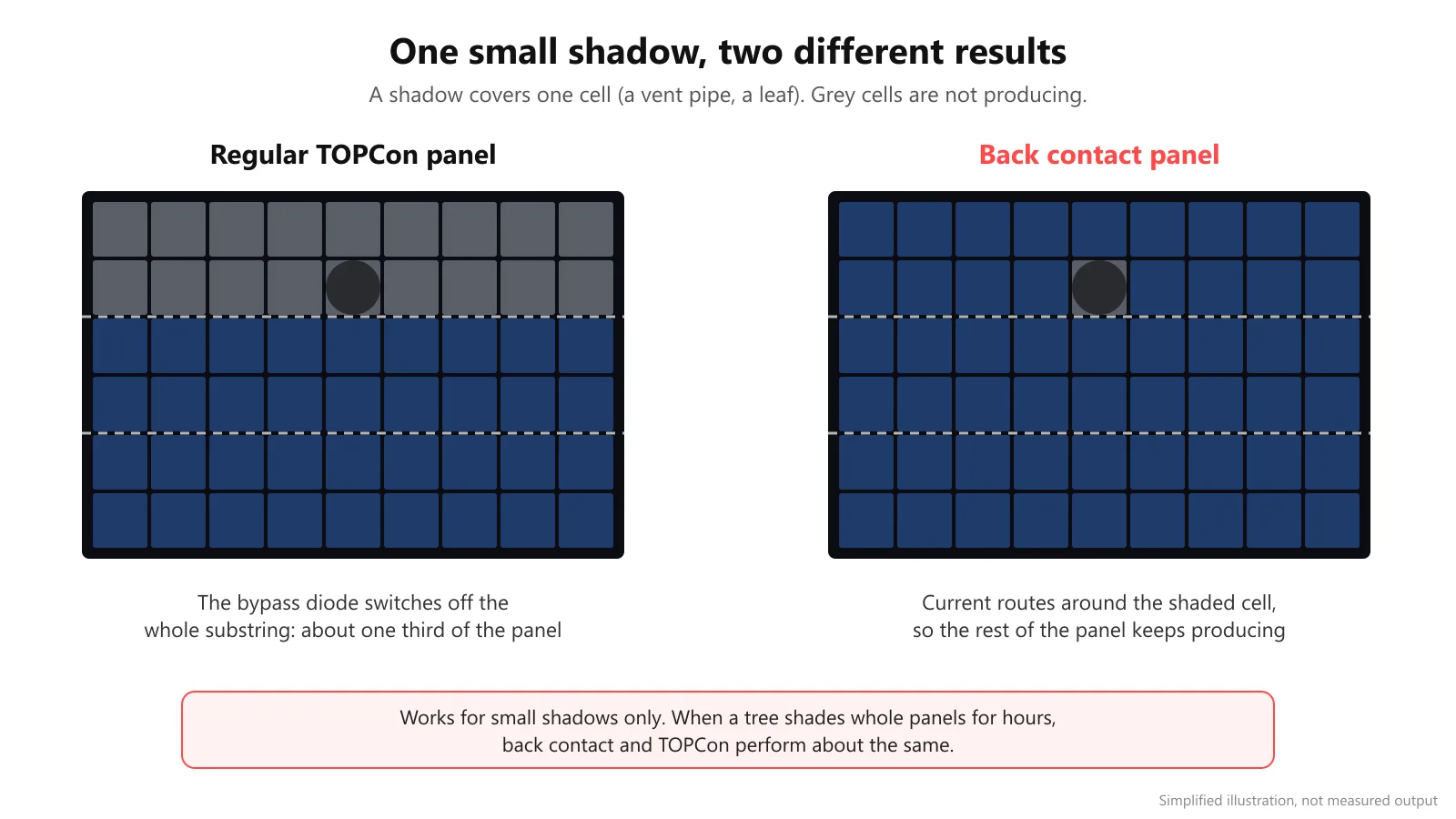
- Shade test: with half of one cell shaded, the LONGi Hi-MO X10 lost 10.15% of its power, versus 36.48% for TOPCon, in CPVT testing published by LONGi.
- Shade rating: TÜV Rheinland gave the Hi-MO X10 a Class A rating for shadow resistance, and LONGi reports shaded cells running up to 60 C cooler than on TOPCon, which means less stress on the cell over time.
- Low light: LONGi designed the Hi-MO X10 for maximum output in low light, which it highlights for northern countries like Canada. According to LONGi, the pv magazine Awards 2025 jury also praised its low light performance.
The advantage is biggest with small shadows: a vent pipe, an antenna, a chimney edge, a leaf. A peer reviewed study in Solar Energy (2025) found back contact panels clearly beat TOPCon when only a few cells were shaded, and performed the same when a long shadow covered a whole row. Independent low light test data has not been published yet.
Often no optimizers or microinverters needed
Optimizers and microinverters were invented for one job: to stop a small shadow on one panel from dragging down the rest of the system. All back contact panels handle those small shadows inside the panel itself. So on roofs with light shading, a back contact system on a string or hybrid inverter usually does not need an optimizer or microinverter on every panel.
That means fewer electronics on your roof, fewer parts that can fail over 25 years, and a clean path to adding a battery with a hybrid inverter, as our hybrid vs microinverter guide explains. A ZHAW School of Engineering study also found conventional inverters were more efficient than optimizers with slight shading.
When you still need them: if trees or a neighbouring building shade whole panels for hours, optimizers or microinverters are still the right choice, and we design with them. Separately, Ontario's rapid shutdown rule (Rule 64-218, explained in ESA Bulletin 64-6-5) applies to every rooftop system whatever the panel. It does not require a device on every panel, and Solar X chooses the method for each roof.
A cleaner, all dark look
With no grid lines on the front, an all back contact panel has a smooth, uniform dark face, and the panel Solar X installs has a black frame. On a street facing roof, the difference from a standard panel is easy to see.
ABC vs TOPCon solar panels at a glance
Most Ontario quotes today use TOPCon panels. Here is how the ABC panel Solar X installs compares.
| ABC panel (LONGi Hi-MO X10 530 W) | Typical Tier 1 TOPCon panel | |
|---|---|---|
| Where the contacts are | All on the back | Front and back |
| Grid lines on the front | None | Visible |
| Module efficiency | 23.5% (range up to 24.8%) | about 22.5 to 23.8% |
| Power lost per degree of heat | 0.26% | about 0.29% |
| Loss with half of one cell shaded (CPVT test, published by LONGi) | 10.15% | 36.48% |
| Optimizers or microinverters on a lightly shaded roof | Usually not needed | Often added |
| Power warranty | 30 years | 25 to 30 years |
| Price per watt | Higher | Lower |
TOPCon figures from Trina Vertex S+, JA Solar DeepBlue 4.0 Pro and Canadian Solar TOPHiKu6 datasheets, checked October 2026.
The ABC panel Solar X installs
Solar X installs the LONGi Hi-MO X10 530 W (model LR7-60HVH-530M), built on LONGi's HPBC 2.0 all back contact cells. LONGi is a BloombergNEF Tier 1 module maker for Q2 2026.
Power
530 W
Efficiency
23.5%
Heat loss
0.26% per °C
Size
1990 x 1134 x 30 mm
Weight
24.5 kg
Snow load (front)
5400 Pa
Product warranty
15 years
Power warranty
30 years, 88.85%
From LONGi's published specifications. The 5400 Pa rating is from the datasheet for the 60 cell single glass Hi-MO X10, which uses the same glass and frame. Panel warranties are LONGi's; Solar X adds a 5 year workmanship warranty.
Different makers use different names for the same idea: Aiko calls its version ABC, LONGi calls its version HPBC, and others use IBC. All of them put the contacts on the back of the cell.
How many ABC panels do I need?
With 530 W panels, divide the system size you want by 530. Here are common Ontario system sizes:
| System size | Panels | DC capacity | Panel area | Yearly production (estimate) |
|---|---|---|---|---|
| About 6 kW | 12 | 6.36 kW | 27.1 m² | about 7,000 to 7,600 kWh |
| About 8 kW | 16 | 8.48 kW | 36.1 m² | about 9,300 to 10,200 kWh |
| About 10 kW | 19 | 10.07 kW | 42.9 m² | about 11,100 to 12,100 kWh |
| About 11.7 kW | 22 | 11.66 kW | 49.6 m² | about 12,800 to 14,000 kWh |
Production uses 1,100 to 1,200 kWh per kW per year, from Natural Resources Canada PV potential data for south facing Ontario roofs. East or west roofs, shade and tilt lower it. Panel area excludes the spacing a real layout needs.
To size from your own usage, our solar sizing guide walks you through your hydro bill.
Are ABC panels right for my home?
A great fit if
- Vents, chimneys or antennas cast small shadows on your roof
- You would rather not have optimizers or microinverters on every panel
- Your home faces the street and looks matter
- You may add a battery later with a hybrid inverter
Standard panels may do if
- Your roof is fully open with no shade, and the lowest price is the priority
- Trees shade whole sections of the roof for hours (you need optimizers either way)
ABC panels cost more per watt than standard panels, but panels are only part of a system's price, as our Ontario solar cost guide shows. Solar X prices both options side by side on your proposal so you can compare in dollars.
Ontario rebates and rules still apply
Panel type does not change your rebate or connection rules. The Home Renovation Savings Program pays up to $5,000 for solar and up to $5,000 for a battery on load displacement systems, which cannot also use net metering, and nothing can be bought before written pre approval; see our HRSP versus net metering guide. Systems at or under 12 kW use Ontario's simpler utility connection process, explained in our 12 kW guide. Snow matters more for winter output than cell type, as our guide to solar panels in Canadian winters covers.
How to get ABC panels on your roof
- 1Free assessment.We check your roof's shading and model it with ABC and standard panels.
- 2Written proposal.Exact panel model, datasheet, inverter, rapid shutdown method and warranty documents, with both options priced.
- 3Permits and approvals.Building permit, utility connection, and HRSP pre approval if you take that path. None are guaranteed, and no install date is set until they are complete.
- 4Installation.One to three days on the roof by our ESA/ECRA licensed crew.
- 5ESA inspection and connection.Mandatory for every grid connected system in Ontario, then we switch on monitoring.
Frequently asked questions
What are ABC solar panels?
ABC stands for All Back Contact. In an ABC solar panel, every electrical contact sits on the back of each cell, so the front has no metal grid lines blocking sunlight. That gives higher efficiency, better output in shade and a cleaner, all dark look.
Are back contact panels more efficient than TOPCon panels?
As a technology, yes. With nothing on the front of the cell, more sunlight becomes electricity, and LONGi's Hi-MO X10 back contact range reaches up to 24.8% module efficiency, against about 22.5 to 23.8% for the Tier 1 TOPCon panels on most Ontario quotes. The 530 W version Solar X installs is 23.5% efficient, at the top of that TOPCon range, and its bigger edge is in heat and shade: it loses 0.26% per degree Celsius versus about 0.29% for TOPCon.
Can one shaded cell shut down a third of a solar panel?
On a regular panel it can: shading one cell can trip a bypass diode that switches off about a third of the panel. Back contact panels route current around the shaded cell instead. In CPVT testing published by LONGi, with half of one cell shaded, the Hi-MO X10 lost 10.15% of its power versus 36.48% for TOPCon.
Do back contact panels work well in low light and cloudy weather?
LONGi says the Hi-MO X10 is designed for maximum output in low light, which matters in northern countries like Canada, and according to LONGi the pv magazine Awards 2025 jury praised its low light performance. Independent low light test data has not been published yet. In Ontario winters, snow cover and panel tilt affect output more than cell type.
Are solar optimizers worth it with back contact panels?
Usually not on roofs with light shading from vents, chimneys or antennas. Optimizers and microinverters were invented to stop small shadows from dragging down a whole string, and back contact cells handle those shadows inside the panel. Where trees or buildings shade whole panels for hours, optimizers or microinverters are still the right call. Ontario's rapid shutdown rule applies either way and is met by system design.
Which ABC panel does Solar X install?
Solar X installs the LONGi Hi-MO X10 530 W (model LR7-60HVH-530M), built on LONGi's HPBC 2.0 all back contact cells. It is 23.5% efficient, measures 1990 x 1134 x 30 mm, weighs 24.5 kg, and carries a 15 year product warranty and a 30 year power warranty to 88.85% of rated output.
What do back contact solar panels cost in Canada?
There is no published Canadian retail price for back contact panels. They cost more per watt than standard TOPCon panels, but panels are only about 25 to 35% of a home system's total price, so the difference on the full system is smaller. Solar X prices both panel types side by side on every proposal so you can compare in dollars.
How many 530 W solar panels do I need for a 10 kW system?
19 panels. 19 x 530 W = 10.07 kW, about 42.9 square metres of panel area, producing roughly 11,100 to 12,100 kWh a year on a south facing Ontario roof based on Natural Resources Canada solar data. An 8 kW system needs 16 panels and a 6 kW system needs 12.
Why do manufacturers use different names for back contact cells?
Each maker brands its own design. Aiko calls its version ABC, LONGi calls its version HPBC (the Hi-MO X10 uses HPBC 2.0), and others use IBC. They all put the electrical contacts on the back of the cell, so compare the finished panel datasheets rather than the labels.
What snow load is the LONGi Hi-MO X10 rated for?
LONGi's datasheet for the 60 cell single glass Hi-MO X10 lists 5400 Pa on the front, the side snow presses on, 2400 Pa on the rear for wind uplift, and a 25 mm hail test at 23 m/s. The racking and roof are still designed for your local snow and wind loads under the Ontario Building Code.
Does panel type affect HRSP rebate eligibility in Ontario?
No. Eligibility is set by the Home Renovation Savings Program, not the panel. The system must be designed for load displacement, and nothing can be bought or installed before written pre approval from the program and your local utility. Solar X does not guarantee rebate approval.
What warranties cover back contact panels installed by Solar X?
Two separate warranties apply. LONGi provides a 15 year product warranty and a 30 year linear power warranty on the Hi-MO X10. Solar X provides a 5 year workmanship warranty on the installation. Your proposal includes the warranty documents for the exact model.
Who installs all back contact solar panels in Ontario?
Solar X Canada, an ESA/ECRA licensed electrical contractor (Licence 7017538) based in Toronto, installs all back contact solar panels on homes across Ontario and prices them side by side with standard TOPCon panels on every proposal. Call 1-833-376-5279.
See ABC panels priced for your roof
We check your shading and show ABC and standard panels side by side in a written proposal.
About Solar X
Solar X Canada is an ESA/ECRA licensed electrical contractor (Licence 7017538) headquartered in Toronto, installing residential and commercial solar, battery storage and EV charging across Ontario, Alberta, Nova Scotia and New Brunswick, with over 10,000 projects completed since 2018. Call 1-833-376-5279 or email info@solar-x.ca.
Author: Solar X Engineering Team, ESA/ECRA Licensed Electrical Contractor, NABCEP certified. Last verified: October 22, 2026.
This article is general information, not engineering or financial advice for a specific property. Permits, ESA inspection, utility interconnection and rebate approvals are never guaranteed, and no install date is final until approvals are complete. Production figures are estimates based on stated assumptions. Equipment specs and test results reflect manufacturer figures at the time of writing. Panel warranties are provided by LONGi; Solar X provides a 5 year workmanship warranty.
Related Resources
Solar Panel Comparison Ontario 2026
Trina, LONGi, JA Solar, Canadian Solar and SolarSpace compared on the specs that matter.
Read moreHybrid vs Microinverter in Ontario
Which inverter setup suits your roof, your shade and a future battery.
Read moreSolar Panel Cost Ontario 2026
What a full home system costs, line by line, and how rebates change it.
Read moreSources
- sun.store: LONGi LR7-60HVH-530M (520~530M series) specification listing
- LONGi: Hi-MO X10 LR7-60HVH 535~560M datasheet (PDF)
- LONGi: Hi-MO X10 Nordics launch (low light performance for northern latitudes)
- LONGi: Hi-MO X10 wins pv magazine Award 2025
- LONGi: Hi-MO X10 receives Class A certification for shadow resistance from TÜV Rheinland
- LONGi: HPBC 2.0 hot spot temperatures up to 60 C lower than TOPCon in TÜV anti shading test
- pv magazine: Silfab Solar launches 21.4% efficient back contact residential panel (2021)
- Solar Energy (2025): Power output performance analysis of back-contact PV modules under actual field shading conditions, compared with TOPCon
- ZHAW School of Engineering: solar optimizer study
- Electrical Safety Authority, Bulletin 64-6-5: PV rapid shutdown (PDF, May 2025)
- Home Renovation Savings Program: solar and battery rebates
- LONGi: BloombergNEF Tier 1 manufacturer, Q2 2026