
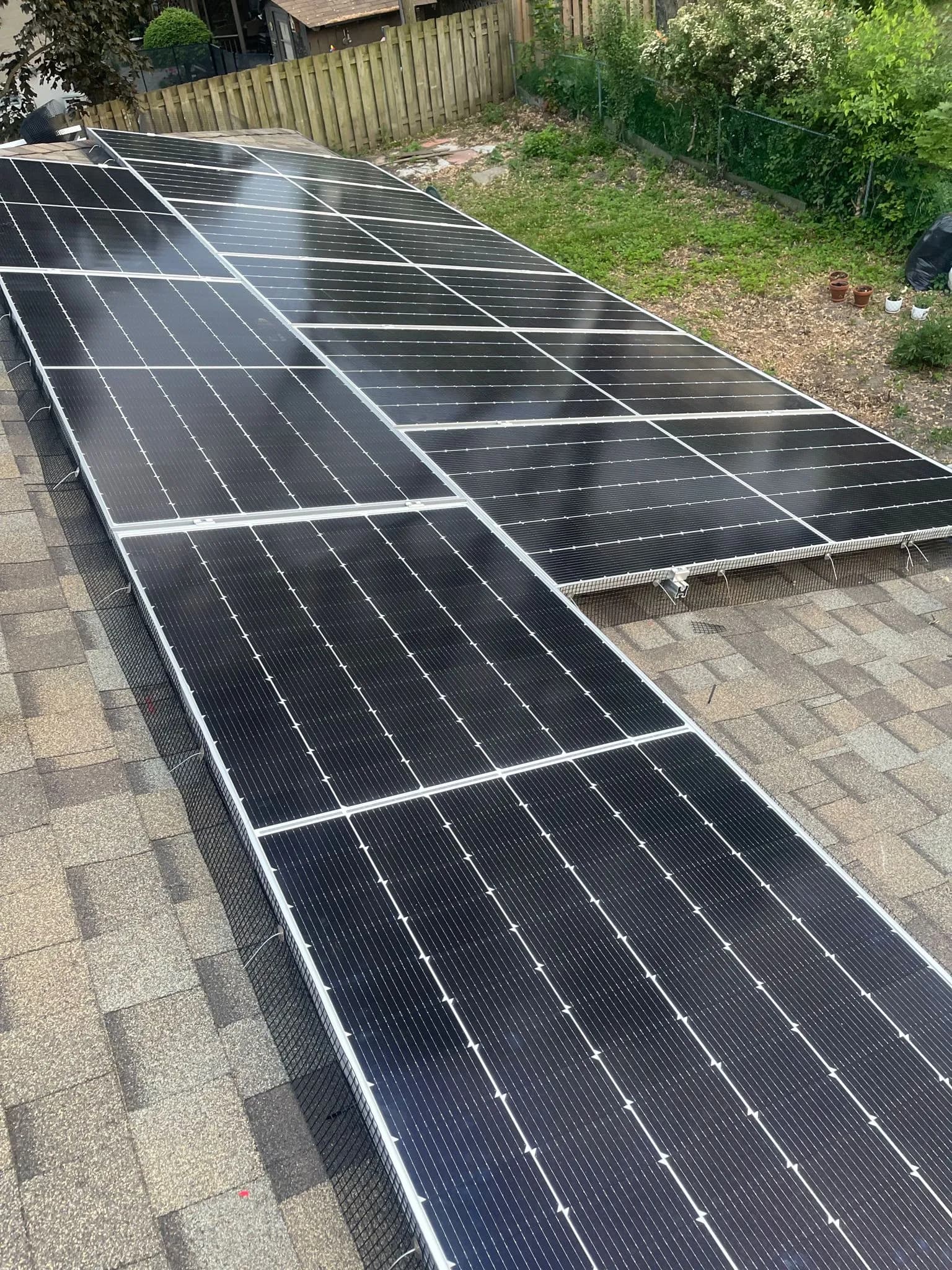
Quick answer: A typical 7.5–10 kW residential solar system in Ontario costs $18,000–$30,000 before incentives. After Ontario's HRSP solar rebate (up to $5,000), net cost can drop to $13,000–$25,000.
Canada national context
The average cost of solar panels in Canada in 2026 is $2.50 to $3.50 per watt installed. For a typical 8 kW residential system, that is $20,000 to $28,000 before incentives. Ontario sits at the affordable end of the national range ($2.42–$3.50/W) thanks to a competitive installer market and the HRSP rebate path. Alberta and British Columbia average $2.60–$3.27/W. Atlantic Canada is higher at $3.00–$3.80/W because of smaller installer capacity per capita.
The short answer: $18,000–$35,000 before incentives, and as low as $0 upfront after rebates and financing
A typical Ontario home needs a 7.5–10 kW solar system, which costs $18,000–$35,000 before incentives and can drop to $13,000–$25,000 after the HRSP rebate. The installed cost per watt in Ontario ranges from $2.42 to $3.50 in 2026. Solar X has completed 10,000+ solar projects with 118 MW of installed capacity across Ontario, all delivered through the same Solar X residential systems process documented here.
Ontario Solar Panel Cost by System Size (2026)
The biggest driver of total cost is system size, determined by your annual electricity consumption. The Ontario Energy Board reports the average Ontario household uses about 9,000 kWh per year. Here's what each system size costs before and after available incentives:
| System Size | Panels Needed | Cost Before Incentives | After HRSP Rebate | Est. Annual Savings | Payback |
|---|---|---|---|---|---|
| 6 kW | 13–15 | $14,500–$21,000 | $9,500–$16,000 | $1,200–$1,500 | 7–10 years |
| 8 kW | 17–20 | $19,400–$28,000 | $14,400–$23,000 | $1,600–$2,000 | 8–11 years |
| 10 kW | 22–25 | $24,200–$35,000 | $19,200–$30,000 | $2,000–$2,600 | 8–12 years |
| 12 kW | 26–30 | $29,000–$42,000 | $24,000–$37,000 | $2,400–$3,200 | 8–12 years |
After HRSP rebate column subtracts the $5,000 solar rebate only. A battery adds its own cost and qualifies for up to $5,000 more. Actual savings depend on rate plan, system orientation, and usage profile.
Note on the 12 kW option: Ontario raised the residential micro-generation inverter cap from 10 kW to 12 kW AC effective May 1, 2026. Homeowners with larger roofs and higher consumption can now install bigger systems under net metering. Read our full breakdown of the Ontario 12 kW limit increase →
What's Included in the Price?
When a reputable installer like Solar X quotes you $2.42–$3.50 per watt, the price should be fully loaded. Here's where your money goes:
Equipment (55–65% of total cost)
Premium Tier-1 solar panels (Trina, Longi, JA Solar, or Canadian Solar), inverter(s), Enphase microinverters, SolarEdge optimizers, or Huawei string inverters, plus racking, mounting hardware, and wiring.
Labour and installation (20–25%)
Certified installation crew (ESA-licensed, NABCEP-certified). Typically a 1–2 day install for residential systems.
Permits, inspections, and interconnection (10–15%)
Building permit, ESA inspection, net metering or load displacement application with your LDC. Permit fees vary: Toronto charges a minimum of $206.53, Hamilton starts at $291, Niagara Falls has a flat $371 fee.
Design and project management (5–10%)
3D system design, structural assessment, energy modelling, and full project coordination.
If a quote doesn't include permits, ESA fees, or interconnection costs, it's not a real quote. Always ask your installer for a fully installed, turn-key price.
Total cost of ownership extends beyond the installation quote. Homeowners should also confirm how home insurance covers solar panels in Ontario, since most policies require notification when solar is added and the dwelling coverage amount may need to be updated to include the system's replacement value.
What Factors Affect Your Solar Cost in Ontario?
Roof Complexity
A simple south-facing roof with a single plane is cheapest to install on. Multiple roof planes, dormers, steep pitches, or split arrays add labour and racking hardware, potentially $1,000–$3,000 to the project.
Equipment Tier
Budget panels can save up to $0.10–$0.20/W upfront, depending on supplier, but Tier-1 panels from Trina, Longi, or Canadian Solar offer better degradation rates and 25-year performance warranties. Enphase microinverters cost more than string inverters but provide panel-level optimization, ideal for roofs with partial shading.
Battery Storage
An increasingly popular add-on, particularly since the HRSP rebate covers up to $5,000 for battery systems paired with solar. A Tesla Powerwall 3 runs $19,000–$24,000 fully installed before incentives in Ontario.
Geographic Location
Urban installs in Toronto or Ottawa may have slightly higher labour costs. Rural Hydro One territory may involve additional interconnection steps. Solar irradiance is consistent across southern Ontario: Ottawa leads at ~1,200 kWh/kW/year, Hamilton at ~1,152 kWh/kW/year.
HST
13% HST applies to solar installations in Ontario. This is usually included in per-watt pricing but worth confirming with your installer.
Ontario Solar Incentives and Rebates in 2026
The incentive landscape shifted dramatically in 2024–2025. Both federal programs, the Canada Greener Homes Grant (closed February 2024) and the Greener Homes Loan (closed October 2025), are no longer accepting new applications. Here's what's actually available right now:
Home Renovation Savings Program (HRSP): Up to $10,000
Ontario's flagship solar incentive, delivered through Save on Energy and Enbridge Gas:
Critical rule: HRSP requires your system to be sized for load displacement only. You generate and consume solar on-site. Homeowners who take the HRSP rebate cannot use net metering. Applications must be pre-approved before installation begins. Solar X handles the entire HRSP application process at no extra cost.
Municipal Financing Programs (LIC Loans)
Several Ontario municipalities offer property-tax-based financing that can be stacked with HRSP for $0 upfront. Toronto homeowners have the strongest combination of financing options in the province:
Federal Clean Technology ITC (Commercial)
Businesses installing solar can claim a 30% refundable tax credit on eligible capital costs. One of the strongest commercial solar incentives in Canadian history.
Enbridge Home Efficiency Rebate Plus (HER+)
Extended through 2027, provides up to $10,000 in grants for energy efficiency upgrades including solar (up to $5,000). Can be stacked with HRSP in certain scenarios.
HRSP Rebate vs. Net Metering: Which Path Saves You More?
This is the decision that defines your ROI. You cannot do both, so choose carefully.
| Factor | HRSP + Battery Path | Net Metering Path |
|---|---|---|
| Upfront rebate | Up to $10,000 | $0 |
| Excess solar | Stored in battery for self-consumption | Exported for 1:1 kWh credits at retail rate |
| Best for | High daytime usage, backup power, TOU/ULO arbitrage | Large systems, high evening usage, simplest setup |
| Net metering available? | No | Yes, credits at full retail rate |
| Battery required? | Strongly recommended | Optional (grid acts as storage) |
| Rate arbitrage potential | Huge: 3.9¢ ULO vs. 39.1¢ peak = 10× spread | Limited to net metering credit value |
| Credit expiry | N/A | 12-month rollover, then credits expire |
Solar X recommendation: For most Ontario homeowners with average consumption (8,000–12,000 kWh/year), the HRSP + battery path delivers the strongest all-in ROI when you factor in the $10,000 rebate, ULO arbitrage savings, and backup power value. The ULO rate spread of 3.9¢ overnight vs. 39.1¢ peak is an 850%+ differential. Battery arbitrage alone can save up to $800–$1,200/year, depending on usage and rate plan. Solar X models both paths for every customer at no cost.
What Is the Payback Period for Solar in Ontario?
Based on Solar X's 10,000+ installations, the typical Ontario solar payback falls between 7 and 12 years, depending on:
After payback, you're looking at 15–20 years of near-free electricity from a system with a 25–30 year lifespan. At an effective 8–12% annual return, solar consistently outperforms GICs, savings accounts, and most conservative investment vehicles, while hedging against Ontario's relentless rate increases.
Ontario TOU rates jumped approximately 29–30% in late 2025, and further increases are expected through 2028. Every year you wait, your payback period actually shortens in absolute terms (because rates keep rising), but you miss another year of savings. With HRSP funding operating first-come, first-served, 2026 is the strategic window.
Does Solar Work in Ontario's Winter?
Yes, and often better than people expect. Solar panels are rated at standard test conditions of 25°C. In reality, cold temperatures improve panel efficiency by reducing electrical resistance. A panel rated at 400W at 25°C can produce 420–440W on a cold, clear January day.
| Month | Production (kWh per kW installed) |
|---|---|
| December (lowest) | ~52 kWh/kW |
| January | ~65 kWh/kW |
| March | ~110 kWh/kW |
| July (highest) | ~125 kWh/kW |
| Annual average | 1,150–1,200 kWh/kW |
Snow is a temporary factor, not a permanent one. Panels are mounted at an angle that encourages natural snow shedding, and modern bifacial panels capture reflected light from snow cover, boosting production by up to 20%. Read our full guide to solar panels in Canadian winters →
How to Get the Best Price on Solar in Ontario
Getting the best price isn't about finding the cheapest quote. It's about finding the best value per dollar invested.
Get at least three quotes
Compare them on a per-watt basis with all costs included. If a quote seems low, check whether permits, ESA inspection, and interconnection fees are included.
Don't oversize or undersize
A system that's too large wastes money if you're on the HRSP path (no net metering to export excess). Match your system to your actual consumption. Our solar calculator does this automatically.
Stack every incentive you qualify for
HRSP + a municipal LIC loan can get you to $0 upfront cost in many Ontario cities. Solar X manages all rebate applications as part of your installation package.
Choose Tier-1 equipment
The panels and inverters need to last 30 years. We use Trina, Longi, JA Solar, and Canadian Solar panels paired with Enphase or SolarEdge inverters, all with manufacturer warranties to match.
Get Your Free Solar Quote from Solar X
10,000+ projects completed · 118 MW installed · ESA & NABCEP certified · No hidden costs, no pressure
Frequently Asked Questions
How much does a 10 kW solar system cost in Ontario?
A 10 kW solar panel system in Ontario costs approximately $24,200–$35,000 before incentives in 2026, based on the installed cost range of $2.42–$3.50 per watt. After the $5,000 HRSP solar rebate, your net cost drops to approximately $19,200–$30,000. Adding a battery qualifies for up to $5,000 more in HRSP rebate (a combined maximum of $10,000), but the battery's own cost is extra. If you're in a municipality with a LIC financing program, you may qualify for $0 upfront installation.
What is the average cost per watt for solar in Canada?
The national average for residential solar in Canada ranges from $2.50 to $3.50 per watt in 2026. Ontario is among the most affordable provinces at $2.42–$3.50/W, thanks to a competitive installer market and strong provincial incentive programs. Alberta and British Columbia fall in the $2.60–$3.27/W range.
Does the HRSP rebate reduce my solar installation cost?
Yes. The Home Renovation Savings Program provides up to $5,000 for solar panels ($1,000/kW, capped at 5 kW) and up to $5,000 for battery storage paired with solar, a combined maximum of $10,000. Taking the HRSP rebate means your system must operate under load displacement. Net metering is not permitted. Pre-approval is required before installation begins.
What is the payback period for solar in Ontario?
The typical payback period for a residential solar system in Ontario is 7–12 years in 2026, depending on system size, equipment, incentive path (HRSP vs. net metering), and your electricity rate plan. Homeowners who combine the HRSP rebate with battery storage and ULO rate arbitrage tend to see the fastest payback, as low as 7–8 years. After payback, the system generates essentially free electricity for another 15–20+ years.
Is solar worth it in Ontario with rising electricity rates?
Ontario TOU rates have increased substantially, with peak rates hitting 39.1¢/kWh and further increases projected through 2028. At these rates, a properly sized solar system can reduce your electricity bill by 70–90% and deliver an effective annual return of 8–12% on your investment.
How do I pay for solar panels in Ontario?
Ontario homeowners typically pay for solar through one of four methods: cash purchase (best long-term ROI), municipal LIC financing where available (Toronto HELP Loan, Hamilton, Kingston, Lanark County, Aurora, Dufferin, London, Peterborough: the municipality pays the installer and you repay through your property tax bill over 10–25 years at low-interest), HELOC at prime rate, or a third-party solar loan. Combined with the HRSP rebate (up to $10,000), most installs become cash-flow neutral. Solar X is not a lender. We help you identify and apply for the best option for your property.
Get Your Free Solar Quote from Solar X
Every Ontario home is different: your roof, your usage, your utility, your goals. The fastest way to get an accurate price is to talk to our team directly. We'll assess your property, model your savings under both the HRSP and net metering paths, and give you a transparent, fully loaded quote with no hidden costs.
Phone: 1-833-376-5279
Email: info@solar-x.ca
Online: solar-x.ca/contact
Calculator: solar-x.ca/solar-calculator
10,000+ projects completed · 118 MW installed · 10+ years of experience · ESA & NABCEP certified
Related Articles
Solar Installation Across Ontario
Solar X installs across the province. Start with our residential solar installation overview and the complete Ontario solar guide, or jump to your city:
Solar X is a Canadian residential and commercial solar installer licensed in Ontario, Alberta, Nova Scotia, and New Brunswick. All systems are installed by ESA-certified crews. Pricing, savings projections, and incentive amounts are accurate as of May 2026 and are subject to change. HRSP rebate availability is subject to program funding and eligibility verification. The Canada Greener Homes Grant (closed February 2024) and Greener Homes Loan (closed October 2025) are no longer accepting new applications. Confirm current program status directly with the relevant program administrator before making financial decisions. Ontario electricity rates shown are per the Ontario Energy Board Regulated Price Plan effective November 1, 2025. Last updated: April 2, 2026.