
By the Solar X Team (Solar X Engineering Team, ESA/ECRA Licensed Electrical Contractor, Licence 7017538, NABCEP Certified). Published May 28, 2026.
The inverter is the brain of your solar system. It decides how much power you can produce, how easily you can add a battery later, and how the whole system behaves when something goes wrong. For most Ontario homes that want to be battery-ready, a hybrid string inverter is the stronger long-term choice. Microinverters still win in a few specific situations, and we install both, so this guide lays out the real tradeoffs without spin.
Quick answer: For a typical Ontario home that wants solar now and a battery later, a hybrid string inverter usually makes the most sense. It lets you oversize your panel array, charge a battery directly on the DC side, and keep more of your storage and solar inside Ontario's 12 kW connection cap. Microinverters make the most sense on small arrays, roofs with panels facing several different directions, or roofs with heavy shade that cannot be designed around.
If you only remember one thing:
In Ontario the connection limit is measured in AC kilowatts, and how your battery connects to that limit is the single biggest reason hybrid usually beats microinverters for battery-ready homes.
Three Kinds of Inverter, in Plain Language
There are three common setups on Ontario roofs. Here is what each one actually does.
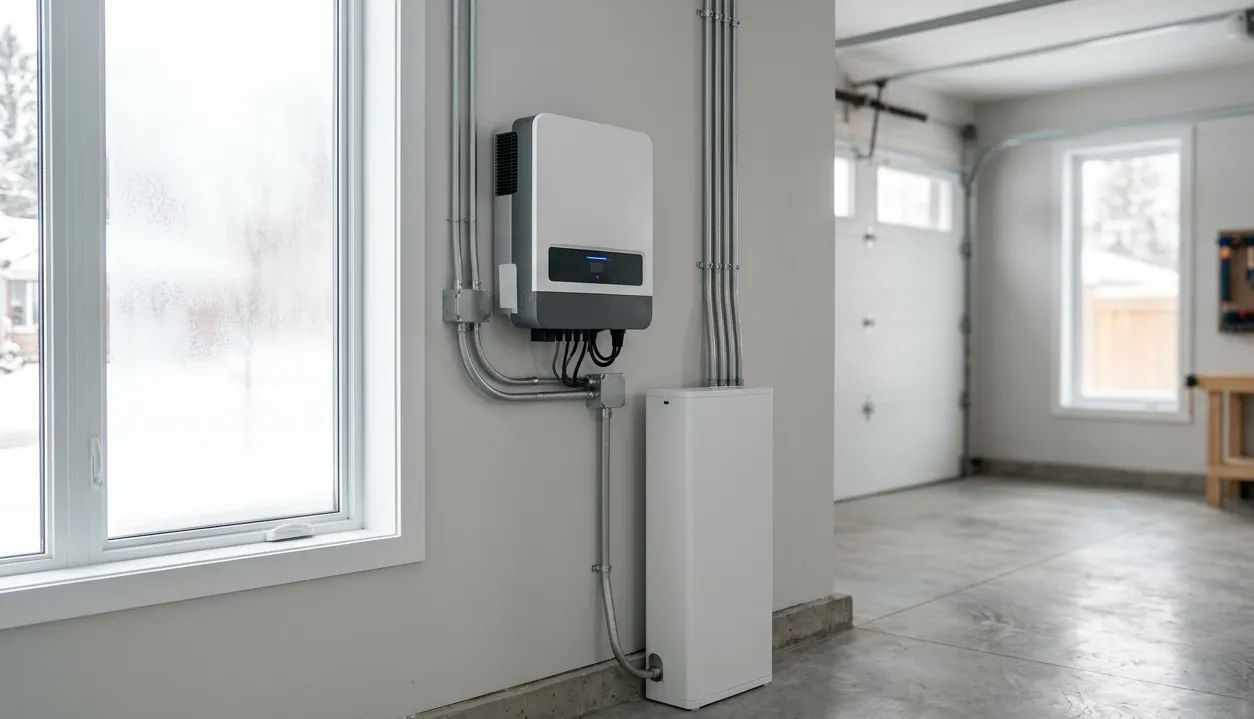
- String inverter. Your panels are wired together in a series, called a string, and all of that DC power runs down to one inverter, usually mounted on a wall in your garage or on the side of the house. One box does the conversion for the whole system.
- Hybrid inverter. This is a string inverter with a battery brain built in. It manages solar panels and a battery from the same unit on the DC side. It is the modern default for any home that wants storage now or in the future.
- Microinverter. Instead of one central box, a small inverter sits under each panel on the roof. Each panel converts its own power to AC right there. Enphase is the best-known brand. Power optimizers, used by SolarEdge, are a related idea: a small device under each panel that conditions the DC power before it reaches one central inverter.
The first real fork in the road is not brand. It is whether your system converts power once in a central location, or many times up on the roof. That choice drives cost, battery options, and how the system fails.
The Ontario Rule That Quietly Decides This for You
Here is the part most homeowners never hear, and it matters more than any spec sheet.
Ontario raised the residential micro-generation limit from 10 kW to 12 kW AC, effective May 1, 2026, under the Ontario Energy Board Distribution System Code. Staying at or under that 12 kW threshold keeps you in the simpler micro-embedded connection process. Going above it pushes your project into a Connection Impact Assessment, which is slower and more expensive. You can read our full breakdown in Ontario's 12 kW solar limit explained.
The key word is AC. The limit is on the AC output your system is allowed to push, not on the size of your panel array in DC. That one detail is what separates the two inverter paths once a battery enters the picture.
How Batteries Connect, and Why It Changes Everything
There are two ways to wire a battery into a solar system.
- AC coupling. Your panels feed one inverter that makes AC, and then a second, separate battery inverter sits beside it and also makes AC. This is how a microinverter system has to add storage, because microinverters already output AC up on the roof. The catch: the battery inverter's AC output stacks onto your solar AC output, and both count toward your 12 kW connection limit. Your solar and your storage are now competing for the same AC budget.
- DC coupling. A hybrid inverter charges the battery directly with DC power from the panels, before any conversion to AC. The battery can fill up on the DC side without spending your AC allowance. This is why a hybrid lets you run more solar and more usable storage inside the same Ontario connection cap.
In short, on a microinverter system your battery eats into the same 12 kW AC budget as your solar. On a hybrid system your battery largely sidesteps it. For an Ontario home that is price-sensitive and wants the most value inside the rules, that is a real, dollars-and-savings difference. Our Ontario home battery storage guide walks through sizing in more detail.
Want a quote built around your roof, not a slogan?
Solar X will model hybrid and microinverter options side by side with real numbers for your address. About 2 minutes to get started.
Get a Free Solar Assessment →ESA Licence #7017538 · NABCEP Certified · No obligation
Why We Lean Toward Hybrid String Inverters for Battery-Ready Homes
1. You Can Oversize the Panel Array
Because the Ontario limit caps AC output, not DC panels, a hybrid lets you install more panels than the inverter's AC rating, then let the inverter shave the rare peak. This is called the DC-to-AC ratio. Ratios around 1.2 to 1.3 are common, so a 12 kW AC hybrid can pair with roughly 14 to 15.6 kW of DC panels. A tiny amount of clipping on the few brightest minutes of the year is normal and usually worth it, because you capture far more energy in the morning, evening, and winter when the sun is weak.
Microinverters are sized close to one per panel, so the system-level oversizing flexibility is much tighter. You get less room to design around Ontario's cap.
2. There Is One Clear Path to a Battery
With a hybrid, the battery is part of the same DC system from day one. Adding storage later is cleaner, and you are not bolting on a second inverter and a second set of conversions. Fewer conversions also means slightly higher round-trip efficiency on a DC-coupled battery, since AC-coupled systems convert the power extra times. If you are thinking about a Tesla Powerwall or other home battery, this is the simpler foundation.
3. Fewer Things on the Roof to Go Wrong
A central hybrid inverter is one unit, usually at ground or wall level, where it is easy and cheap to inspect or replace. A microinverter system puts one small electronic unit under every panel, living through Ontario's full temperature swing from deep winter cold to summer roof heat, year after year. More units in a harsh environment means more potential points of failure, and when one does fail it sits under a panel on your roof, which makes service more involved and more costly than swapping a single wall-mounted box.
To be fair and accurate: manufacturers like Enphase publish very low per-unit failure rate targets, and a single microinverter failure only drops one panel offline rather than the whole array (Enphase reliability brief). We are not claiming microinverters are unreliable. The honest engineering point: more devices in a tough rooftop environment means more total opportunities for a service call over 25 years, and roof-level repairs cost more than ground-level ones. That is a maintenance and access argument, not a smear.
Decision Table: Hybrid String vs Microinverter in Ontario
| Factor | Hybrid String Inverter | Microinverters |
|---|---|---|
| Battery path | DC coupled, charges before the AC cap | AC coupled, competes for the AC cap |
| Fits Ontario 12 kW cap with storage | More solar and storage inside the limit | Battery inverter eats into the limit |
| Oversize the panel array | Strong (common 1.2 to 1.3 DC:AC ratio) | Limited (close to one per panel) |
| Points of failure | One central unit, easy to service | One unit per panel on the roof |
| Performance on a clean roof | Excellent | Excellent |
| Performance with mixed roof angles | Good with multiple trackers | Best (each panel independent) |
| Performance with heavy shade | Good with modern panels | Best (each panel independent) |
| Best fit | Most Ontario homes, especially battery-ready | Small arrays, multi-direction roofs, heavy shade |
Do You Still Need Power Optimizers? Mostly Not, but Not Never
Optimizers were invented to solve one problem: shade. When one panel in a string is shaded, it can drag down the panels wired with it. An optimizer lets each panel work at its own best point so a shaded panel does not pull down its neighbours.
Here is what changed. Modern panels now use half-cut cells and several bypass diodes built in. A bypass diode lets current route around a shaded section of a panel so the rest of the string keeps flowing. This has narrowed the gap a lot. On a clean, well-sited Ontario roof with little or no shade, the extra cost and the extra rooftop electronics of optimizers often are not worth it.
But it is not accurate to call optimizers useless, and we will not put that on our site. Bypass diodes and optimizers do different jobs. A bypass diode protects the panel and routes around a shaded section, but the bypassed section produces zero power. An optimizer or a microinverter still tries to harvest energy from that shaded panel and keeps it from affecting the others. On genuinely shaded or complex roofs, that difference is real and can mean meaningfully more energy over a year. For a deeper technical reference, see Aurora Solar on bypass diodes and module-level electronics.
The practical Solar X position: on a clean roof, modern panels plus a hybrid inverter usually capture the value without paying for optimizers under every panel. On a shaded or awkward roof, module-level electronics, whether optimizers or microinverters, earn their cost. We size this per roof, not by slogan.
When Microinverters Are the Right Call
We install Enphase, and there are homes where it is the better answer. Reach for microinverters when:
The array is small
If you only have room for roughly 5 to 10 panels, the case for a central inverter is weaker and microinverters are a clean fit.
Panels face several directions
If your panels are split across multiple roof faces pointing different ways, each microinverter lets every panel run independently, which a single string struggles to match.
Shade is unavoidable
Trees, chimneys, or neighbouring buildings that you cannot design around favour panel-by-panel independence.
You want panel-level monitoring out of the box
Microinverters report on each panel individually, which some homeowners value.
If none of those describe your roof, and especially if you want a battery now or later, a hybrid string inverter is usually the stronger pick.
How to Choose, in Four Steps
Start with the battery question
Do you want storage now or within a few years? If yes, lean hybrid. Ontario's time-of-use and Ultra-Low Overnight rates make storage compelling, which we cover in our Ontario solar and battery rebate guide.
Look at your roof
One or two clean roof faces with little shade favour a hybrid. Many small faces or heavy shade favour microinverters.
Count your panels
Small arrays lean microinverter. Medium and larger arrays lean hybrid.
Think in 25-year terms
Weigh service access, oversizing room, and how the system grows. A central unit is simpler to live with over decades.
For the rebate side of this decision, see our Ontario solar and battery rebate guide.
How Solar X Designs Ontario Inverter Systems
Solar X is an ESA and ECRA licensed electrical contractor (Licence 7017538), not a general contractor subcontracting the electrical work, with a NABCEP-certified team. We size every system from your actual hydro usage, your roof geometry, and your local utility's net metering rules, then we design to pass the Electrical Safety Authority inspection on the first attempt. We install hybrid string inverters, microinverters, and optimizers, and we recommend based on your roof and your goals, not on what is easiest to sell.
A few honest notes that match how Ontario solar actually works. Permits, ESA inspection, utility interconnection, and rebates are never guaranteed, and no install date is locked until approvals are complete. Rebate programs such as the Home Renovation Savings Program have caps and eligibility rules, and we do not guarantee approval or specific savings. We put the plan in writing so you can see the assumptions for yourself. You can explore our full residential solar offering or our Ontario solar service area.
Frequently Asked Questions
Is a hybrid inverter or a microinverter better in Ontario?
For most Ontario homes, especially ones that want a battery now or later, a hybrid string inverter is usually the better choice. It lets you oversize your panels, charge a battery on the DC side, and keep more solar and storage inside Ontario's 12 kW AC connection cap. Microinverters are the better choice for small arrays, roofs with panels facing several directions, or roofs with heavy shade.
Do microinverters limit how big a battery I can add in Ontario?
In practice, yes. Microinverters output AC, so adding a battery means AC coupling with a separate battery inverter. That battery inverter's AC output counts toward your 12 kW AC connection limit along with your solar. A DC coupled hybrid inverter charges the battery before that AC limit, so you can run more usable solar and storage inside the same cap.
What is the difference between AC coupled and DC coupled batteries?
A DC coupled battery connects on the DC side of a hybrid inverter and charges directly from the panels with one conversion, which is efficient and sidesteps the AC connection cap when charging. An AC coupled battery uses its own separate inverter and charges from AC power, which adds conversions and counts toward your AC limit. New solar plus battery installs usually favour DC coupling, while AC coupling is common when retrofitting storage onto an existing system.
Can I add a battery to an existing microinverter system?
Yes. Because microinverters are an AC system, you add an AC coupled battery, such as an Enphase IQ Battery, which has its own inverter. It works, but the battery inverter's AC output counts toward your Ontario connection limit, so your storage and solar share the same AC budget. If a large battery is a priority, a DC coupled hybrid setup gives you more room.
Are power optimizers worth it in 2026?
It depends on your roof. Modern panels with half-cut cells and built-in bypass diodes already handle light shade well, so on a clean, well-sited roof optimizers often are not worth the extra cost and rooftop electronics. On roofs with real shade or many different angles, optimizers and microinverters still capture meaningfully more energy because each panel can work independently. Optimizers are not useless, they are situational.
How many points of failure does a microinverter system have?
A microinverter system has roughly one electronic unit per panel, so a 20 panel system has about 20 small inverters on the roof. A central string or hybrid inverter has one main conversion unit, usually at wall or ground level. A single microinverter failure only takes one panel offline, but more units in a hot and cold rooftop environment means more total chances for a service call over 25 years, and roof-level repairs cost more than reaching one wall-mounted box.
Can you oversize a solar system with a hybrid inverter?
Yes. Because Ontario's limit caps AC output rather than DC panels, a hybrid inverter lets you install more panels than its AC rating, commonly at a DC to AC ratio of about 1.2 to 1.3. A small amount of clipping on the brightest minutes of the year is normal and usually worth it, because you gain more energy during weak light in mornings, evenings, and winter.
What is the best solar inverter for a home in Ontario?
There is no single best inverter for every home. For a typical detached Ontario home with one or two clean roof faces that wants to be battery ready, a hybrid string inverter is usually the strongest all-round choice. For a small array, a multi-direction roof, or a heavily shaded roof, microinverters are often better. The right answer comes from your roof, your usage, and your battery plans.
Does Ontario's 12 kW limit apply to panels or to the inverter?
It applies to AC output, which in practice is your inverter's AC rating, not your panel array's DC size. That is why a hybrid inverter can pair a 12 kW AC unit with around 14 to 15.6 kW of DC panels and still stay inside the micro-embedded connection process. Always confirm how your local utility applies the threshold to your specific application.
When do microinverters make more sense than a string or hybrid inverter?
Microinverters make the most sense on small arrays of roughly 5 to 10 panels, on roofs where panels face several different directions, or on roofs with shade you cannot design around. In those cases, letting each panel operate independently outperforms a single string. For most other Ontario homes, a hybrid string inverter is the more flexible and battery-friendly choice.
Ready to Find the Right Inverter for Your Roof?
Book a free, no-obligation assessment. We will model your roof, show you hybrid and microinverter options side by side with real numbers, and lay out a clean path to a battery if you want one.
Sources & References
- 1
- 2
- 3Aurora Solar Help Center, bypass diodes and module-level electronicshelp.aurorasolar.com
- 4
- 5
- 6
Related Guides
This article is general information, not engineering or financial advice for a specific property. System design, equipment choice, oversizing, and battery sizing depend on your roof, electrical service, usage, and local utility rules. Permits, ESA inspection, utility interconnection, and rebate approvals are never guaranteed, and no install timeline is final until approvals are complete. Rebate programs have caps and eligibility rules and may change. Equipment specifications reflect manufacturer-published figures at the time of writing. Last updated: May 28, 2026.
Solar X Canada · ESA/ECRA Licensed (Licence 7017538) · NABCEP Certified · 955 Bay St, Suite 2307, Toronto, ON M5S 0C6 · 1-833-376-5279 · info@solar-x.ca