
Direct Answer
For most Ontario homes, the five Tier 1 panels Solar X installs are close enough in real-world output that the right pick comes down to roof size, budget, and warranty depth, not brand. Trina Vertex S+, LONGi Hi-MO X6, JA Solar DeepBlue 4.0 Pro, Canadian Solar TOPHiKu6, and SolarSpace Lumina II SSA-54HDB all use modern N-type TOPCon (or HPBC for LONGi) cells, all sit between roughly 21% and 23% module efficiency, and all carry 25 to 30 year performance warranties. Tight roof: pick highest efficiency. Tight budget: lowest installed cost per watt. Long-term peace of mind: longest product warranty.
TL;DR
- All five panels are Tier 1, ESA-listed, and approved for use in Ontario.
- Module efficiency range: ~21.3% to 23.0% depending on exact model.
- Performance (power) warranty: 25 to 30 years on the latest residential models.
- Product warranty (covers defects): 12 to 25 years depending on model and region.
- Temperature coefficients are tightly clustered (~-0.29%/°C to -0.30%/°C), so cold-weather performance is similar across all five.
- The bigger ROI levers in Ontario are roof orientation, system size, inverter choice, the HRSP rebate, and net metering setup with your local utility — not the panel brand.
Who this comparison is for
This is for an Ontario homeowner who is getting solar quotes and trying to decide between similar-looking proposals. You are likely seeing one of these five panel brands on every quote you receive, because they are the residential Tier 1 brands most ESA-licensed installers in the province carry. This guide pulls from manufacturer datasheets, third-party reliability testing, and Ontario program rules so you can compare on facts, not on the salesperson's pitch.
What “Tier 1” actually means
Tier 1 is a Bloomberg New Energy Finance (BNEF) bankability classification, not a quality test. It only tells you the manufacturer has shipped panels to enough financed projects to be considered financially stable, not that the panels are higher quality. All five brands in this comparison are Tier 1. For a more useful quality signal, look at the PV Evolution Labs (PVEL) Top Performer scorecard, which runs independent reliability tests on modules from major manufacturers each year.
The five panels, side by side
Numbers below are pulled from current manufacturer datasheets and product pages. They reflect popular residential models, not commercial or utility panels. Exact model variant matters, so always confirm the exact part number on your Solar X proposal.
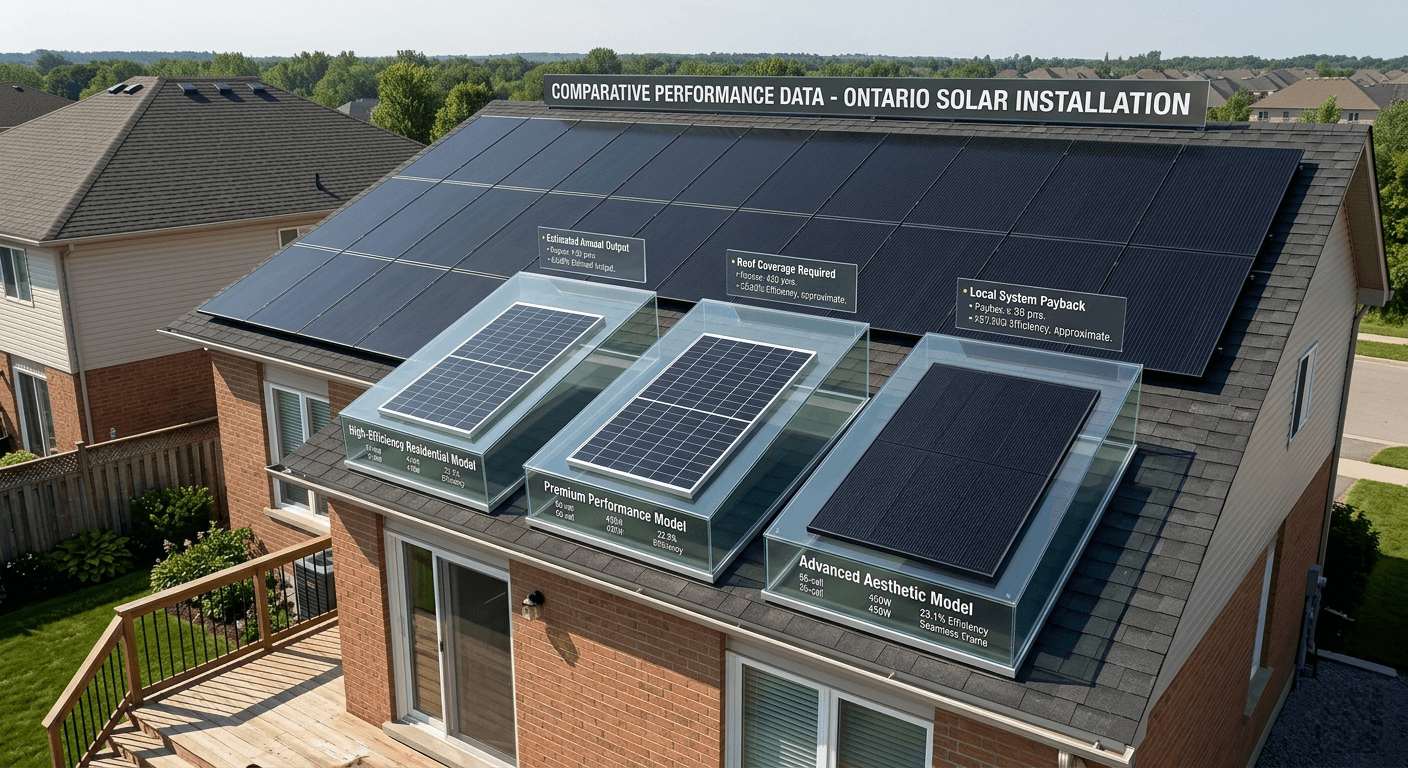
| Spec | Trina Vertex S+ (~430–475W) | LONGi Hi-MO X6 (~425–440W) | JA Solar DeepBlue 4.0 Pro (~440–455W) | Canadian Solar TOPHiKu6 (~445–460W) | SolarSpace Lumina II SSA-54HDB (~480–500W) |
|---|---|---|---|---|---|
| Cell technology | N-type TOPCon | HPBC (back-contact mono) | N-type TOPCon | N-type TOPCon | N-type TOPCon |
| Module efficiency | up to ~22.8% | up to ~22.3% | up to ~22.6% | up to ~22.5% | up to ~22.5% |
| Temperature coefficient (Pmax) | ~-0.29%/°C | ~-0.29%/°C | ~-0.29%/°C | ~-0.29%/°C | ~-0.29%/°C |
| First-year degradation (max) | 1.0% | 1.5% | 1.0% | 1.0% | 1.0% |
| Annual degradation after year 1 | 0.4% | 0.4% | 0.4% | 0.4% | 0.4% |
| Performance warranty | 25 or 30 yr (model-dependent) | 25 yr | 30 yr | 30 yr | 30 yr |
| Product (defect) warranty | 25 yr (TrinaProtect, US/CA) | 15–25 yr (model/region) | 25 yr (Pro variant) | 12 or 25 yr (model/region) | 15 yr |
| Output retained at year 25 (typical) | ~89.4% | ~88.9% | ~87.4% (yr 30) | ~87.4% (yr 30) | ~89.4% |
| Construction | mono- or bifacial dual-glass | dual-glass options | bifacial dual-glass on Pro | mono- or bifacial dual-glass | bifacial dual-glass, full black |
| All-black option | Yes | Yes | Yes | Yes | Yes |
| Country of HQ | China (global mfg) | China (global mfg) | China (global mfg) | Canada HQ (Guelph), global mfg | China (mfg China, Cambodia, Laos) |
Sources: manufacturer datasheets and product pages (Trina Solar US, LONGi Global, JA Solar, Canadian Solar NA, SolarSpace Technology). Verified May 4, 2026. Verify the exact spec sheet revision on your Solar X proposal before signing.
What the numbers actually mean for an Ontario homeowner
Module efficiency
The percentage of sunlight a panel converts into electricity. The spread across the five brands is about 1.5 percentage points, which is roughly 1 to 2 fewer panels needed on a 10 kW system if you pick the highest-efficiency option. That matters on a small roof. It does not matter on a large roof.
Temperature coefficient
How much output drops per degree Celsius above 25°C. All five panels are essentially tied at about -0.29%/°C. Ontario peak summer roof temperatures rarely cause the kind of heat losses that make this a deciding factor.
Cold weather performance
The more relevant Ontario question. Solar panels actually produce more voltage in cold air, which slightly improves output on clear winter days. The bigger Ontario winter issue is snow cover blocking the panel surface, not cold itself. All five panels are rated for high snow loads (typically 5400 Pa or higher), and steeper tilts shed snow faster.
Degradation rate
Controls how much electricity you still produce in year 20 versus year 1. A 0.4% annual rate after year 1 is now the industry baseline for premium residential panels, and all five brands meet it. This is a real improvement over older PERC panels which often degraded at 0.5 to 0.7% per year.
Product warranty length
The underrated spec. A 25-year product warranty (covering manufacturing defects, not just power output) is worth more than a marginal efficiency advantage. Trina, JA Solar Pro, and Canadian Solar all offer up to 25 years of product coverage on their flagship variants, while LONGi varies by model and market. Ask for the specific warranty document attached to the model number on your quote.
Ontario specific: what is different here
Most online solar panel reviews are written for US, UK, or Australian markets. A few things change when you bring this to Ontario.
You are getting net metering, not a feed-in tariff
Ontario's microFIT program closed in 2017. Today, residential systems use net metering with your local distribution company (LDC). Excess generation creates kWh credits that offset future consumption, with credits expiring after 12 months in most LDC tariffs. This caps the value of oversizing a system.
The HRSP is the active rebate
The Home Renovation Savings Program offers a solar-and-battery rebate stream administered by Save on Energy (IESO) and Enbridge Gas. Your contractor must submit a pre-installation application and receive written pre-approval before any equipment is purchased or installed. Self-installs are not eligible. Currently open with no announced end date, and Ontario rebate programs have closed early in the past.
ESA inspection is mandatory
Every grid-connected solar or battery system in Ontario requires an Electrical Safety Authority inspection before interconnection. This is non-negotiable. The installer's ECRA/ESA contractor license number should be on every contract.
Snow climate over panel performance
In Ontario's snow zones, mounting tilt, panel edge clearance, and roof orientation usually matter more for annual yield than the 1% efficiency gap between Tier 1 brands.
How to read a panel proposal without getting fooled
Sales decks emphasize different specs depending on which brand the installer carries. Here is what to actually compare line by line.
- 1Model number and datasheet revision.Not just "Trina 440W." The exact part number (e.g., TSM-NEG9RC.05 425W). Datasheets get updated. Sub-models exist.
- 2Module power rating in watts.This is the STC rating. Multiply by panel count to get system DC size.
- 3Module efficiency percentage.Higher means fewer panels for the same output, which matters only if your roof is space-constrained.
- 4Temperature coefficient (Pmax).The lower the absolute value, the better the hot-weather performance. Tightly clustered across Tier 1.
- 5First-year and annual degradation.Lower is better.
- 6Product warranty.This is the one most homeowners miss. Performance warranties are easy to honour. Product warranties are the ones that pay out if a panel actually fails.
- 7Bifacial or monofacial.Bifacial gains on a residential pitched roof are minimal because there is no reflective surface behind the panel. Bifacial is most useful on flat roofs or ground mounts.
- 8Snow and wind load ratings (Pa).Both should comfortably exceed your local code requirement.
- 9Country of origin and country of manufacture.Country of HQ is not the same as country of manufacture. Both can affect warranty service.
When one panel actually wins over the others
Use this as a tiebreaker, not a deal-maker. The installer's workmanship and the inverter platform matter more than the panel brand for long-term system performance.
| Situation | Lean toward |
|---|---|
| Smallest possible roof footprint, premium budget | Highest-efficiency Trina Vertex S+ or JA Solar DeepBlue 4.0 Pro variant |
| Longest product (defect) warranty matters most | Trina Vertex S+ with TrinaProtect, or Canadian Solar with 25-year product variant |
| Brand recognition with a Canadian connection | Canadian Solar (HQ in Guelph, Ontario; manufacturing global) |
| Best low-light performance on a partly shaded roof | LONGi Hi-MO X6 (HPBC tends to do well in low light) or any TOPCon panel paired with optimizers or microinverters |
| Tight budget without giving up Tier 1 status | JA Solar DeepBlue 4.0 standard or Canadian Solar HiKu6 |
What matters more than the panel brand
The honest founder answer. The panel is roughly 25 to 35% of your total system cost and 15 to 25% of your long-term performance variance. The bigger drivers are:
- 1System sizing.Undersized means you keep paying the LDC for top-up. Oversized means you build credits you may never use because they expire.
- 2Inverter platform.String inverter, optimizers, or microinverters. This affects shading tolerance, monitoring, future battery integration, and rapid shutdown compliance.
- 3Roof orientation and tilt.Due south at 30–40 degrees is ideal in Ontario. East-west splits work, just at slightly lower annual yield.
- 4Workmanship.Flashing, mounting, conduit routing, and string testing. This is where ESA inspections fail. This is also where roof leaks happen 5 years later.
- 5Net metering setup with your LDC.Toronto Hydro, Alectra, Hydro One, Hydro Ottawa, Elexicon, ERTH, London Hydro all have their own application process and timeline. None are guaranteed.
- 6HRSP application timing and order of operations.Equipment cannot be purchased before pre-approval. Skip this step and the rebate is gone.
Spec figures are taken from manufacturer datasheets and product pages as of April 30, 2026. Manufacturers update spec sheets without notice. Confirm the exact model number and revision in your Solar X proposal before signing. Solar X does not guarantee rebate approval, install timelines, or specific savings. Eligibility for HRSP, net metering, and any tax credit depends on factors outside Solar X's control.
Frequently Asked Questions
Are all five brands actually Tier 1?
Yes. Trina Solar, LONGi, JA Solar, Canadian Solar, and SolarSpace are all recognized Tier 1 module manufacturers under the Bloomberg NEF bankability framework. Tier 1 is a financial bankability rating. It does not measure quality on its own, but it is the baseline most installers and lenders require.
Which solar panel performs best in Ontario winter?
Cold air slightly improves panel output, so all modern N-type TOPCon panels do well in winter. The bigger winter factor is snow cover and roof tilt. All five brands have similar temperature coefficients (about -0.29%/°C). Pick on warranty and price, not on cold-weather performance, because the difference is small.
How long do these solar panels actually last?
Performance warranties run 25 to 30 years, but real-world data on monocrystalline panels installed in the 2010s shows most are still producing well above 80% of nameplate at 20+ years. Plan for 25 to 30 years of useful life. Plan for an inverter replacement or two during that window.
Does Solar X recommend one brand over the others?
Solar X stocks Trina, LONGi, JA Solar, Canadian Solar, and SolarSpace because all five meet our internal quality bar (Tier 1, modern N-type cells, strong warranties, ESA-listed). Brand selection on a given home is driven by roof size, budget, current stock pricing, and warranty preference, not by us favouring one manufacturer.
What about SunPower / Maxeon, REC, Q Cells, or Panasonic?
These brands exist at a higher price point. SunPower (now Maxeon) and REC Alpha Pure can edge out Tier 1 Chinese panels on efficiency and product warranty, but typically cost 20 to 40% more installed. For most Ontario homes, the payback math favours the Tier 1 panels Solar X installs, because the production gap does not justify the price gap. If you have a roof so small that 1% extra efficiency is the only way to hit your kWh target, premium panels may make sense.
Do bifacial panels help on a regular shingle roof?
Marginally. The bifacial gain depends on what is behind the panel. On a sloped asphalt shingle roof, the answer is almost nothing extra. Bifacial pays off on flat roofs (white membrane), ground mounts, or tilted carports.
Do these panels qualify for the HRSP rebate in Ontario?
HRSP eligibility is set by the program and the IESO, not by the panel brand. The program requires that the system be designed and installed by a licensed electrical contractor (Solar X qualifies, ECRA/ESA licensed), that the equipment passes ESA inspection, and that pre-approval is received before any equipment is purchased. Solar X does not guarantee rebate approval.
Is country of manufacture a factor for Ontario buyers?
For tariffs and trade-policy reasons it can matter, but for Ontario residential consumers the practical impact is small. All five brands manufacture across multiple countries (including China, Vietnam, Malaysia, Cambodia, and Laos) and ship CSA-listed, IEC-certified panels into Canada. Confirm the panel is approved for use in Ontario (CSA marking) on the spec sheet.
Get a panel-by-panel quote for your roof
Solar X provides written proposals showing the exact panel model, datasheet, inverter, racking, and warranty document for each system, alongside an HRSP eligibility review.
Author and Review
Author: Solar X Engineering Team. ESA/ECRA licensed electrical contractor. 1,000+ residential solar installations across Ontario.
Last verified: May 4, 2026.
Last updated: May 4, 2026 — added SolarSpace Lumina II SSA-54HDB to comparison.
Next scheduled review: 90 days from last_verified, or sooner if any manufacturer issues a new datasheet revision or a major Ontario program change occurs.
Related Resources
How to Choose a Solar Installer in Ontario (2026)
Six red flags every Ontario homeowner must check before signing a solar contract.
Read moreNet Metering Ontario: How Credits Work
Including the new 12 kW residential limit and HRSP load displacement comparison.
Read moreLondon Ontario Solar Incentives 2026
How HRSP, ULO, and load displacement stack — full provincial incentive guide.
Read moreSources & Further Reading
- Trina Solar US — TrinaProtect 25-Year Product and Power Warranty for Residential PV
- LONGi Solar — Hi-MO X6 product family page
- JA Solar — DeepBlue 4.0 Pro product page
- Canadian Solar — TOPHiKu6 (North America) product page
- SolarSpace Technology — N-Type Module product family
- Save on Energy (IESO) — Home Renovation Savings Program
- IESO — HRSP Solar and Storage Program Stream Requirements (PDF)
- Electrical Safety Authority (ESA)