
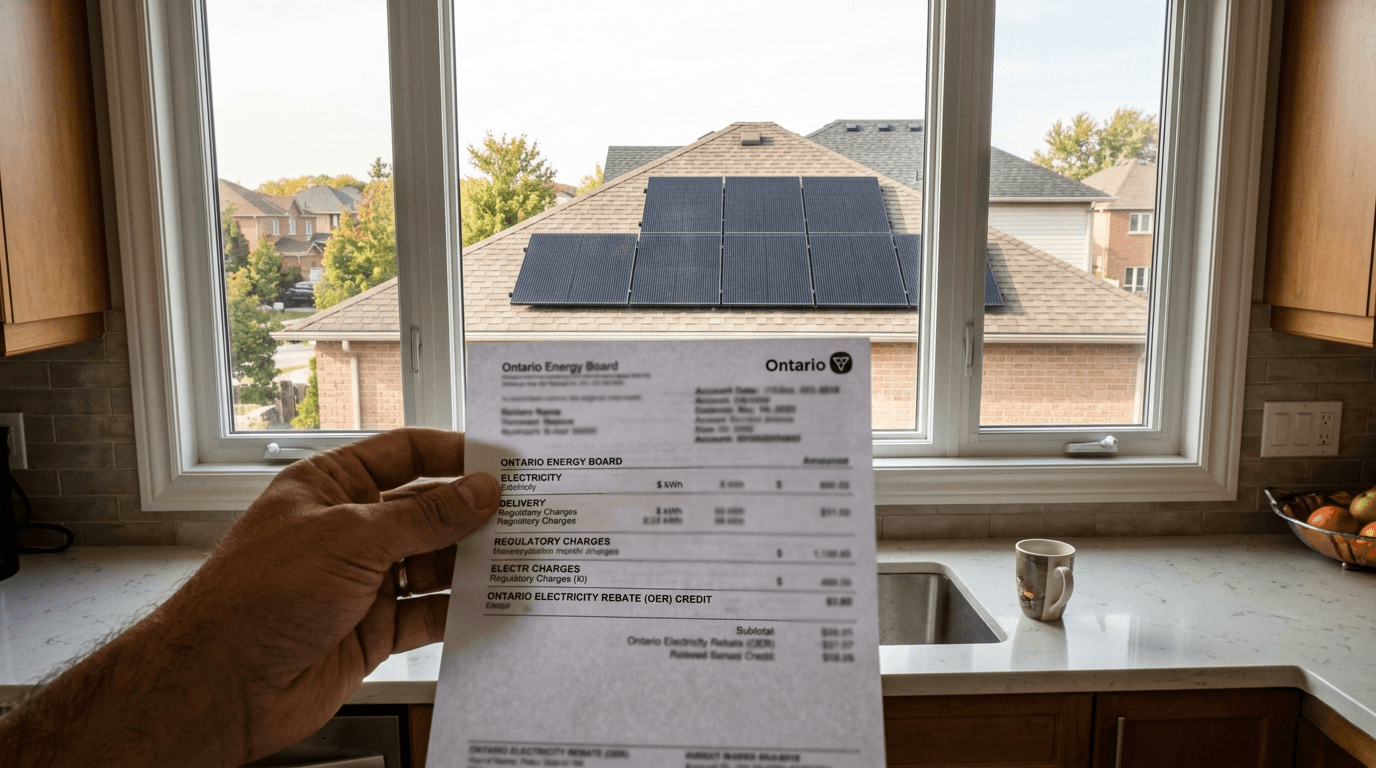
The short answer
The Ontario Energy Board (OEB) is the independent Crown agency that regulates electricity and natural gas in Ontario. It sets residential electricity rates under the Regulated Price Plan, approves distribution charges for all 58 Ontario utilities, enforces consumer protection rules, and adjusts rates on May 1 and November 1 each year. The OEB is headquartered at 2300 Yonge Street in Toronto.
Reviewed by the Solar X Engineering Team. ESA/ECRA Licensed Electrical Contractor (Ontario, Licence 7017538). Tesla Powerwall Certified Installer.
Last verified: June 10, 2026 against the OEB Regulated Price Plan and Newsroom pages.
If you pay an electricity bill in Ontario, the Ontario Energy Board affects how much you pay every single month. The OEB is the regulatory body that sets the per-kilowatt-hour rates on your bill, approves the delivery charges your local utility is allowed to collect, and enforces the consumer protection rules that govern how utilities treat you.
Most Ontario homeowners have heard the name but few understand exactly what the OEB does, how rate decisions are made, or what options exist when rates go up. This guide covers the OEB's role in plain language, breaks down the 2025 and 2026 rate decisions that are already affecting your bill, and explains the tools available to reduce your exposure to future increases.
What the OEB Does and Why It Matters to Homeowners
The Ontario Energy Board is a Crown regulatory agency established under the Ontario Energy Board Act, 1998. Its mandate is to protect the interests of Ontario's energy consumers while supporting reliable and affordable energy delivery. The OEB is independent from the provincial government, though its commissioners are appointed by the Lieutenant Governor in Council.
The OEB's responsibilities that directly affect your electricity bill include:
Setting the Regulated Price Plan (RPP) rates
The OEB sets the per-kilowatt-hour electricity rates that most Ontario households, small businesses, and farms pay. These rates apply to the three available pricing plans: Time-of-Use (TOU), Tiered, and Ultra-Low Overnight (ULO). Rate changes take effect on November 1 each year, with seasonal structural adjustments (peak hour schedules and tiered thresholds) changing on May 1.
Approving distribution rates for all 58 Ontario electricity distributors
Every utility in Ontario, from Toronto Hydro to Hydro One to small municipal distributors like Oshawa PUC and Elexicon Energy, must apply to the OEB before changing its delivery charges. The OEB reviews each application, holds hearings when necessary, accepts public comments, and issues decisions that set rates for one to five years.
Enforcing consumer protection rules
The OEB administers a winter disconnection ban (November 15 to April 30) that prevents utilities from disconnecting residential customers for non-payment during cold months. It handles consumer complaints, monitors utility compliance, and can impose penalties on utilities that violate regulations.
Overseeing energy retailer conduct
If a door-to-door energy salesperson visits your home, the rules they must follow are set and enforced by the OEB under the Energy Consumer Protection Act, 2010. The OEB publishes complaint statistics about energy retailers and has the authority to revoke retailer licences.
The OEB is headquartered at 2300 Yonge Street, 27th floor, in Toronto. Its current Chair is Geoff Owen. On May 25, 2026, the OEB appointed Julia McNally as a new full-time Commissioner.
Source: Ontario Energy Board, Ontario Energy Board Act 1998.
How the OEB Sets Your Electricity Rate
The rates on the “Electricity” line of your bill are set through a process called the Regulated Price Plan (RPP). Here is how it works.
The OEB forecasts the cost of generating electricity in Ontario for the coming year. This forecast accounts for the cost of nuclear generation (which provides roughly 50 to 60 percent of Ontario's supply), hydroelectric generation, natural gas peaking plants, wind, solar, and conservation programs. The Independent Electricity System Operator (IESO) provides the underlying supply cost data.
Based on that forecast, the OEB calculates the per-kilowatt-hour rates that RPP consumers will pay. The OEB aims to set rates that recover the actual cost of electricity supply without over- or under-collecting from consumers. When forecasts are off, the OEB adjusts the following year's rates to make up the difference.
The current rates, effective November 1, 2025 through October 31, 2026, are:
Time-of-Use (TOU)
| Period | Rate | When it applies |
|---|---|---|
| Off-peak | 9.8¢/kWh | Weekdays 7 PM to 7 AM, all day weekends and holidays |
| Mid-peak | 15.7¢/kWh | Summer: 7 AM to 11 AM and 5 PM to 7 PM weekdays |
| On-peak | 20.3¢/kWh | Summer: 11 AM to 5 PM weekdays; Winter: 7 AM to 11 AM and 5 PM to 7 PM weekdays |
Tiered
- Tier 1: 12.0¢/kWh (first 1,000 kWh/month in winter, first 600 kWh/month in summer)
- Tier 2: 14.2¢/kWh (all usage above the threshold)
Ultra-Low Overnight (ULO)
| Period | Rate | When it applies |
|---|---|---|
| Overnight | 3.9¢/kWh | 11 PM to 7 AM every day |
| Weekend off-peak | 9.8¢/kWh | 7 AM to 11 PM Saturday and Sunday |
| Mid-peak | 15.7¢/kWh | Weekdays outside on-peak hours |
| On-peak | 39.1¢/kWh | Weekday evenings 4 PM to 9 PM |
These are the electricity supply charges only. Your total bill also includes delivery charges (set by your local utility and approved separately by the OEB), regulatory charges (currently 1.486¢/kWh), and the Ontario Electricity Rebate (OER) credit.
Source: OEB Newsroom, October 17, 2025.
For a detailed breakdown of what each charge means and how to compare pricing plans, see our Ontario Electricity Rates Explained (2026) guide.
The November 2025 Rate Decision and What It Cost You
On November 1, 2025, the OEB implemented the largest residential electricity rate increase since 2019. All three RPP pricing plans saw increases of roughly 29 to 30 percent on the commodity (electricity supply) portion of the bill.
To partially offset the impact, the Ontario government increased the Ontario Electricity Rebate from 13.1 percent to 23.5 percent. The OER is applied as a credit to the subtotal of your electricity, delivery, and regulatory charges before HST is calculated.
After accounting for the OER increase, the net impact for a typical Ontario household using 700 kWh per month was roughly $15 to $25 more per month. For higher-consumption homes (1,000+ kWh per month), the increase was $25 to $40 per month.
The drivers behind the November 2025 increase included higher nuclear generation costs as Ontario's Darlington and Pickering refurbishment programs continued, elevated natural gas prices affecting peaking plant costs, and rising conservation program expenses that are recovered through RPP rates.
These rates remain in effect through October 31, 2026. The next RPP rate adjustment will take effect November 1, 2026. The OEB typically publishes new rates and the accompanying backgrounder in mid-October.
Source: OEB Newsroom, October 17, 2025.
The May 2026 Summer Changes That Raised Your Bill Without a Rate Increase
On May 1, 2026, the OEB's seasonal adjustments took effect. The per-kilowatt-hour rates did not change, but two structural shifts effectively increased monthly costs for most households.
- TOU peak hours shifted to midday. Summer on-peak hours moved to 11 AM to 5 PM on weekdays, when air conditioning demand is highest. This means the most expensive rate (20.3¢/kWh) now applies during the hours when many homes draw the most power.
- The Tiered threshold dropped. The monthly consumption threshold for Tier 1 pricing dropped from 1,000 kWh (winter) to 600 kWh (summer). This means summer households hit the higher Tier 2 rate (14.2¢/kWh) 400 kWh sooner than in winter.
The combined effect is that most Ontario households will pay more on their summer bills even though the rates themselves are unchanged. This is by design: the OEB sets seasonal structures to reflect the actual cost of electricity supply during peak-demand periods.
2026 Distribution Rate Applications: All 58 Utilities Filing
Separately from RPP rates, every Ontario electricity distributor must apply to the OEB to set or adjust its delivery charges. These are the charges on the “Delivery” line of your bill, and they vary significantly depending on which utility serves your home.
In December 2024, the OEB identified the distributors scheduled to file cost-of-service applications for 2026 rates. Three rate-setting methods are available to distributors: Price Cap Incentive Rate-setting, Custom Incentive Rate-setting, and Annual Incentive Rate-setting Index.
Case study: Hydro Ottawa 2026 (EB-2024-0115)
A notable 2026 decision involved Hydro Ottawa. The utility applied for a 16 percent increase in distribution rates effective January 1, 2026, arguing it needed an operational budget of $140 million (up from $120.6 million in 2025). The OEB rejected the full request, approving $129 million instead, citing affordability concerns.
“A one-year increase of 16 per cent is significantly above inflation and would not result in a just and reasonable increase for customers.”Ontario Energy Board decision, May 2026
The OEB also noted that Hydro Ottawa's plan to hire 81 new full-time positions in a single year had not been adequately justified.
This decision matters because it demonstrates that the OEB does push back on utility rate requests. Ratepayers who participate as intervenors or submit letters of comment directly influence the board's decisions. In the Hydro Ottawa case, the OEB received 151 letters from customers, and the majority expressed concerns about affordability.
Sources: OEB 2026 Distribution Rate Applications, CBC News, May 14, 2026.
What to Expect on November 1, 2026
The OEB will set new RPP rates for the period beginning November 1, 2026. While the exact rates have not been announced, several factors suggest the direction is upward.
Ontario's nuclear refurbishment program at Darlington is in full swing, with five units scheduled to begin refurbishment stages by late 2026. These costs are recovered through RPP rates. Natural gas generation costs remain elevated. The IESO has projected that Ontario electricity demand will grow 75 percent by 2050 as transportation and heating electrify. In the shorter term, a Power Advisory LLC forecast commissioned by the OEB projects wholesale electricity prices to rise 71 percent on average from late 2025 to late 2026, per our detailed forecast analysis.
The Ontario government may adjust the OER percentage again to offset some of the increase, as it did in November 2025. However, the OER is a provincial policy tool, not an OEB decision, and there is no guarantee it will be expanded further.
The OEB typically publishes new rates and the seasonal structure backgrounder in mid-October. Homeowners can monitor announcements at oeb.ca/newsroom.
Your Rights as an Ontario Electricity Consumer
The OEB provides several consumer protection mechanisms that many homeowners do not know about.
Winter disconnection ban
Between November 15 and April 30, your electricity utility cannot disconnect your service for non-payment. This applies to all residential customers.
10-day disconnection notice
Outside the winter ban period, your utility must give you at least 10 days written notice before disconnecting service.
Complaint process
If you have an unresolved issue with your utility, you can file a complaint directly with the OEB. The process begins by contacting your utility first. If the issue is not resolved, you can reach the OEB at oeb.ca/were-here-help. The OEB will acknowledge your complaint within 2 business days and provide a reference number.
Intervenor participation
When your utility applies for a rate increase, you have the right to participate in the OEB proceeding as an intervenor. Intervenors can submit evidence, ask questions of the utility, and make submissions to the board. You can also submit a letter of comment without becoming a formal intervenor. Details are available at oeb.ca/participate/hearings.
Rate plan choice
You have the right to choose your pricing plan: TOU, Tiered, or ULO. Switching is free and takes effect at the start of the next billing period after your request is processed.
Ontario Electricity Support Program (OESP)
Low-income households may qualify for a monthly on-bill credit through the OESP. Eligibility is based on household income and size.
How Solar Protects Your Household From OEB Rate Increases
Every time the OEB raises electricity rates, every kilowatt-hour your solar panels produce becomes worth more. This is because solar generation offsets consumption you would otherwise purchase at the OEB-set rate.
Fixed-cost energy for 25+ years
A solar installation locks in your per-kilowatt-hour generation cost at the time of purchase. Ontario residential systems typically produce electricity at 6 to 9 cents per kWh over their 25-year warranty period. That number does not change when the OEB raises rates.
Net metering credits grow with rate increases
Under Ontario's net metering program, surplus solar electricity exported to the grid earns bill credits valued at the full retail rate you would have paid for that electricity. As the OEB increases rates, the value of each credit increases automatically.
Battery arbitrage on the ULO plan
If you pair solar with a battery on the ULO rate plan, you can charge the battery overnight at 3.9¢/kWh and discharge during the on-peak evening window at 39.1¢/kWh. That 35.2¢/kWh spread already generates an estimated $1,000 to $1,500 per year in additional savings depending on system and battery size. As on-peak rates rise, the arbitrage spread widens. Learn more in our home battery storage guide.
HRSP rebate reduces your upfront cost
The Ontario Home Renovation Savings Program provides up to $5,000 for solar panels and an additional $5,000 for battery storage. Solar X is a registered Save on Energy contractor and handles the full HRSP pre-approval process. See our HRS vs net metering guide to choose the right path, or details at residential incentives.
Federal Clean Technology ITC for businesses
Commercial properties and rental property owners can claim the federal 30 percent refundable tax credit on eligible solar and battery equipment, further reducing the effective cost per kilowatt-hour.
Solar X has completed over 10,000 installations in Ontario and holds ESA Licence #7017538. Every system is designed using 12 months of actual consumption data from your utility account through Green Button, not estimates. For a free assessment of how much of your OEB rate exposure solar can offset, contact us.
Hedge against the next OEB rate decision
Pull your last hydro bill, open the Solar X Savings Calculator, and see your effective solar rate, your 25-year savings, and your custom system size. Calculated against your actual usage, not an estimate.
Frequently Asked Questions About the Ontario Energy Board
What is the Ontario Energy Board (OEB)?+
The OEB is Ontario's independent Crown regulatory agency responsible for setting residential electricity rates under the Regulated Price Plan, approving distribution rate applications from all 58 Ontario electricity distributors, and enforcing consumer protection rules for the electricity and natural gas sectors. It operates under the Ontario Energy Board Act, 1998.
How often does the OEB change electricity rates?+
The OEB sets new RPP electricity rates once per year, effective November 1. Seasonal structural changes to TOU peak hours and Tiered pricing thresholds take effect on May 1 and November 1. Distribution rates for individual utilities are set on a case-by-case basis through separate OEB proceedings.
Why did Ontario electricity rates increase 30 percent in November 2025?+
The OEB approved a 29 to 30 percent increase in RPP commodity rates effective November 1, 2025, driven by higher nuclear generation costs during Darlington and Pickering refurbishments, elevated natural gas prices, and rising conservation program charges. The Ontario government partially offset the increase by raising the Ontario Electricity Rebate from 13.1 percent to 23.5 percent.
What is the Ontario Electricity Rebate (OER)?+
The OER is a provincial government rebate applied to the pre-tax portion of residential, small business, and farm electricity bills. As of November 1, 2025, the OER is set at 23.5 percent. For a typical household using 700 kWh per month, this reduces the bill by approximately $36 per month. The OER is automatic and requires no application.
Can I participate in OEB rate hearings for my utility?+
Yes. When your local utility applies for a rate change, you can submit a letter of comment to the OEB or apply for formal intervenor status. Intervenors can submit evidence, ask questions of the utility, and make submissions to the board. Details are at oeb.ca/participate/hearings. In the 2026 Hydro Ottawa proceeding, the OEB received 151 customer letters, and public input contributed to the board's decision to reduce the utility's requested increase.
What is the winter disconnection ban in Ontario?+
Under OEB rules, Ontario electricity distributors cannot disconnect residential customers for non-payment between November 15 and April 30 each year. Outside this period, utilities must provide at least 10 days written notice before disconnection.
Will Ontario electricity rates go up again in November 2026?+
The OEB has not yet announced November 2026 RPP rates, which are typically published in mid-October. However, Ontario's nuclear refurbishment costs, natural gas generation costs, and projected demand growth all suggest upward pressure. The OEB-commissioned wholesale electricity forecast projects a 71 percent average price increase through 2026.
How does solar protect against OEB rate increases?+
Solar panels generate electricity at a fixed cost per kilowatt-hour for their 25+ year lifespan, regardless of OEB rate changes. Net metering credits are valued at the current retail rate, so credits become more valuable each time rates increase. Pairing solar with battery storage on the ULO plan creates a rate-arbitrage opportunity that widens as peak rates rise.
Contact Solar X
Solar X
- 1-833-376-5279
- solar-x.ca/contact
- 955 Bay Street, Suite 2307, Toronto, ON M5S 0C6
- ESA/ECRA Licensed Electrical Contractor - Licence 7017538
About the author
Marcus Thibodeau is a Residential Energy Analyst at Solar X. Solar X is a Canadian-owned residential and commercial solar company operating primarily in Ontario, founded by Bilal Jarmakani (Clean50 honouree). We are an ESA-licensed electrical contractor (Licence 7017538) and a Tesla Powerwall Certified Installer, with sales, design, and installation handled in-house. Reach the team at info@solar-x.ca or 1-833-376-5279.
Related resources
- Ontario Electricity Rates Explained: TOU vs Tiered vs ULO
- Ontario Hydro Rates - OEB Wholesale Forecast 2026-2027 (71% projected increase)
- Ontario Hydro Bill Skyrocket 2026 - rate-shock context
- Ontario Electricity Prices 2026 Forecast
- HRS Rebate vs Net Metering Ontario 2026 - the path decision
- Home Battery Storage Ontario 2026 - complete buyer's guide
- Green Button Data Ontario - share usage in under 5 minutes
- Residential Incentives - HRSP and federal ITC
- Solar X Savings Calculator
Sources and further reading
- Ontario Energy Board - homepage (canonical)
- OEB - Regulated Price Plan and electricity rates
- OEB Newsroom - changes to electricity prices, October 17, 2025
- OEB - 2026 Electricity Distribution Rate Applications
- OEB - Consumer Protection ("We're Here to Help" complaint process)
- OEB - Participate in Hearings (intervenor and letter of comment process)
- CBC News - Hydro Ottawa rate decision, May 14, 2026
- Electrical Safety Authority - licensed contractor verification
Disclaimer. The figures, rates, and consumer protection rules referenced in this article are drawn from publicly available OEB and Government of Ontario publications. Rates and rules change. Nothing in this article is legal, financial, or regulatory advice. Solar X does not determine eligibility for the Home Renovation Savings program. Applications are reviewed under the official program rules administered by the Government of Ontario. Reviewed for compliance with cited primary sources and Solar X editorial standards. Published June 10, 2026. We update this article when OEB rates, decisions, or consumer protection rules change.