

The short version
The Ontario Energy Board commissioned an independent wholesale electricity price forecast covering November 1, 2025 to April 30, 2027. The forecast, prepared by Power Advisory LLC and published October 17, 2025, projects Ontario's average wholesale electricity price will rise from approximately $55/MWh in late 2025 to approximately $94/MWh in late 2026, a 71% increase. On-peak prices rise 64% over the same period. Three drivers: five nuclear units begin refurbishment in September 2026, carbon pricing on gas generation rises from $95/tonne to $125/tonne by 2027, and natural gas prices climb 34%.
Reviewed by the Solar X Engineering Team. ESA/ECRA Licensed Electrical Contractor (Ontario, Licence 7017538). Tesla Powerwall Certified Installer.
Last verified: May 14, 2026 against the OEB Regulated Price Plan page and the Power Advisory forecast PDF.
Running a business or facility? See the commercial Ontario electricity price forecast for 2026.
Key numbers at a glance
| Metric | Value | Context |
|---|---|---|
| Average wholesale price increase | +71% | Late 2025 to late 2026 |
| On-peak wholesale price increase | +64% | $66.22 to $108.83 / MWh |
| Carbon price on gas generation | $125/tonne | Up from $95/tonne in 2025 (+32%) |
| Effective natural gas price | $7.27/MMBtu | Up from $5.43/MMBtu (+34%) |
| Forecast period | Nov 2025 - Apr 2027 | 18 months |
| Forecast author | Power Advisory LLC | Commissioned by the OEB |
What the OEB's forecast actually says
The Ontario Energy Board sets the Regulated Price Plan (RPP) twice a year, the rates most Ontario homeowners pay for their electricity supply. To inform those decisions, the OEB commissions an independent wholesale price forecast. The most recent forecast, covering November 1, 2025 to April 30, 2027, was prepared by Power Advisory LLC and published on October 17, 2025.
Here is the base-case forecast in Canadian dollars per megawatt-hour (C$/MWh), reproduced from the published report:
| Period | On-peak | Off-peak | Average |
|---|---|---|---|
| Nov 2025 to Jan 2026 | $66.22 | $45.89 | $55.13 |
| Feb 2026 to Apr 2026 | $63.45 | $47.43 | $54.85 |
| May 2026 to Jul 2026 | $55.62 | $30.69 | $42.17 |
| Aug 2026 to Oct 2026 | $73.20 | $50.04 | $60.55 |
| Nov 2026 to Jan 2027 | $108.83 | $82.54 | $94.53 |
| Feb 2027 to Apr 2027 | $97.06 | $77.29 | $86.46 |
| 18-month average | $77.37 | $55.57 | $65.56 |
Source: Power Advisory LLC, Ontario Wholesale Electricity Market Price Forecast (Nov 2025 to Apr 2027), prepared for the Ontario Energy Board, October 17, 2025. Available on the OEB Regulated Price Plan page (direct PDF).
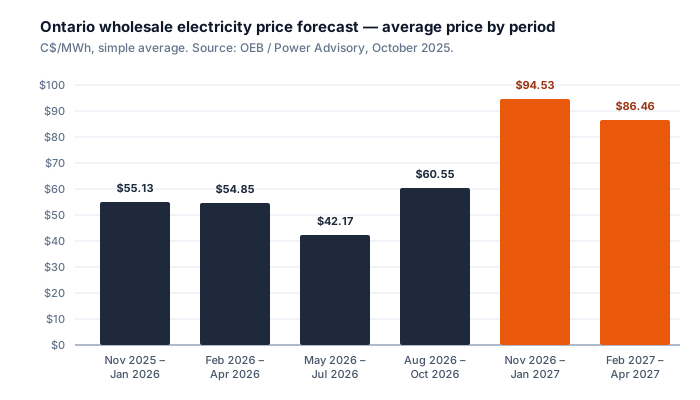
If you watch only the headline 18-month average ($65.56/MWh), you miss the more important signal: the back half of the forecast period is sharply more expensive than the front half. Prices dip in May to July 2026 (when two refurbished nuclear units return to service), then climb steadily, peaking in November 2026 to January 2027. That peak lines up with the Pickering shutdown and the November 1, 2026 rate reset.
Why prices are forecast to rise
The report identifies three primary drivers. Each one matters in a different way.
One. Nuclear refurbishments take low-cost baseload offline
Ontario's nuclear fleet provides roughly half of the province's electricity. Five reactors, the four remaining Pickering units (5 to 8) and Bruce B Unit 5, are scheduled to begin refurbishment at the end of September 2026. The forecast assumes two units that are currently offline (Bruce A Unit 3 and Darlington Unit 4) return to service at the beginning of May 2026, providing temporary relief, but the net effect by late 2026 is a meaningful loss of low-cost baseload generation. When low-cost generation comes off the grid, the marginal price of supply rises, because gas-fired generation, which is more expensive, has to fill the gap.
Two. Carbon pricing on gas generation rises every year
Ontario's gas-fired generators pay an excess emissions charge under the province's Emissions Performance Standards program. The forecast incorporates these charges at the following levels:
- 2025: $95 per tonne of CO2e above benchmark
- 2026: $110 per tonne
- 2027: $125 per tonne
That is a 32% increase in carbon cost on gas generation between 2025 and 2027, and natural gas often sets the marginal price for Ontario electricity in any given hour.
Three. Natural gas prices are forecast to climb
The forecast's effective natural gas price (including emissions charges) rises from $5.43/MMBtu in November 2025 to $7.27/MMBtu in February 2027, a 34% increase. Combined with rising demand (the IESO September 2025 Reliability Outlook projects 2.5% higher demand than the prior year's outlook), this puts further upward pressure on prices.
“Solar and wind generation put downward pressure on Ontario's wholesale electricity prices.”Power Advisory LLC, OEB-commissioned forecast, October 2025
One counterweight the report explicitly flags: Ontario's solar and wind capacity is expected to reach 2,800 MW of solar and 5,500 MW of wind by April 2027, meeting approximately 13% of provincial demand. Even Ontario's own contracted forecast acknowledges, in writing, that more solar on the grid reduces prices for everyone.
Wholesale price isn't your retail rate. But it's the biggest input.
Here is where most articles overstate the case. We won't.
The wholesale Ontario Electricity Market Price (OEMP) is one input into the Regulated Price Plan price you see on your bill. The retail price you pay also includes:
- The Global Adjustment (which funds contracted generation and conservation programs)
- Delivery and regulatory charges (your local distribution company)
- Taxes
- Any provincial rebates currently in effect (e.g., the Ontario Electricity Rebate)
A 71% jump in the wholesale price does not translate directly to a 71% increase on your bill. Historical patterns suggest retail rate changes follow wholesale trends in a smoothed, partial way. Government policy can also change the picture in either direction: rebates can expand, rate freezes can be introduced, programs can be wound down.
What the forecast does tell us, with the OEB's own analysts behind it:
- The largest variable input into your hydro bill is forecast to rise materially.
- The trajectory is up, not flat or down.
- The same number the OEB uses to set future RPP rates is the one we just looked at.
The report itself notes that “by their nature forecasts are uncertain and cannot be guaranteed.” We agree. This is a base case, not a promise. But it is what Ontario's own commissioned analysis projects under current assumptions.
What this means for an Ontario homeowner
Take a typical Ontario household with a $250 monthly hydro bill and roughly 12,000 kWh of annual usage. Their effective rate today is approximately 25 cents per kWh, all-in.
If the wholesale supply portion of that bill rises in line with the forecast's late-2026 trajectory, that homeowner could see annual hydro spend increase by several hundred dollars within the next two years, and compound from there as future RPP cycles factor in the higher costs.
Over 25 years, even a modest 4% annual inflation on a $3,000/year hydro bill compounds to roughly $125,000 in total utility spend. That is not a forecast, it is just compounding math on historical Ontario rate inflation. The OEB report is one signal that 4% may be a conservative assumption for the next two years specifically.
See your numbers in 60 seconds
Use your real hydro bill. We'll show you your custom system size, your effective solar rate in cents per kWh, and your 25-year cost of doing nothing - calculated in front of you, no phone call required.
Open the Solar X Savings Calculator →How solar changes the equation
The structural difference between solar and the utility isn't ideology, it's price formation.
The utility's price is set every six months by a regulator that takes the wholesale forecast (the one we just walked through) as an input. The price you pay reflects supply costs, distribution costs, regulatory decisions, carbon costs, and global adjustments. Almost every input on that list is forecast to rise over the next two years.
A residential solar system is a different kind of asset. You pay the install cost once. The system produces electricity for approximately 25 years. If you divide the install cost (net of any rebate you may qualify for, such as the Ontario Home Renovation Savings program) by the lifetime production in kWh, you get your effective solar rate, and that rate doesn't change with carbon policy, nuclear refurbishments, or natural gas prices.
For most Ontario homes, the math currently works out to a solar rate in the range of single-digit cents per kWh, fixed for the system's 25-year life.
An important note on the HRS program
Eligible Ontario homeowners may qualify for up to $10,000 in rebates through the Home Renovation Savings program. Eligibility is determined by the Government of Ontario under the official program rules and is assessed during your proposal. Solar X does not pre-approve eligibility - we assess your file against the current program criteria as part of the design stage.
We won't tell you what your specific solar rate is here. That depends on your roof, your usage, your eligibility under the HRS program, and a dozen other variables. But our savings calculator does the math in 60 seconds using your real bill. For deeper context on how usage data improves sizing accuracy, see our Green Button data guide.
What you can do today
- 1
Pull your last 12 months of hydro bills
Add them up. Note the total kWh and the total dollars. That gives you your real, all-in rate per kWh today, the baseline for any comparison.
- 2
Calculate your solar rate
Use our free Solar X Savings Calculator. It uses the exact same Ontario sizing formula a Solar X advisor would use in your kitchen.
- 3
Get a personalized proposal
If the numbers look good, an advisor will assess your home, confirm HRS eligibility under current program rules, and send you a detailed proposal, typically within one business day.
There's no obligation, and no high-pressure sales call unless you want one. We'd rather you say no today than cancel after we've started the work.
Run your real numbers against the forecast
Pull your last hydro bill, open the Solar X Savings Calculator, and see your effective solar rate, your 25-year savings, and your custom system size - calculated against your actual usage, not an estimate.
Frequently Asked Questions
Why are Ontario electricity prices forecast to rise in 2026 and 2027?+
According to the OEB-commissioned forecast prepared by Power Advisory LLC and published October 17, 2025, three factors are driving the increase: (1) five nuclear units (the four remaining Pickering units and Bruce B Unit 5) begin refurbishment at the end of September 2026, taking low-cost baseload offline; (2) carbon pricing on gas-fired generation rises from $95/tonne in 2025 to $125/tonne in 2027 under Ontario's Emissions Performance Standards program; and (3) natural gas prices and Ontario electricity demand are both trending upward.
How much are Ontario wholesale electricity prices forecast to rise?+
Average wholesale prices are forecast to rise approximately 71%, from about $55/MWh in late 2025 to about $94/MWh in late 2026. On-peak prices rise approximately 64%, from $66.22/MWh to $108.83/MWh over the same period. The 18-month average across the full forecast period (November 2025 to April 2027) is $65.56/MWh.
What is the OEB rate forecast and where can I read it?+
The Ontario Energy Board commissions an independent forecast of wholesale electricity prices twice a year to inform Regulated Price Plan (RPP) rate-setting. The most recent forecast was prepared by Power Advisory LLC, covers November 1, 2025 to April 30, 2027, and was published on October 17, 2025. You can read it on the OEB's Regulated Price Plan page, which always links to the latest forecast and the source PDF.
Does a 71% increase in wholesale prices mean my hydro bill goes up 71%?+
No. Wholesale prices are the largest variable input into the Regulated Price Plan, but your retail bill also includes the Global Adjustment, delivery and regulatory charges, taxes, and any provincial rebates currently in effect. Historical patterns suggest retail rate changes follow wholesale trends in a smoothed, partial way. Government policy can change the picture in either direction.
When are Ontario electricity prices forecast to be highest?+
The peak in the forecast period falls in November 2026 to January 2027, with an on-peak wholesale price of $108.83/MWh and an off-peak price of $82.54/MWh. This coincides with five nuclear units having begun refurbishment in late September 2026 and the 2027 carbon price of $125/tonne taking effect on gas-fired generation.
Can Ontario homeowners lock in their electricity rate?+
The Regulated Price Plan resets every six months based on OEB methodology, so the rate paid through the utility cannot be locked. A residential solar system functions differently. The install cost is paid once, and the system produces electricity for approximately 25 years. Dividing the net install cost by lifetime production gives an effective solar rate that does not change with carbon policy, nuclear refurbishments, or natural gas prices.
Does residential solar make sense in Ontario right now?+
For most Ontario homes, the math currently works out to a solar rate in the range of single-digit cents per kWh, fixed for the system's 25-year life. Eligibility for the Ontario Home Renovation Savings program (up to $10,000 in combined rebates for solar and battery) is determined by the Government of Ontario under the official program rules. Whether solar makes sense for your specific home depends on roof orientation, usage profile, and HRS eligibility, which is assessed during the proposal stage.
What is the Ontario Home Renovation Savings (HRS) program?+
The Home Renovation Savings program is a Government of Ontario rebate program that may provide eligible homeowners with up to $10,000 in combined rebates for solar panels and battery storage. Eligibility is determined by the Government of Ontario under the official program rules. Solar X does not pre-approve eligibility - we assess your file against the current program criteria as part of the design stage.
Is the OEB forecast guaranteed?+
No. The report itself states that 'by their nature forecasts are uncertain and cannot be guaranteed.' It is a base case prepared under current assumptions about nuclear refurbishment schedules, carbon pricing, natural gas prices, and demand. Government policy decisions, including rebates, rate freezes, or program changes, can shift the picture in either direction.
Does solar reduce wholesale electricity prices for everyone?+
Yes, according to the OEB-commissioned forecast. The report explicitly states that 'solar and wind generation put downward pressure on Ontario's wholesale electricity prices.' Ontario's solar and wind capacity is expected to reach 2,800 MW of solar and 5,500 MW of wind by April 2027, meeting approximately 13% of provincial demand.
Contact Solar X
Solar X
- 1-833-376-5279
- solar-x.ca/contact
- 955 Bay Street, Suite 2307, Toronto, ON M5S 0C6
- ESA/ECRA Licensed Electrical Contractor - Licence 7017538
About the author
Solar X Engineering Team. Solar X is a Canadian-owned residential and commercial solar company operating primarily in Ontario, founded by Bilal Jarmakani (Clean50 honouree). We are an ESA-licensed electrical contractor (Licence 7017538) and a Tesla Powerwall Certified Installer, with sales, design, and installation handled in-house. Reach the team at info@solar-x.ca or 1-833-376-5279.
Related resources
- Green Button Data Ontario - share your real usage in under 5 minutes for accurate system sizing
- Choosing a Solar Installer in Ontario (2026) - six red flags to check before signing
- Ontario Solar + Battery Complete Financing Guide 2026
- Home Battery Storage Ontario 2026 - complete buyer's guide
- Is Solar Power Worth It in Canada in 2026?
- Ontario Electricity Rates Explained: TOU vs Tiered vs ULO
- Solar X Savings Calculator
Sources and further reading
- Ontario Energy Board - Regulated Price Plan (canonical hub page)
- Power Advisory LLC - Ontario Wholesale Electricity Market Price Forecast (Nov 2025 - Apr 2027), prepared for the OEB, October 17, 2025 (direct PDF)
- OEB News Release - changes to electricity prices for households, small businesses and farms (October 17, 2025)
- Ontario Energy Board - Regulated Price Plan and electricity rates
- IESO - Reliability Outlook
- IESO - Annual Planning Outlook
- Government of Ontario - Emissions Performance Standards program
- Government of Ontario - Home Renovation Savings program
- Electrical Safety Authority - licensed contractor verification
Disclaimer. The figures, forecasts, and analyses in this article are drawn from publicly available reports, including the OEB-commissioned forecast prepared by Power Advisory LLC and IESO planning documents. Forecasts are inherently uncertain and can change based on market conditions, regulatory decisions, and government policy. Nothing in this article is a quote, a contract, or a guarantee of future utility rates. Solar X does not determine eligibility for the Home Renovation Savings program - applications are reviewed under the official program rules administered by the Government of Ontario. Reviewed for compliance with cited primary sources and Solar X editorial standards. Published May 12, 2026. Last updated May 14, 2026. We update this article when new OEB forecasts are released.