
Written and reviewed by the Solar X Engineering Team. ESA/ECRA Licensed Electrical Contractor, Licence 7017538. 10,000+ solar and battery installations, 118 MW installed across Canada. Last verified against Tesla's published Powerwall 3 Heat Mode white paper and the sources listed at the end of this guide.
We get this question on assessments all winter, and the confusion behind it is costing people the best battery placement on their house. So let us clear it up properly.
What the minus 20 on the warranty actually means
Here is the part nobody explains. You look at a battery spec sheet and it says operating temperature minus 20 C. You live somewhere that hits minus 25 a few nights every winter. So you figure the battery cannot live outside, and you squeeze it into the basement instead.
Wrong conclusion. Here is why.
That minus 20 is not the temperature of the battery. It is the temperature of the air around the battery that the whole unit is built to handle, with everything inside it working. The part that actually cares about cold, the battery cell, lives in its own managed climate inside the box.
Think about what sits between a January night and the actual cells. On the outside you have the cover, a sealed weather rated enclosure. Inside that you have the skeleton of the battery, the structure holding everything together. And wrapped around the cells themselves you have heaters, real heating elements in direct contact with each individual cell. Several layers between the outside world and the thing that matters, with a heater working the whole time.
So the cold has to fight through all of that before it ever touches a cell. That is why the number on the warranty is not the wall people think it is.
One thing before we go further. This applies to heated batteries, the ones with heating elements built around the cells. The minus 20 outdoor rating is the standard for batteries with a heater inside. A battery without a heater is indoor equipment, full stop, and plenty of batteries on the market do not have one.
The number that actually matters is zero
Now the part almost nobody knows. The real chemistry limit is not minus 20. It is zero, and it applies at the cell.
Every lithium battery on the market has the same rule, every brand, LFP included. Below about 10 C at the cell, charging slows down. Below 0 C at the cell, charging stops completely, because pushing charge into a frozen lithium cell wrecks it permanently. Discharging handles cold a bit better, but it drops off too.
This is universal. The differences between brands move the edges of that window, not the window itself. So the real question when you compare batteries is not whether cold limits them. Cold limits all of them. The question is what the battery does about it.
Most batteries do nothing. They sit there and wait for the cell to warm up on its own. The ones built for our climate heat themselves.
How the heater does it, with Tesla's own numbers
Tesla published a white paper on this feature, called Heat Mode, so we can show you exactly how it works instead of asking you to take our word for it.
Every cell in a Powerwall 3 carries its own heating element, in direct contact with the cell. When the air outside drops below 0 C, the system holds the internal cell temperature at 0 C so the battery can keep discharging to your house, and it heats the cells further when it knows solar charging is coming, at about 6.7 C per hour. It runs itself. No setup, no switch, standard on every unit on current firmware as of August 2026.
Two things from Tesla's own data that matter if you live here:
They proved it in Toronto. The white paper shows a Powerwall 3 site in Toronto holding cell temperature above 0 C through cold days, charging from solar in the morning, running the house at night. Plus fleet data across 100 cold climate sites through a February, with minimum cell temperatures held above freezing.
The heater costs almost nothing. Tesla's figures put it at roughly 200 watt hours a day even at minus 20 outside. That is about one and a half percent of the battery per day. A rounding error next to what the battery earns shifting your usage off peak rates.
One honest limit. In a long outage with no solar and a nearly empty battery, the heating pauses below a 10 percent state of energy to save what is left for your house. A battery cannot heat itself forever on nothing. That is one of the reasons a backup battery belongs with solar.
So can you put it outside? Yes. Here is how to do it right.
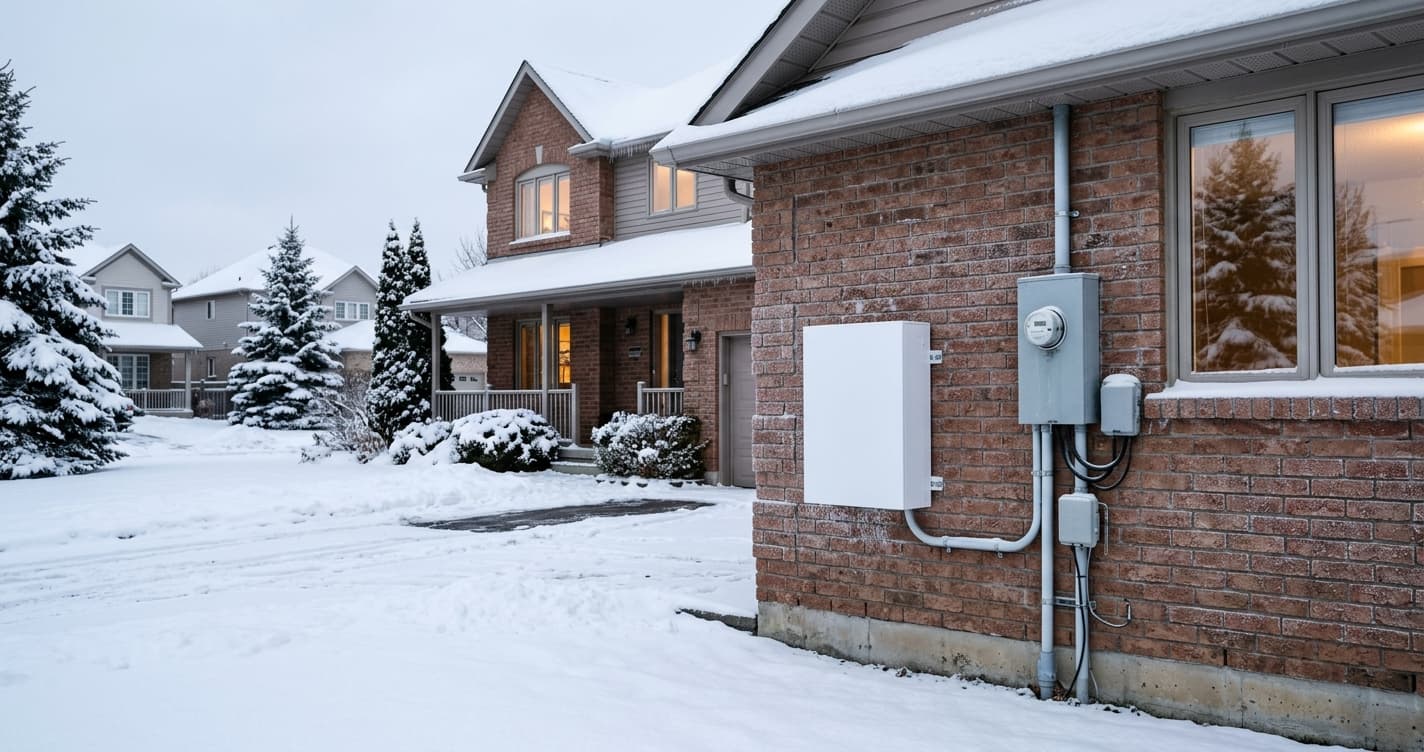
If you have a good spot outside, use it. In Ontario the code actually pushes you that way: an exterior wall or attached garage allows up to 80 kWh of battery, while an indoor room caps you at 20 kWh per system and has to be built to fire safety specs. Sleeping areas are off limits entirely. The full placement rules are in our Ontario battery installation rules guide.
| Factor | Outdoor wall | Garage or indoor room |
|---|---|---|
| Winter cold | The heater manages it within the rated range | The easiest environment the battery can have |
| Ontario code capacity | Up to 80 kWh | 20 kWh per system, fire rated room required |
| Space inside your house | None used | Takes garage or utility room wall |
| Best fit | Most homes, and anything over 20 kWh | Regions with long stretches of sustained deep cold |
Three rules from the field:
Confirm the battery is a heated model before any outdoor quote. Not every battery has cell heating. If the spec sheet does not show active heating, the unit belongs indoors no matter what the outdoor rating claims or what a salesperson says.
Pick a wall out of the wind. Wind does not make the air colder than it is, but it strips heat off the enclosure faster, which makes the heater work harder for the same result. A spot sheltered from the prevailing wind is the better spot. If you have a corner with no wind at all, even better.
If your area sees long sustained stretches colder than the rated range, use the garage. Not overnight dips, sustained cold. The spec sheet range is what the warranty stands on, so we design inside it. Simple.
What winter actually costs you
Straight answer, because it is not zero:
- Heater energy. Around 200 watt hours a day in deep cold. Small, but real.
- Winter solar. December days are short. A winter smart design sizes the battery to bridge the long nights on your essential loads and treats solar recharge as a bonus.
- Lifespan, nothing. The heater exists precisely to prevent the cold charging damage that kills batteries. A battery installed to spec and managed by its own thermal system is doing exactly what it was engineered for.
What winter does not do is make outdoor installation a mistake. The heated batteries sold for this market were rated, heated and fleet tested for this exact climate. People are leaving the best placement on their house unused because of a number they misread on a warranty.
For sizing and cost, see our complete home battery backup guide for Canada, the Tesla Powerwall 3 cost breakdown for Ontario, and our comparison of the six home batteries we install in Ontario.
Frequently asked questions
Can a home battery be installed outside in Canada?
Yes, if the battery is a heated model. Heated home batteries are rated down to minus 20 C ambient because internal heaters keep the cells near 0 C, while batteries without active heating belong indoors. In Ontario, exterior wall installation is permitted by the Electrical Safety Code and allows larger systems than indoor rooms. Respect the manufacturer's published range and local code.
Does the minus 20 rating mean the battery dies below minus 20?
No. Minus 20 C is the ambient air rating the manufacturer designed and warranties the complete unit for, with its enclosure and heaters working. The chemistry limit that matters is 0 C at the cell, and the heating system exists to hold cells above that line. For regions with sustained cold beyond the rated range, garage installation is the design answer.
Why do lithium batteries stop charging in the cold?
Charging a lithium cell below 0 C cell temperature causes permanent internal damage, so every reputable battery blocks charging below that point and slows it below roughly 10 C. This applies to all brands and chemistries including LFP. Batteries built for cold climates add cell heaters so charging stays available through winter instead of waiting for cells to warm on their own.
How much energy does the battery heater use?
Tesla's published figures for Powerwall 3 Heat Mode put consumption at roughly 200 watt hours per day even at minus 20 C ambient, about one and a half percent of the battery's capacity. The heater runs automatically and predicts when warmth is needed. In an extended outage, heating pauses below a 10 percent state of energy to preserve power for the home.
Is it better to install the battery in the garage?
A garage gives the battery the mildest environment and is the right call in regions with sustained deep cold. In Ontario, however, indoor rooms are limited to 20 kWh per system while an exterior wall or attached garage allows up to 80 kWh, so larger systems often belong outside or in the garage by code. A site assessment weighs code, wind exposure and your coldest weeks.
Sources
- Tesla, Powerwall 3 Heat Mode white paper: energylibrary.tesla.com
- Electrical Safety Authority, contractor and installation requirements: esasafe.com
- Solar X, Where Can You Install a Home Battery in Ontario, verified against ESA Bulletin 64-8-2 and Rule 64-1100: solar-x.ca