
Written and reviewed by the Solar X Engineering Team. ESA/ECRA Licensed Electrical Contractor, Licence 7017538. 10,000+ solar and battery installations, 118 MW installed across Canada. Last verified against the sources listed at the end of this guide.
This guide covers how battery backup works in Canadian homes, whole home versus essential loads coverage, realistic runtimes, typical installed costs, winter performance, and where rebates fit.
What is home battery backup and how does it work?
A home battery backup system is a stationary battery, wired into your electrical panel by a licensed electrical contractor, that detects a grid outage and takes over your home's power supply in a fraction of a second.
The switch is automatic. When the grid fails, a transfer device isolates your home from the utility lines and the battery begins supplying your circuits. Lights stay on, the fridge keeps running, and the internet stays up. When grid power returns, the system reconnects and recharges on its own.
Most systems installed in Canada today use lithium batteries in the 10 to 20 kWh range. Two things determine what a system can do for you:
kW is power. It measures how much the battery can deliver at once, which decides how many appliances can run at the same time.
kWh is energy. It measures how much the battery holds, which decides how long those appliances can run.
A battery can also be charged by rooftop solar. During a daytime outage, solar recharges the battery while it runs the house, which can extend essential coverage from hours into days. Standard grid tied solar without a battery shuts down during an outage for line worker safety, so the battery is what turns solar into backup power.
Whole home backup vs essential loads: which do you need?
This is the first design decision, and it drives cost more than any other choice.
Whole home backup connects the battery at your service entrance so it can power the entire electrical panel. Whether one battery can do this is a power question: a modern high output unit delivering more than 11 kW continuous can run a typical home's loads at once, including high surge appliances. Capacity then decides how long that lasts, so whole home designs often add units for duration rather than coverage. Everything works during an outage, and nothing needs to be rewired.
Essential loads backup moves your chosen circuits to a backup subpanel. During an outage, only those circuits stay live: typically the fridge, freezer, furnace fan or heat pump controls, sump pump, well pump, internet, and a few lights and outlets.
| Factor | Whole home backup | Essential loads backup |
|---|---|---|
| What stays on | Everything | The circuits you pick |
| Typical battery capacity | 13.5 kWh and up, more units for longer duration | 10 to 20 kWh |
| Electrical work | Connects at the service entrance | Backup subpanel added |
| Relative cost | Highest | Lower |
| Best for | Homes with electric heat, medical equipment, or well pumps that want zero disruption | Most homes managing a budget |
Most Canadian homes land on essential loads backup first, because it covers the outages that actually matter at a fraction of the capacity. Whole home coverage makes sense when the house depends on high draw loads that cannot pause, or when you simply do not want to think about it.
How long can a home battery power a house?
It depends on the battery's usable capacity and what you ask it to run. The figures below are estimates for a single 13.5 kWh usable battery, a common size for home batteries installed in Canada, assuming no solar recharge.
| What is running | Estimated average draw | Estimated runtime |
|---|---|---|
| Essentials only: fridge, freezer, lights, internet, furnace fan | About 0.5 kW | Roughly 24 hours or more |
| Essentials plus normal living: cooking, TV, laundry in bursts | About 1 kW | Roughly 12 hours |
| Heavy loads: electric heating or central air running steadily | 2 to 3 kW | Roughly 4 to 6 hours |
These are planning estimates, not promises. Real runtime depends on your appliances, the season, and how you behave during the outage. Two batteries double the numbers. Rooftop solar changes the picture entirely: in daylight, solar can run the essentials and recharge the battery at the same time, which is how battery homes ride out multi day outages.
The honest limit: a battery alone, without solar, is built for the outages Canadians actually experience most, which are measured in hours, not weeks. For very long rural outages, see the generator comparison below.
What does home battery backup cost in Canada?
As a typical range in 2026, a professionally installed home battery backup system in Canada runs roughly $15,000 to $24,000 before incentives for a 13 to 15 kWh class system, including the battery, backup switching equipment, electrical work, and permits. That range spans the systems Solar X currently installs: a Tesla Powerwall 3 lands at $19,000 to $24,000 installed in Ontario, and comparable systems from other manufacturers start lower. Multi unit whole home configurations cost more.
That range assumes straightforward electrical work. The variables that move the price:
- Capacity. More kWh costs more. This is the biggest lever.
- Backup scope. Whole home switching equipment costs more than a backup subpanel.
- Your electrical service. An older panel or limited service capacity can require upgrades before a battery can be connected.
- Installation location. The battery must be installed in a location that meets your provincial electrical code and the manufacturer's requirements, which on some houses is simple and on others is not.
Final pricing is always subject to a site assessment, because the electrical details of the specific house decide the scope of work. Anyone quoting a firm number before seeing your panel and your loads is guessing. For a full component level breakdown, see our Tesla Powerwall 3 cost guide for Ontario, and to weigh systems against each other, compare home batteries available in Ontario.
Battery backup or a generator?
The short version: a battery switches over instantly, runs silently, needs no fuel, and earns savings on your electricity bill every day the grid is up. A generator has a lower upfront cost for very long runtimes but needs fuel, maintenance, and tolerance for noise, and it does nothing for you the other 360 days a year.
For most Canadian homes with typical outage patterns, the battery wins. For rural properties on long distribution lines where multi day outages are routine, a battery as the primary system with a generator as the deep reserve is a legitimate design. The full cost breakdown over five and ten years is in our generator versus battery comparison.
Does battery backup work in a Canadian winter?
Yes, with two design considerations that a competent installer handles for you.
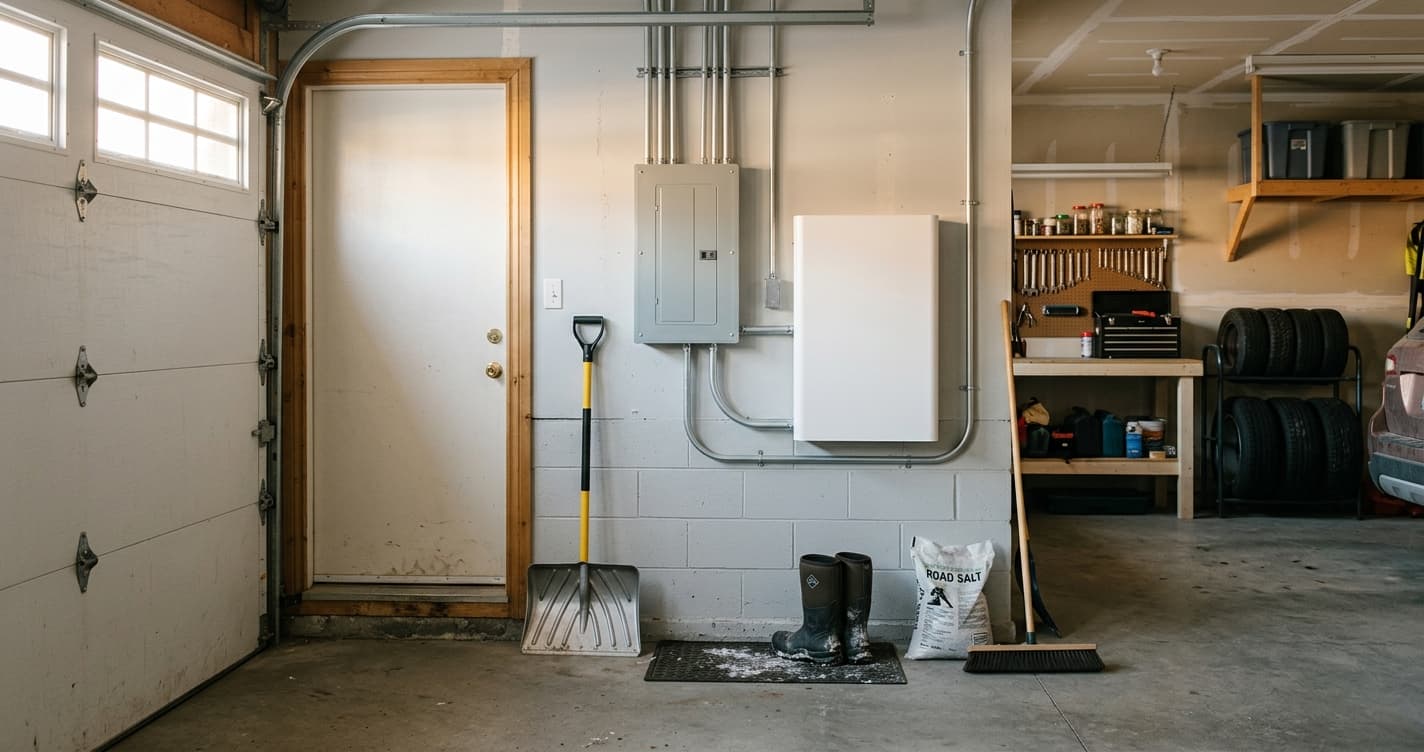
Placement. Lithium batteries have manufacturer specified operating temperature ranges, and provincial electrical codes restrict where a home battery can be installed. In cold provinces that typically means a garage, a dedicated utility room, or cold rated equipment on a sheltered exterior wall. The right location is a code and specification question, not a guess.
Winter solar recharge. If your battery pairs with solar, December days are short and generation is lower. Winter focused designs size the battery so essentials can bridge the longer nights, and treat solar recharge as a bonus rather than the plan.
Cold is also the reason battery backup matters most here. The outages that hurt in Canada are the winter ones, when a house without heat becomes unlivable in hours. A battery that keeps the furnace fan, controls, and sump pump running through an ice storm is doing exactly the job it was sized for.
What rebates and programs can help?
Battery incentives in Canada are provincial, they change, and eligibility rules decide everything. Two points apply nationally:
First, programs typically require pre approval before you purchase or install anything, so the application comes before the contract, not after.
Second, in Ontario, the Home Renovation Savings Program offers rebates for solar and battery systems installed in a no export configuration, which is a different path from net metering, and the two do not stack. Which path pays better depends on your usage. Our Ontario battery sizing and rebate guide walks through the choice with current figures.
Program details for the province you live in belong in a conversation with current numbers, not in a national guide that could age. Wherever you are, verify the program's own page before signing anything, and treat any installer who guarantees a rebate with caution. Approval always belongs to the program, not the contractor.
How Solar X designs a backup system
Solar X Canada is an ESA/ECRA licensed electrical contractor (Licence 7017538) headquartered in Toronto, installing residential and commercial solar and battery storage in Ontario, Alberta, Nova Scotia and New Brunswick. Since 2018 the company has completed more than 10,000 solar and battery installations totalling 118 MW, and is a certified installer on both major battery platforms operating in Ontario.
A backup design starts with your loads, not with a product. The process: identify what must stay on during an outage, measure what those circuits actually draw, then size the battery and the switching scheme around that number. Where a homeowner authorises it, Solar X builds the design from the household's actual hourly consumption data rather than an estimate from an annual bill, so the system is sized against what your house really does, including the hours that matter.
The same battery that backs up your house can also cut your bill the rest of the year by shifting your usage away from the most expensive hours on time based rate plans, which is how the system pays for itself between outages. Details on the day to day economics live in the provincial guides linked above, and our battery storage installation service covers how an installation actually proceeds from assessment to commissioning.
Frequently asked questions
Is a home battery backup worth it in Canada?
For most homeowners who experience outages, yes, provided it is sized to your loads. A battery provides instant, silent backup for essential circuits and can also reduce your electricity bill year round by shifting usage on time based rate plans. The economics depend on your province, your rate plan, and your usage, so the answer comes from a load assessment, not a brochure.
How long will a 13.5 kWh battery run a house?
As an estimate, a 13.5 kWh battery runs essential loads such as a fridge, freezer, lights, internet, and furnace fan for roughly 24 hours or more. Heavier use shortens that to a working day or less. Rooftop solar can recharge the battery during a daytime outage, extending essential coverage from hours into days.
Can a battery back up my whole house?
Yes. A whole home configuration connects at your service entrance and can power the entire panel. A modern high output battery delivering more than 11 kW continuous can run a typical home's loads at once, and additional units extend how long that lasts. Most homes choose essential loads backup instead, where a subpanel keeps selected circuits live at a lower cost.
Do home batteries work in winter?
Yes. Lithium home batteries operate within manufacturer specified temperature ranges, and installers place them in code compliant locations such as a garage, utility room, or sheltered exterior wall with cold rated equipment. Winter designs also account for shorter solar days by sizing the battery to bridge long nights on essential loads.
Do I need solar panels for battery backup?
No. A battery can charge from the grid and provide backup on its own. Solar changes two things: it can recharge the battery during a daytime outage, extending coverage from hours into days, and it improves the year round economics. Note that grid tied solar without a battery shuts down during an outage for safety.
What happens when the battery runs out during an outage?
The system shuts down the backed up circuits until power is available again, either from the returning grid or from solar recharge in daylight. Good design prevents this for typical outages by sizing capacity to your essential loads with a reserve. For regions with routine multi day outages, a generator can be added as a deep reserve.
Sources
- Ontario Energy Board, Electricity rates: oeb.ca
- Save on Energy and Enbridge Gas, Home Renovation Savings Program, solar and battery stream: homerenovationsavings.ca