
Generator vs. Battery Backup for Solar Homes: The Complete Canadian Homeowner's Guide (2026)
The full cost breakdown, provincial rebates, rate arbitrage savings, real 10-year numbers, and the expert recommendation — from Canada's certified Powerwall 3 installer.
⚡ Quick Answer
For most Canadian homeowners with solar panels, a battery backup system outperforms a traditional generator on total cost of ownership, daily savings, safety, and long-term value. Batteries eliminate fuel costs, operate silently, qualify for federal and provincial rebates, and earn money every day through energy rate arbitrage — even when the power never goes out.
Bottom line: If you have solar panels, a battery is the smarter investment. If you're in a remote area with multi-day outage risk, a battery-first system with a generator as a secondary backup is the optimal configuration.
Key Takeaways
- Battery storage can save up to $600–$1,500/year in electricity bills via rate arbitrage (depending on usage and rate plan) - every year, not just during outages.
- Generators cost $850–$3,200/year in ongoing fuel and maintenance. Battery maintenance is essentially zero.
- Federal and provincial rebates cover $5,000–$10,000 of a battery system's cost. Generators qualify for nothing.
- Battery outage response: under 20 milliseconds — imperceptible. Generator startup: 10–30 seconds.
- Tesla Powerwall 3 operates down to -20°C, making it viable across every Canadian climate zone.
- Homes with solar + storage sell faster and at a premium vs. comparable homes without storage.
- For rural properties with multi-day outage risk: battery-first + propane generator as backup-to-the-backup.
Why Canadians Are Asking This Question in 2026
Power outages across Canada are becoming more frequent and more severe. Ice storms shut down the grid across Ontario and Quebec. Wildfires knock out transmission lines in BC and Alberta. Coastal storms leave Atlantic homeowners dark for days at a stretch. At the same time, electricity rates have climbed in every province — Ontario's on-peak rate has reached approximately 18¢/kWh, BC Hydro rates increased again in April 2026, and Alberta's deregulated market continues to expose homeowners to price volatility.
Homeowners who installed solar are now asking a logical follow-up question: do I need a generator, a battery, or both?
The answer has shifted decisively toward battery storage. Costs have dropped significantly since 2022. Federal incentive programs have expanded. And the math on daily bill savings — not just outage protection — now makes battery-plus-solar one of the strongest home energy investments available in Canada in 2026.
How Each System Works
Traditional Backup Generator
A standby generator is a combustion engine permanently installed outside your home on a concrete pad, connected to your electrical panel through an automatic transfer switch (ATS). When grid power fails, the ATS detects the outage and starts the generator within 10–30 seconds.
It runs on natural gas, propane, or diesel and can operate continuously as long as fuel is available. Whole-home standby generators range from 11 kW to 22+ kW.
Installation requires a licensed electrician for the transfer switch and, for gas-powered units, a licensed gas fitter. Most provinces require an electrical permit and inspection.
⚠️ What a generator cannot do: earn you a single dollar on the 360+ days per year when the power stays on.
Home Battery Storage System
A home battery system stores electricity in lithium iron phosphate (LFP) cells. In a solar-plus-storage configuration, solar panels charge the battery during the day. The battery can also be charged from the grid during low-rate overnight periods.
When the grid fails, the battery's built-in inverter switches your home to stored power in under 20 milliseconds — fast enough that computers, clocks, and sensitive electronics never register the interruption.
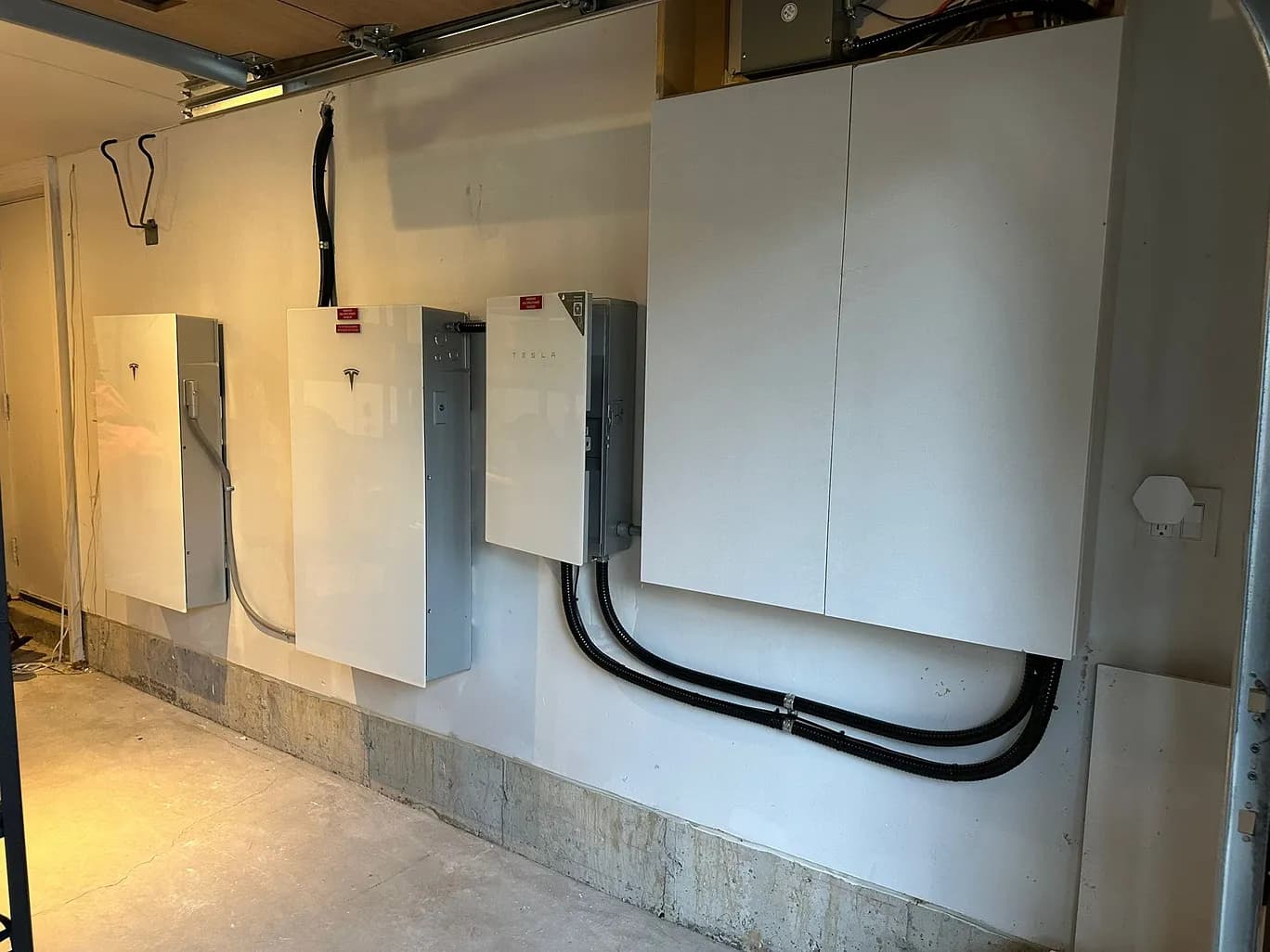
The Tesla Powerwall 3 — Canada's benchmark — delivers 13.5 kWh of usable capacity and 11.5 kW of continuous power output with 97.5% round-trip efficiency. It operates down to -20°C.
✅ What makes batteries different: they work for you every single day — not just during outages.
Side-by-Side Comparison: 12 Factors (2026 Data)
All figures reflect Canadian market conditions as of Q1 2026, after available federal and provincial incentives.
| Factor | Traditional Generator | Battery + Solar (e.g., Powerwall 3) |
|---|---|---|
| Upfront Cost (installed) | $6,000–$16,000 | $15,000–$23,000 |
| Federal/Provincial Rebates | None | $5,000–$10,000 depending on province |
| Net Cost After Incentives | $6,000–$16,000 | $9,000–$18,000 |
| Annual Fuel Cost | $600–$2,500/year | $0 with solar recharging |
| Annual Maintenance | $250–$700/year | Minimal — software updates only |
| Noise Level | 65–75 dB (lawnmower) | 0 dB — completely silent |
| Outage Startup Time | 10–30 seconds (gap in power) | Under 20 ms — seamless |
| Daily Bill Savings (no outage) | $0 | $600–$1,500/year via rate arbitrage |
| Carbon Emissions | High — combustion running | Zero local emissions (solar-charged) |
| Permit Required | Yes — electrician + gas fitter | Yes — licensed electrician + authority |
| System Lifespan | 10–20 years with maintenance | 10,000+ cycles (15+ year effective life) |
| Resale Value Impact | Minimal | Increases home value — buyers pay premium |
Overall winner for solar homeowners: Battery storage wins on total cost of ownership in virtually every Canadian urban and suburban scenario. The generator wins in one specific scenario: multi-day rural outages exceeding 4–5 days with no solar recharge opportunity.
Real Cost Breakdown: What You Actually Pay in 2026
Generator: True 10-Year Cost
| Cost Item | Low | High |
|---|---|---|
| Installation (unit + ATS + pad + gas) | $6,000 | $16,000 |
| Annual Fuel (×10 years) | $6,000 | $15,000 |
| Annual Service (×10 years) | $2,500 | $7,000 |
| Rebates Available | $0 | $0 |
| Bill Savings (10 years) | $0 | $0 |
| Total 10-Year Cost | ~$14,500 | ~$38,000 |
Battery + Solar: True 10-Year Cost
| Cost Item | Amount |
|---|---|
| Tesla Powerwall 3 Installed | $15,000–$19,000 |
| Ontario HRS / BC Hydro Rebate | –$5,000 |
| Provincial Incentives | –$1,000 to –$5,000 |
| Net Cost After Incentives | $9,000–$18,000 |
| 10-Year Bill Savings | $6,000–$15,000 |
| Effective 10-Year Net Cost | $0 to $12,000 (often net positive) |
The generator costs money every year regardless of how often the grid fails. The battery earns money every year — even when the grid never goes down.
The Battery Advantage Most Homeowners Miss: Daily Bill Savings
A backup battery paired with solar is not just an insurance policy. It is a revenue-generating asset that reduces your electricity bill every single day of the year — even on days the grid never blinks.
How Rate Arbitrage Works
Every Canadian province with time-of-use or tiered electricity pricing creates an opportunity. Electricity costs significantly more during peak demand hours than overnight. A battery system charges during cheap periods — overnight, or from solar panels during the day — and discharges during expensive periods, effectively replacing costly grid electricity with electricity you generated or stored for a fraction of the price.
2026 Rate Spreads by Province
| Province | Off-Peak / Overnight Rate | On-Peak Rate | Effective Spread |
|---|---|---|---|
| Ontario (TOU) | 9.8¢/kWh | 20.3¢/kWh | ~10.5¢/kWh |
| Ontario (ULO overnight) | 3.9¢/kWh | 39.1¢/kWh | ~35.2¢/kWh |
| BC Hydro (Step 1 vs Step 2) | 10.3¢/kWh | 15.4¢/kWh | ~5.1¢/kWh |
| Alberta (avg spot vs peak) | 6–8¢/kWh | 14–22¢/kWh | ~8–14¢/kWh |
| Nova Scotia (off-peak) | 12¢/kWh | 18¢/kWh | ~6¢/kWh |
A 13.5 kWh Powerwall 3 cycling daily in Ontario on the Ultra-Low Overnight rate saves roughly $1,000–$1,300/year in bill reductions alone — before counting a single minute of outage protection. Over a 10-year system life, that is $10,000–$13,000 in electricity savings from a device that also protects your home from outages, powers your EV overnight, and qualifies for thousands in rebates.
A generator produces exactly $0 on those same days.
Provincial Rebates and Incentives Available in 2026
Incentive programs change frequently. Verify current program status with your installer before making purchasing decisions.
| Province | Program | Maximum Benefit |
|---|---|---|
| BC | BC Hydro Battery Storage Rebate (from April 2026) | Up to $5,000 |
| Ontario | Home Renovation Savings Program (battery storage) | Up to $5,000 |
| Quebec | Hydro-Québec residential energy programs | Varies by program |
| Alberta | Municipal and utility rebates (varies by utility) | $500–$3,000 |
| Nova Scotia | Efficiency Nova Scotia solar rebates | Up to $3,000 |
Generators qualify for none of the above programs. This alone shifts the net cost comparison significantly in favour of battery storage for any homeowner in a rebate-eligible province.
When a Generator Still Makes Sense
Battery storage is the right primary choice for most Canadian solar homeowners in 2026. But generators are not obsolete — there are specific situations where they remain the right tool or a valuable addition.
Remote and Rural Properties
Homeowners in rural areas — particularly those on long distribution lines far from utility substations — face a different risk profile than urban or suburban households. Outages caused by downed lines in remote areas can last 4–7 days or longer. A 13.5 kWh battery without solar recharge will deplete within 12–24 hours under typical household load. For these homeowners, the optimal configuration is battery as the primary system — for seamless, silent, daily outage coverage — and a propane standby generator as the backup-to-the-backup for events exceeding 3–4 days.
Very High Whole-Home Load Requirements
Homes running central air conditioning, EV charging, a heat pump, and a well pump simultaneously can approach or exceed a single battery's continuous output during a whole-home outage. The solution is either a second Powerwall 3 (doubling both capacity and output) or a properly integrated generator-plus-battery hybrid system. A qualified installer will assess your peak load requirements during system design.
Budget-Constrained Phased Approach
Some homeowners cannot absorb the full upfront cost of a solar-plus-storage system, even after rebates. A temporary generator bridges the gap while the household saves toward a battery system. If this is your situation, select a generator rated at 20 kW or higher to avoid undersizing issues when the battery is eventually added.
Electrical Code and Permit Requirements: What Both Systems Need
In every Canadian province, both generator and battery installations are regulated by the local electrical authority. Non-compliant installations can void home insurance, create liability exposure on property sale, and result in failed inspections.
Generator Requirements
- Licensed electrical contractor must install the ATS
- Licensed gas fitter required for natural gas or propane connections
- Electrical permit and inspection required in all provinces
- Concrete pad and adequate clearances from structure required
Battery Storage Requirements
- All equipment must be certified to Canadian Standards (CSA/UL listed)
- Licensed electrical contractor must perform installation
- Electrical permit and inspection required (ESA in Ontario, Technical Safety BC, TSASK in Saskatchewan, etc.)
- Solar-plus-storage systems must comply with local utility interconnection and net metering rules
⚠️ Both systems require permits. Anyone offering to install either without pulling a permit is creating liability you will carry — not them.
Frequently Asked Questions
How long can a home battery power my house during an outage?
A Tesla Powerwall 3 (13.5 kWh) running essential circuits — fridge, lights, sump pump, internet — typically lasts 1.5 to 2.5 days without solar recharging. On a clear day, your solar array recharges the battery and extends coverage indefinitely. Running the whole home including A/C and electric heat reduces that window significantly.
Can I use a generator with a battery system?
Yes, but integration varies by battery brand. The Tesla Powerwall 3 does not natively charge from a generator input — it requires a properly configured transfer switch to keep the systems separated. Other battery systems, including FranklinWH and Generac PWRcell, offer native generator integration. Discuss your specific requirements with your installer before combining systems.
Do batteries work in Canadian winters?
Yes. Solar panels are actually more efficient in cold temperatures — they perform better at -10°C than at +30°C. The battery itself operates down to -20°C. Winter output is lower due to shorter daylight hours and potential snow cover, but modern systems remain viable year-round across all Canadian climate zones. Steeper panel tilt angles (40–50°) help shed snow and capture low-angle winter sun.
What is the payback period for a battery system in Canada?
With current rebates and electricity rates, most Canadian homeowners see payback periods of 8–12 years on a battery-only installation and 10–15 years on a full solar-plus-battery system. As electricity rates continue rising — which they have in every province for the past decade — those payback periods shorten. Systems installed today will still be operating in 2040, generating savings against rates that will almost certainly be higher than today's.
Does a battery increase home resale value?
Yes. Canadian real estate data increasingly shows homes with solar-plus-storage sell faster and at a premium compared to equivalent homes without. Buyers purchasing in 2026 are energy-cost aware in a way buyers in 2015 were not. A battery system is now a marketable asset, not a curiosity.
Which is cheaper over 10 years — a generator or a battery?
After federal and provincial rebates ($5,000–$10,000 available for battery storage) and factoring in $850–$3,200/year in ongoing generator fuel and maintenance costs vs. $600–$1,500/year in bill savings from a battery, the battery system's 10-year total cost of ownership is lower for most Canadian urban and suburban homeowners. The generator's lower upfront cost is erased by its ongoing operating costs within 3–5 years.
Which battery brand does Solar X install?
Solar X primarily installs the Tesla Powerwall 3, Canada's most recognized residential battery system. We are a certified Powerwall 3 installer and carry ESA-listed equipment across our full product line. For homeowners requiring generator integration or specific load configurations, we assess alternatives including FranklinWH and other CSA-certified systems.
The Solar X Recommendation
For Canadian homeowners with solar panels:
Choose a battery storage system as your primary backup. It outperforms a generator on cost, convenience, daily financial return, rebate eligibility, safety, and noise. It provides seamless, instant protection the moment the grid fails — and earns you money every day it doesn't.
For rural homeowners or properties in extreme-weather zones:
Battery-first, generator-second. Design your primary system around a Tesla Powerwall 3 or equivalent, and add a properly integrated propane standby generator only for events that exceed your battery's capacity window. This hybrid configuration gives you the best of both technologies without the daily costs and noise of running a generator as your primary backup.
Why Solar X
Local Installation Areas
Solar X installs solar and battery storage systems across Canada. Our installation teams are active in the following regions:
Ontario
Toronto, Mississauga, Brampton, Hamilton, Ottawa, London, Kingston, Barrie, Kitchener-Waterloo, Guelph, Oshawa, Burlington, Oakville, Markham, Richmond Hill, Vaughan, Newmarket, Pickering, Ajax, Whitby, St. Catharines, Niagara Falls, Peterborough, Sudbury, and surrounding areas.
Alberta
Calgary, Edmonton, Red Deer, Lethbridge, Medicine Hat, and surrounding communities.
British Columbia
Greater Vancouver, Surrey, Burnaby, Kelowna, Kamloops, Victoria, and surrounding areas.
Saskatchewan & Manitoba
Saskatoon, Regina, Winnipeg, and surrounding communities.
If your city or town is not listed, contact us — our network continues to expand and we may have a certified installation partner near you.
Ready to Find Out What a Battery System Would Save You?
Book a free home energy assessment. Most assessments are completed within 48 hours. We'll calculate your specific rate arbitrage savings, identify every rebate you qualify for, and give you a transparent, fixed-price quote — no pressure, no surprises.
About This Guide
This article was written by the Solar X energy advisory team. All cost estimates reflect Canadian market conditions as of Q1 2026. Rebate program availability and electricity rates change; verify current figures with your Solar X consultant at time of booking.
Solar X is a licensed Canadian solar installation company specializing in residential and light commercial solar-plus-storage systems with a primary focus on Ontario and expanding national coverage.
Solar X — Modern Solar Solutions · Canada's Premium Residential Solar Installer · CSA/ESA-Listed Equipment · Tesla Powerwall 3 Certified · solar-x.ca