
By the Solar X Team (Solar X Engineering Team, ESA/ECRA Licensed Electrical Contractor, Licence 7017538, NABCEP Certified). Published June 2, 2026.
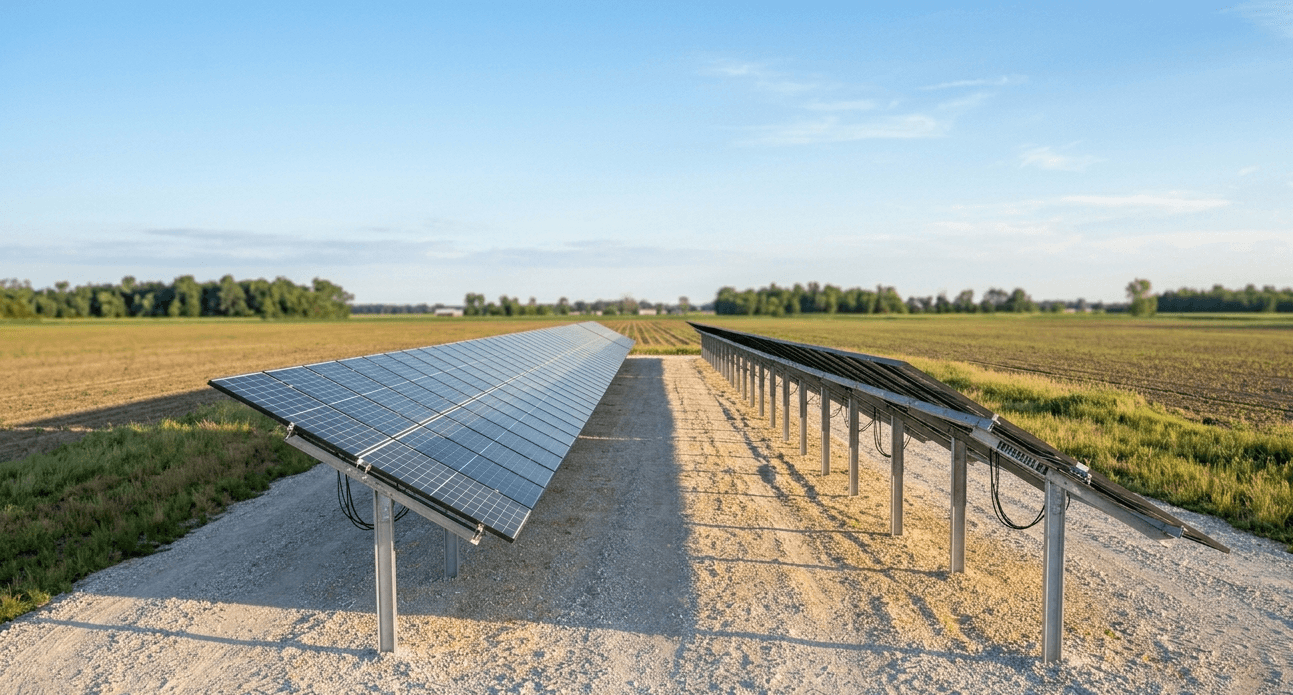
If you have open land, a ground mount solar array often beats a rooftop one. You face the panels exactly where the sun is strongest, you avoid shade from chimneys and dormers, and you leave room to grow the system later. Add bifacial panels, which collect light on both the front and the back, and a well placed ground mount can produce meaningfully more power than a basic one-sided array.
Two questions decide whether it makes sense for your property: how much extra power you will really get, and which Ontario rules apply. Here is the straight version.
Quick answer: Real Ontario bifacial gain is usually 5 to 15 percent over a one-sided panel, with the often-quoted 30 percent only reached over fresh snow or white gravel when panels are raised and spaced. You can net meter a ground mount in Ontario under O. Reg. 541/05, but you cannot get the HRS rebate, which is rooftop only. Placement is set by your municipal zoning bylaws.
If you only remember one thing:
The HRS rebate is rooftop only, and rooftop HRS customers give up net metering. A ground mount owner skips the HRS rebate but keeps full net metering and the 12-month credit rollover. Which path wins depends on your roof, your land, and your usage, and the only honest way to know is to model both.
What Makes Bifacial Ground Mount Solar Different
A standard solar panel is a one-way street. Light hits the front, the cells turn it into power, and anything that misses the front is lost. A bifacial panel has a transparent back, so it also captures light that reflects off whatever sits below and around the array.
That back-side bonus is called bifacial gain, and it lives or dies on one thing: how much light the ground bounces back. Scientists measure this with a number called albedo. Dark grass and bare dirt reflect very little. Snow, light gravel, and white surfaces reflect a lot. According to peer-reviewed modeling aligned with the U.S. National Renewable Energy Laboratory, ground-mounted bifacial gain stays under 10 percent over ordinary ground, and only climbs toward 30 percent when you raise the panels and put a highly reflective surface beneath them.
This is exactly why bifacial panels belong on the ground, not flat on a roof. On a roof the panels sit close together with no reflective gap behind them, so the back stays dark. On a ground mount you can lift them, tilt them, and space them out, which is what turns the back side into real kilowatt-hours.
How Much More Power, Honestly
The marketing number you will see online is 25 to 30 percent. The field number for most installs is lower. Here is what actually drives the gain in Ontario.
| Ground surface | Reflectivity (albedo) | Typical bifacial gain |
|---|---|---|
| Grass or bare soil | Low (about 0.2 to 0.25) | About 5 to 10 percent |
| Light gravel or concrete | Medium (about 0.3 to 0.4) | About 10 to 15 percent |
| Fresh snow or white stone | High (about 0.5 to 0.8) | About 15 to 30 percent |
Two things make Ontario a genuinely good place for bifacial ground mount solar. First, our winters bring snow, and snow is one of the most reflective surfaces there is, so the back-side gain spikes in the exact months a basic panel struggles. Second, open rural land lets you raise and space the array to keep the rear side lit, and you can even lay light-coloured stone under the panels to push reflectivity higher.
Worth separating two different gains here, because they stack. The first is orientation. A ground array faces true south at the ideal tilt, so against a shaded or poorly angled roof you can gain roughly 10 to 25 percent from better aim alone, which we cover in our ground mount versus rooftop comparison. The second is the bifacial rear bonus in the table above. A good ground mount captures both, which is why the combined advantage over a compromised roof can be large even when the bifacial portion on its own is modest.
The honest takeaway: treat 30 percent as the best case, plan around 5 to 15 percent, and let a real site design tell you where your property lands. Anyone promising a flat 30 percent on grass is selling, not measuring.
Can You Net Meter a Ground Mount in Ontario? Yes, and Here Is the Myth to Ignore
You may have read on older blogs that Ontario does not allow ground mount net metering for homes. That was true years ago under a provincial rule called Ontario Regulation 274/18, but that regulation was revoked on July 1, 2021. It is no longer in force, and a lot of solar content online has simply never been updated.
Today, net metering is governed by Ontario Regulation 541/05, administered by your local utility such as Hydro One, Alectra, Elexicon, or Toronto Hydro. Ground mount systems are eligible the same way rooftop systems are. You export surplus power, earn a one-to-one credit on the energy portion of your bill, and credits roll over for 12 months. We explain the mechanics in our net metering in Ontario guide, and the official rules sit on the Ontario Energy Board net metering page.
Because the old provincial siting rule is gone, ground mount placement is now controlled by your municipal zoning bylaws. Each municipality sets its own rules for setbacks, lot coverage, and where an array can sit. Rooftop solar is generally exempt from zoning when it meets the building code, but ground mount and pole mount systems are subject to local zoning bylaws. So a ground mount is a design and permitting project, not an off-the-shelf kit, and the setback you need depends on your town rather than a single province-wide number.
One more current detail: Ontario raised the residential micro-generation cap to 12 kW AC in 2026, which gives grid-tied systems more headroom. We break that down in our 12 kW limit guide.
The HRS Rule That Trips People Up
Ontario homeowners hear a lot about the Home Renovation Savings Program, often called HRS, which puts rebate money toward solar and battery storage. It is a real and useful program, and we cover it in full on our Save ON Energy program page.
The catch:
The HRS rebate is for rooftop solar only. Ground mount and pole mount arrays are not eligible. The program rules require the panels to be on a rooftop, and portable or temporary structures are excluded as well.
There is a tradeoff baked into this that works in a ground mount's favour. The HRS rebate is designed for load displacement, which means the system powers your home directly with no export to the grid, and HRS recipients are not eligible for a net metering agreement. So a rooftop owner who takes the HRS rebate gives up net metering. A ground mount owner skips the HRS rebate but keeps full net metering and the 12-month credit rollover. Which path wins depends on your roof, your land, and your usage, and the only honest way to know is to model both. We do that side by side in our HRS rebate versus net metering breakdown.
So if a salesperson tells you a ground mount will get the HRS rebate, that is wrong, and it is the kind of mistake that blows up at the finish line. We would rather tell you up front. Either way, rebate eligibility is set by the program and the IESO, not by the panel brand or the installer, and no rebate is guaranteed until the program and your utility confirm it in writing.
So Who Is Bifacial Ground Mount Solar Actually For in Ontario?
It is a strong fit when most of these are true:
Open land with southern exposure
You have room to face true south at the ideal tilt and meet your municipality's setback rules.
Your roof is compromised
Shaded, aging, oddly angled, or simply too small for the system size you want.
You want the rear-side bonus
Only a raised, spaced ground array can deliver real bifacial gain. A roof leaves it on the table.
You expect to grow your load
An EV, a heat pump, or farm equipment is on the horizon, and you want headroom to expand.
Rural, farm, estate, and acreage properties are the sweet spot, because space lets you raise and spread the array and even add reflective ground cover for more rear-side gain. We design these across rural Ontario, from horse farms and estates in Caledon to acreage properties in north Pickering. If you are a typical suburban homeowner with a sound, sunny, well-oriented roof, rooftop solar with the HRS rebate may still be the better financial call, and we will tell you so.
Ground Mount Versus Rooftop in Ontario, at a Glance
| Factor | Rooftop solar | Bifacial ground mount |
|---|---|---|
| HRS rebate eligible | Yes | No, rooftop only |
| Net metering eligible | Yes | Yes, under O. Reg. 541/05 |
| Bifacial production bonus | Minimal, panels sit flush | Meaningful, rear side stays lit |
| Placement rules | Zoning exempt when code compliant | Subject to municipal zoning bylaws |
| Best for | Sunny, sound roofs | Open land, shaded or aging roofs, rural and farm |
| Room to expand | Limited by roof area | Strong, limited by land |
What It Costs and What Affects Payback
Pricing depends on system size, racking, trenching distance back to your panel, and site conditions, so treat any single number with caution. For context, typical Ontario residential solar runs in the range of about eighteen thousand to thirty thousand dollars before incentives, and rural ground mount can sit a little higher because of the mounting and trenching work. These are estimates for orientation only, not a quote. Payback on a well designed Ontario system commonly lands in the high single-digit years, and bifacial gain plus avoiding roof shade can shorten it on the right site. Your real figures come from a site-specific design. We walk through utility specifics in our Alectra connection guide.
How Solar X Handles Ground Mount the Right Way
Ground mount is a permitting and engineering project, so the process protects you only if it is done in the correct order:
Confirm net metering and your connection path
with your local utility under O. Reg. 541/05, and check your municipality's zoning bylaw for ground mount setbacks and permitted use, before any design work.
Site and orient the array
to meet local setbacks, then raise and space the bifacial panels on engineered racking for real rear-side gain, with reflective ground cover where it helps.
Design, then permit, then ESA, then utility approval
in that order, before any install date is committed.
Install and connect
with a bidirectional meter for net metering, then commission the monitoring.
Solar X is an ESA and ECRA licensed electrical contractor (Licence 7017538), not a general contractor subcontracting the electrical work, with a NABCEP-certified team and more than 10,000 solar projects completed across Canada. We install both rooftop and ground mount systems, including bifacial panels on engineered racking, and we recommend based on your roof, your land, and your usage, not on what is easiest to sell.
A few honest notes that match how Ontario solar actually works. Permits, ESA inspection, utility interconnection, and rebates are never guaranteed, and no install date is locked until approvals are complete. Rebate programs such as the Home Renovation Savings Program have caps and eligibility rules, and we do not guarantee approval or specific savings. We put the plan in writing so you can see the assumptions for yourself. You can explore our full residential solar offering or our Ontario solar service area.
Frequently Asked Questions
Do bifacial ground mount panels really produce 30 percent more power?
Up to about 30 percent is a ceiling, not a typical result. It needs a highly reflective surface such as fresh snow or white gravel and panels raised and spaced so the back stays lit. Most Ontario ground mount systems gain about 5 to 15 percent over a one-sided panel, with the upper end reached in snowy winter conditions.
Do ground mount solar panels qualify for the HRS rebate in Ontario?
No. The Home Renovation Savings Program requires panels to be installed on a rooftop. Ground mount and pole mount systems are not eligible. The rebate covers rooftop solar and paired battery storage only.
Can you net meter a ground mount solar system in Ontario?
Yes. An older provincial restriction, Ontario Regulation 274/18, was revoked on July 1, 2021. Net metering today is governed by Ontario Regulation 541/05, and ground mount systems are eligible just like rooftop systems. Placement is governed by your municipality's zoning bylaws, and the standard permit, ESA inspection, utility interconnection, and the 12 kW AC residential cap apply. Confirm details with your local utility before designing the system.
Who is bifacial ground mount solar best for in Ontario?
Anyone with open land, good southern exposure, and a roof that is shaded, aging, oddly oriented, or too small. Rural, farm, estate, and acreage properties are an especially strong fit because they have room to raise and spread the array for maximum rear-side gain.
Is ground mount more expensive than rooftop?
Often slightly, because of the mounting structure and trenching back to your panel. The extra production from bifacial gain and ideal orientation can offset that over time, especially on a shaded or poorly angled roof. A site design gives you the real comparison.
Does ground mount solar count toward Ontario's 12 kW residential cap?
Yes. The 12 kW AC micro-embedded generation cap applies to the connection, not the panel mounting method. A ground mount system is treated like any other residential solar install for connection purposes, and going above 12 kW AC pushes the project into a Connection Impact Assessment.
Have Land? Let's See If Ground Mount Beats Rooftop on Your Property
Book a free, no-obligation assessment. We model both rooftop and ground mount, confirm net metering and zoning, and show the numbers side by side before anything is signed.
Sources & References
- 1
- 2
- 3
- 4Save on Energy, Home Renovation Savings Programsaveonenergy.ca
- 5
- 6
- 7
- 8
Related Guides
This article is general information, not engineering or financial advice for a specific property. System design, mounting choice, oversizing, and bifacial gain depend on your roof or land, electrical service, usage, and local utility and municipal rules. Permits, ESA inspection, utility interconnection, and rebate approvals are never guaranteed, and no install timeline is final until approvals are complete. Rebate programs have caps and eligibility rules and may change. Regulation citations (O. Reg. 541/05, O. Reg. 274/18) reflect public information current at the date of publication and should be confirmed against the official Government of Ontario sources before contracting.