
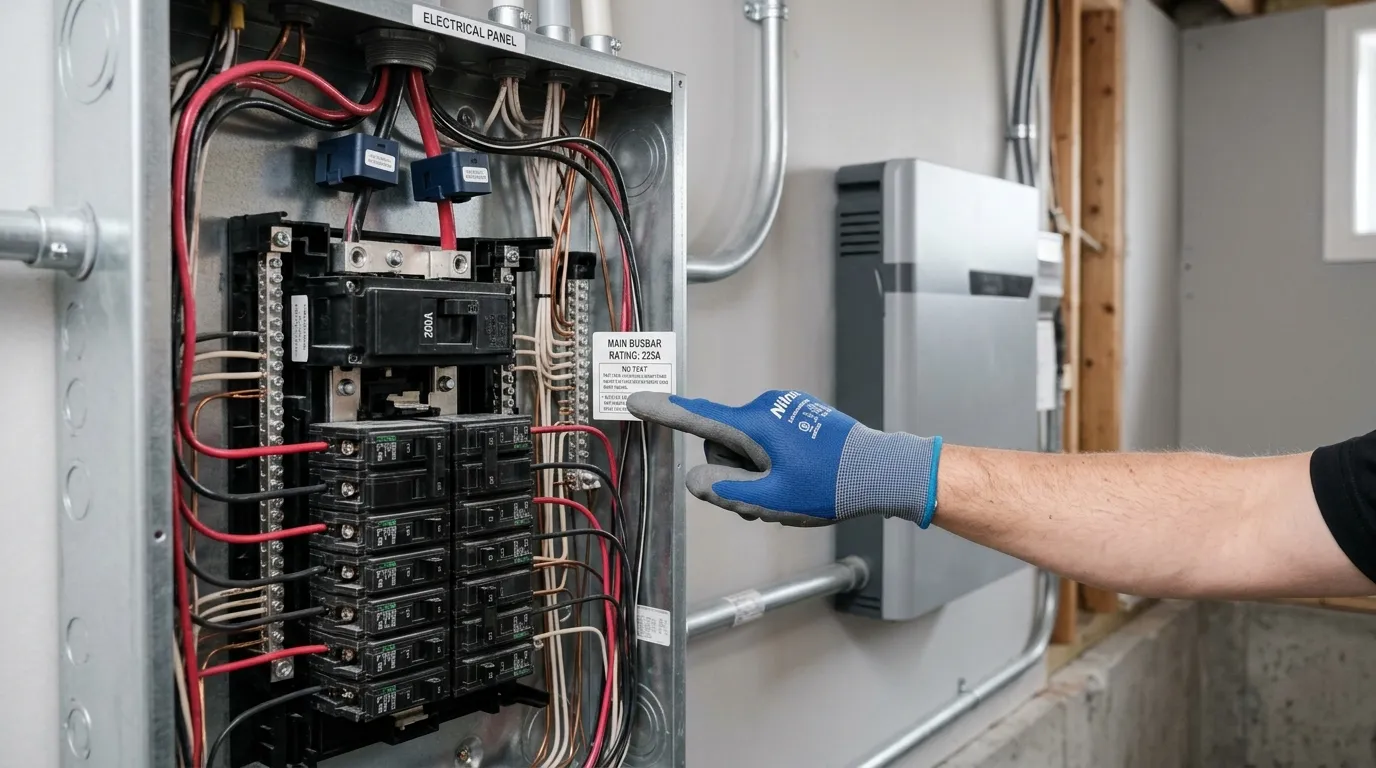
Quick answer: A power control system (PCS) is a certified safety system that uses current sensors to limit how much power your solar panels or battery push into your electrical panel. Because the busbar can never be overloaded, Ontario’s electrical code allows a larger inverter or battery on the panel you already have, often avoiding an expensive main panel upgrade (MPU).
Last checked against ESA Bulletin 64-1-4, the OEB connection procedures and the manufacturer documents listed under Sources. Every home is different, and the final design is confirmed by a site assessment and ESA inspection.
Many Ontario homeowners get a solar or battery quote with a surprise line item: a new main panel or a bigger electrical service. Sometimes that upgrade is truly needed. Often the real issue is a single code limit on the metal bar inside your panel, and a power control system is built to solve exactly that. We are Solar X, a Canadian residential solar and battery installation company serving Ontario homeowners. Below we explain how a PCS works, what the code allows, and when an upgrade is still the better choice.
Why do solar and battery quotes include a panel upgrade?
Every breaker in your panel clips onto a metal bar called the busbar. The busbar has a current rating, commonly 100 A, 200 A or 225 A in Ontario homes, printed on the label inside the panel door.
Normally, power enters the busbar from one place: the main breaker fed by your utility. A solar inverter or a home battery adds a second source, through its own breaker. If the utility and the inverter both fed the bus at full output while the house drew heavy loads, the busbar could carry more current than it was built for. The code therefore limits how much source breaker capacity a panel can take. When a system goes over that limit, a common default answer is a new panel. A power control system is often the smarter alternative.
What is the 125% busbar rule in Ontario?
According to the Electrical Safety Authority’s Bulletin 64-1-4, issued May 2024, Rules 64-112 4) c) and d) of the Ontario Electrical Safety Code allow the breakers feeding a panel to total up to 125% of the busbar rating in dwelling units and 120% in other buildings. The “120% rule” you may read on American solar sites is the United States figure. For Ontario homes, it is 125%.
The simple version: multiply your busbar rating by 1.25 and subtract your main breaker. What is left is the largest solar or battery breaker the panel can take without a workaround. When the breakers add up to more than the busbar rating, the inverter breaker must sit at the opposite end of the busbar from the main, with a warning label so nobody moves it later. ESA also allows designers to use 125% of the inverter’s maximum continuous output current instead of the breaker size, which helps some borderline systems.
How much room does a typical panel have?
| Busbar | Main breaker | Breaker room | Continuous inverter current | Approx. AC output |
|---|---|---|---|---|
| 100 A | 100 A | 25 A | 20 A | about 4.8 kW |
| 200 A | 200 A | 50 A | 40 A | about 9.6 kW |
| 200 A | 175 A (downsized) | 75 A | 60 A | about 14.4 kW |
| 225 A | 200 A | 80 A | 64 A | about 15.4 kW |
Breaker room is the busbar rating times 1.25 minus the main breaker, rounded down to a standard breaker size where needed. Continuous current is the room divided by 1.25. Output assumes 240 V. Based on Rule 64-112 as explained in ESA Bulletin 64-1-4, as of October 2026. Your panel label and the inspector decide the real figure.
Example: a Powerwall 3 on a 200 A panel
Tesla’s Powerwall 3 installation manual lists a default on grid setting of 11.5 kW and 48 A of continuous current on a 60 A breaker. On a 200 A panel with a 200 A main there is only 50 A of room, and even the continuous current method gives 48 A times 1.25, or 60 A. Both are over the limit.
The same manual lists lower settings: 10 kW on a 60 A breaker, 7.6 kW on a 40 A breaker and 5.8 kW on a 30 A breaker. The 7.6 kW setting fits the 50 A of room, but you give up about a third of its continuous output. To keep the full 11.5 kW on the same panel, the usual options are a 175 A main breaker, which leaves 75 A of room if a load calculation shows your home can live with it, or a power control system, where ESA accepts the specific product for busbar protection.
How does a power control system work?
Think of it as a doorman counting people at the door. Current sensors, called current transformers or CTs, clip around the conductors feeding your panel. A certified controller reads them continuously. If the total current on the busbar approaches its limit, the controller tells the inverter or battery to reduce output until the current is back within range.
Because the busbar cannot be overloaded, the 125% breaker limit is no longer the deciding factor. ESA’s bulletin says Rule 64-112 4) e) allows the sum of the breakers to exceed the 120% and 125% limits when such a means is provided, and that this allows any size of connected system at the opposite end of the busbar, as long as the current is monitored and controlled. The bulletin names one acceptable method: “the use of CT’s on each source and an associated control system to throttle the current contribution of the interconnected source.”
What does a PCS installation look like?
- Sensors on the conductors. CTs are installed where the controller can see the current from each source.
- Breaker placement. The inverter breaker goes at the far end of the busbar from the main, with a label warning not to relocate it.
- A programmed limit. The current setting is configured by a qualified installer and recorded on a field label. Tesla’s manual, for example, calls for a PCS field marking label, where required, showing the configured maximum current.
- An inspection. ESA reviews the setup, including whether the specific product carries a certification it accepts.
Was your solar or battery quote tied to a panel upgrade?
Tell us about your panel and the quote you received. We will check the busbar math and explain whether a power control system, a derated inverter or an upgrade fits your home.
Get a Free Solar AssessmentWhat are the two jobs a PCS can do?
The same kind of controller can handle two separate limits, and they are approved by different authorities.
1. Protecting your panel. This is the busbar job described above. It is an electrical safety question, so it falls under the Ontario Electrical Safety Code and ESA inspection.
2. Capping what you export. Your utility limits how much power your system can send to the grid. Ontario’s micro embedded threshold rose from 10 kW to 12 kW, as published in the Ontario Gazette. Under the OEB’s DER Connection Procedures in force since May 1, 2026, a connection is processed as micro embedded when a distributor approved PCS limits export to no more than 12 kW and the system’s nameplate capacity is no more than 24 kW. The PCS technology must be approved by your distributor, and the distributor may take up to 30 days beyond the standard micro embedded timeline to make an offer to connect or give reasons for a refusal. Our article on grid capacity and solar connections in Ontario covers that process in more detail.
Passing one review does not guarantee the other. A system can be approved by ESA for busbar protection and still need your utility’s approval for its export settings.
How does a PCS compare with the other options?
When the 125% math does not work for the system you want, these are the main ways to connect it.
| Option | How it works | Tradeoff |
|---|---|---|
| Power control system | Current sensors and a certified controller throttle the solar or battery output so the busbar is never overloaded | Can keep the full inverter size on the existing panel where ESA accepts the product. Output can be trimmed briefly at peak moments |
| Derate the inverter | The inverter is locked to a lower continuous output, so a smaller breaker fits the panel | No extra hardware, but you give up power you paid for |
| Downsize the main breaker | A 175 A main on a 200 A busbar frees 25 A of room | Low cost, but only works if a load calculation shows the home stays under the smaller main |
| Supply side connection | The inverter connects ahead of the panel, so the busbar rule does not apply | Not limited by the busbar rule, but the service equipment still has to support it, and the work involves the meter base and your utility |
| Main panel upgrade | A new, larger panel or service replaces the existing one | Usually the costliest and slowest path, and it usually needs your utility to disconnect and reconnect the service |
Derated inverters are accepted under ESA Bulletin 64-1-4 when, among other conditions, the setting is locked behind a tool or password, the derated current and power are marked on the inverter, and the limit is documented for the inspector.
A whole home battery is often connected on the supply side, ahead of the busbar, which sidesteps the limit entirely. Our guide to whole home battery backup in Ontario explains how that connection works.
What can a power control system not do?
A PCS protects the busbar. It does not make your electrical service bigger. A home on a 100 A service still has 100 A to run the house, with or without solar. If you are adding an EV charger, a heat pump and a large battery for whole home backup, the size of the service itself may be the real limit, and a controller cannot change that.
It also depends on certified equipment. Power control functions are tested under UL 3141, the safety standard for power control systems, or under the earlier UL 1741 PCS requirements. Tesla, for example, states that Powerwall 3 is certified to UL 1741 PCS for import and export only modes. Before you sign, ask which standard the exact product is certified to and which Canadian certification mark it carries. ESA confirms acceptance on each project.
When is a main panel upgrade still the right answer?
- The panel is damaged or corroded, or it has no free spaces and no room for a subpanel.
- The panel cannot accept a backfed breaker.
- The service is too small for the house, such as a 60 A or 100 A service adding several large electric loads at once.
- You are renovating anyway and the panel will be replaced regardless.
What happens after you ask Solar X for a quote?
- We review your usage and assess your roof and electrical panel, including the busbar label.
- We run the busbar math and choose a connection path: size to fit, derate, downsize the main, power control system, supply side connection or upgrade.
- If you decide to go ahead, you sign a contract that lists the equipment and the connection path.
- We apply for any required permits and for your utility’s connection approval.
- Our crew installs the system.
- An ESA inspection and your utility’s sign off come before the system is switched on. Each approval is decided by that authority, not by us.
You can see our residential solar and battery services for the equipment we install.
Frequently Asked Questions
Can I get a bigger solar system without upgrading my main panel?
Often, yes. The Ontario Electrical Safety Code lets source breakers on a home's panel total up to 125% of the busbar rating, and Rule 64-112 4) e) allows more than that when a control system keeps the busbar from being overloaded. Derating the inverter or downsizing the main breaker are other options. A site assessment confirms which one your panel supports.
Will a Tesla Powerwall 3 fit on my 200 amp panel?
At its default 11.5 kW setting, Tesla's installation manual lists a 60 A breaker, which is more than the 50 A of room on a 200 A panel with a 200 A main. Tesla also lists a 7.6 kW setting on a 40 A breaker, which fits. To keep the full 11.5 kW, a power control system or a main breaker downsize is usually needed.
Is current limiting allowed under the Ontario Electrical Safety Code?
Yes. ESA Bulletin 64-1-4, issued May 2024, says Rule 64-112 4) e) permits the source breakers to exceed the 125% limit when a means monitors and controls the current. One acceptable method it names is current transformers on each source with a control system that throttles the connected source. The equipment still needs certification accepted by ESA.
Does the controller cut my solar production?
Only at moments when your home's load and your solar or battery output would together push the busbar past its limit. Then it reduces the inverter output until the current is back within range. How often that happens depends on your panel, your loads and your system size, so the expected effect should be explained in your design before you sign.
Can a 100 amp house add solar and a battery?
Yes, within limits. A 100 A panel with a 100 A main has 25 A of breaker room, enough for an inverter of about 4.8 kW. Current limiting can allow a larger inverter on the same busbar. It does not make the service bigger, so if you are also adding an EV charger or a heat pump, a service upgrade may still be the right call.
Does my utility need to sign off as well?
ESA and your utility look at different things. ESA checks that your panel is protected. Your utility reviews how much power the system can export. Under the OEB's connection procedures in force since May 1, 2026, a distributor approved PCS that caps export at 12 kW lets a system of up to 24 kW nameplate use the micro embedded process, subject to your distributor's approval.
What certification should the equipment carry?
Ask which standard the product is certified to and which Canadian certification mark it carries. Power control functions are tested under UL 3141 or the earlier UL 1741 PCS requirements. Tesla, for example, states Powerwall 3 is certified to UL 1741 PCS for import and export only modes. Whether ESA accepts a specific product is confirmed project by project.
When is a main panel upgrade still the better choice?
When the panel itself is the problem: it is damaged, corroded, full with no room for a subpanel, or cannot accept a backfed breaker. An upgrade also makes sense when the service is too small for the house, for example a 60 A or 100 A service adding an EV charger, a heat pump and whole home battery backup at the same time.
Find out if your panel can take a bigger system
We will check your panel label, your loads and your goals, and tell you honestly whether you need an upgrade or whether a power control system does the job.
Get a Free Solar AssessmentSources
- Electrical Safety Authority, Bulletin 64-1-4, Utility interactive inverters, issued May 2024
- Tesla, Powerwall 3 Installation Manual, Backup Switch (output settings and UL 1741 PCS information)
- Ontario Energy Board, Distributed Energy Resources Connection Procedures, Version 3, May 1, 2026 (Section 8.1, export limited capacity using a Power Control System)
- Ontario Gazette, Volume 159 Issue 19, May 9, 2026 (micro embedded threshold raised to 12 kW)