
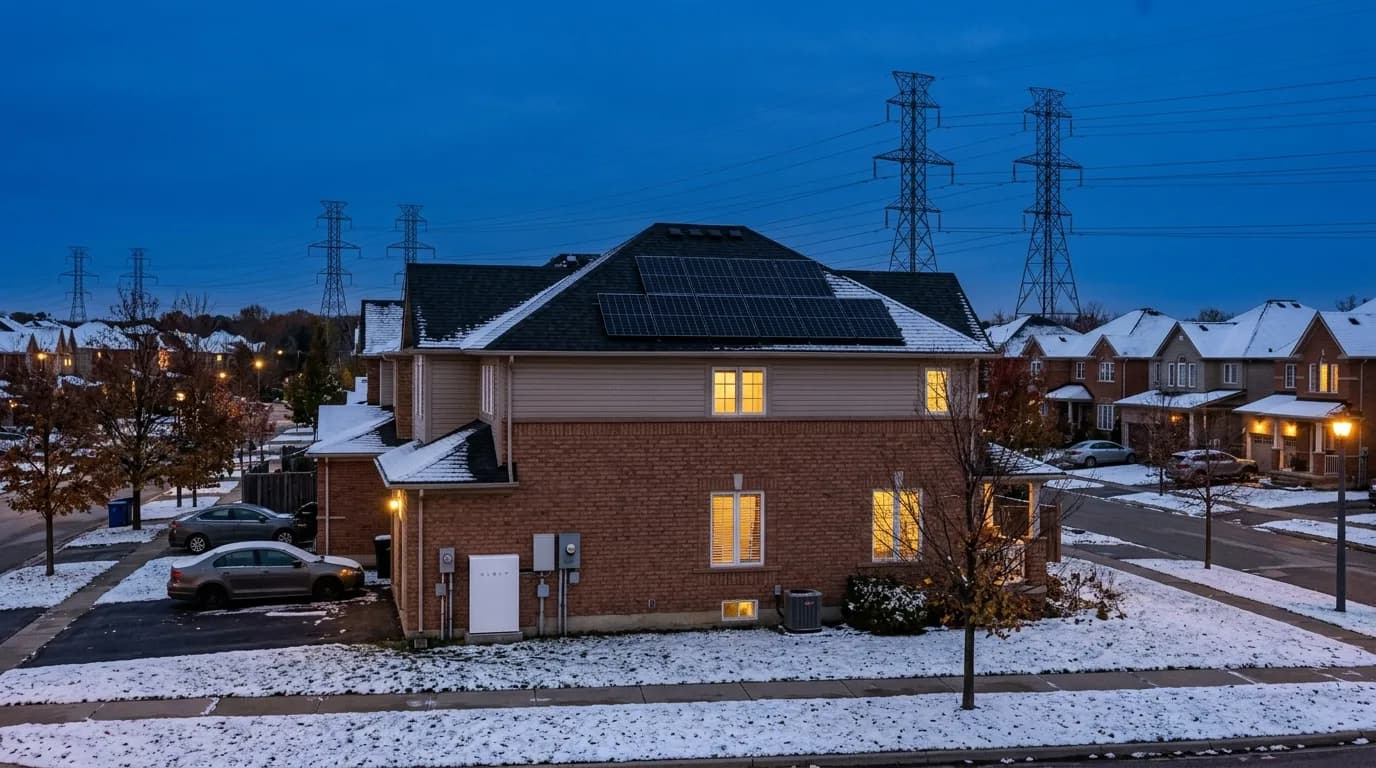
Quick answer: The Ontario Electricity Rebate falls from 23.5% to 15.7% of the pre-HST bill on November 1, 2026, under Ontario Regulation 328/26. Electricity prices drop about 4% to 7% the same day. For a typical home using 700 kWh a month, the Ontario Energy Board estimates the rebate is worth about $23 a month, down from about $36.
Last checked against the regulation and the OEB announcement listed under Sources. Prices and the rebate can change, so confirm current figures with your utility.
The Ontario Electricity Rebate is the credit near the bottom of your hydro bill, and on November 1 it gets smaller. At the same time, the price you pay for each kilowatt hour goes down. Below we explain what the new regulation says, what the change means in dollars, and what you can do about it. We are Solar X, a Canadian residential solar and battery installation company serving Ontario homeowners, so we also show how the change affects the value of solar and home batteries.
What are the new Ontario electricity prices and rebate for November 2026?
Here are the Regulated Price Plan prices that apply from November 1, 2026, set by the Ontario Energy Board in its October 16, 2026 announcement, next to the prices that applied until October 31. Prices are cents per kWh. The hours and the 1,000 kWh threshold shown are the winter settings, which run to April 30, 2027. Until October 31, summer Time-of-Use hours and a 600 kWh tier 1 threshold applied.
| Item | When it applies | Until Oct 31, 2026 | From Nov 1, 2026 |
|---|---|---|---|
| Ontario Electricity Rebate | On the pre-HST bill | 23.5% | 15.7% |
| Time-of-Use off-peak | Weekdays 7 p.m. to 7 a.m., weekends, holidays | 9.8¢ | 9.1¢ |
| Time-of-Use mid-peak | Weekdays 11 a.m. to 5 p.m. (winter) | 15.7¢ | 14.6¢ |
| Time-of-Use on-peak | Weekdays 7 to 11 a.m. and 5 to 7 p.m. (winter) | 20.3¢ | 18.9¢ |
| Ultra-Low Overnight | Every day 11 p.m. to 7 a.m. | 3.9¢ | 3.7¢ |
| ULO on-peak | Weekdays 4 to 9 p.m. | 39.1¢ | 37.7¢ |
| Tiered, tier 1 | First 1,000 kWh a month (residential, winter) | 12.0¢ | 11.2¢ |
| Tiered, tier 2 | Above the tier 1 threshold | 14.2¢ | 13.2¢ |
Sources: O. Reg. 328/26 for the rebate; Ontario Energy Board, October 16, 2026, for prices, hours and the 1,000 kWh winter tier threshold. ULO weekend off-peak is 9.1¢ and ULO mid-peak is 14.6¢. As of October 2026.
What does O. Reg. 328/26 change?
Ontario Regulation 328/26 was made on October 8, 2026, filed on October 9 and published in The Ontario Gazette on October 24. It amends O. Reg. 363/16, the general regulation under the Ontario Rebate for Electricity Consumers Act, 2016.
The change is short. In two places, section 2 and subsection 4 (3), the regulation strikes out 23.5 per cent and substitutes 15.7 per cent. It comes into force on the later of November 1, 2026 and the day it was filed, which makes November 1 the effective date.
Because the percentage sits in a regulation, the province can change it without passing a new law. That is exactly what has happened over the past two years: 13.1% from November 2024, 23.5% from November 2025, and now 15.7%.
How much will the smaller rebate cost a typical household?
The rebate is a percentage of your bill, so the dollar change depends on how much you use. For a typical residential customer using 700 kWh a month, the OEB estimates the rebate reduces the bill by about $23 a month, compared with about $36 last year.
Here is the same change on a simple $140 subtotal of electricity, delivery and regulatory charges.
| $140 subtotal | At 23.5% | At 15.7% |
|---|---|---|
| Rebate credit | -$32.90 | -$21.98 |
| Subtotal after rebate | $107.10 | $118.02 |
| HST at 13% | +$13.92 | +$15.34 |
| Total | $121.02 | $133.36 |
That example holds the subtotal fixed to isolate the rebate. In practice your subtotal also changes, because per-kWh prices fall about 4% to 7% on November 1 and the residential tier 1 threshold rises to 1,000 kWh for the winter. Delivery charges are set separately by your local utility and are not part of this change. To see what the new prices mean for your own usage, you can connect your hydro usage data and we will model it hour by hour.
Why is the rebate shrinking while prices fall?
The OEB states it plainly: “Electricity prices under the OEB’s RPP are decreasing year-over-year, which allows for a reduction in the OER.” RPP is the Regulated Price Plan that most homes are billed under. The OEB adds that the overall rate of increase for customer bills will stay consistent with previous years.
In other words, the price cut and the rebate cut were designed together. Lower prices on their own would have reduced bills more. The smaller rebate takes back part of that drop, so most households should not expect a lower bill simply because the per-kWh price fell.
See how the new rates affect your home
Send us your recent hydro bills and we will show what solar or a battery could change on your bill under the November 2026 prices, with the assumptions written out.
Get a Free Solar AssessmentDo you need to do anything about the rebate change?
For most homes, no. The rebate is automatic for most customers and shows as its own credit line, taken off the bill before HST is added. In its November 2026 price announcement, the OEB confirms the rebate applies to residential, small business and farm customers. You will simply see a smaller credit on bills that cover usage from November 1 onward.
What you can control is how much you buy from the grid and when. Three practical steps:
- Check your rate plan. Time-of-Use, Tiered and Ultra-Low Overnight suit different routines. The OEB bill calculator compares all three using your own usage.
- Shift flexible loads. On ULO, overnight power is 3.7¢ and the weekday 4 to 9 p.m. window is 37.7¢, a tenfold gap. Laundry, dishwashers and EV charging move easily.
- Look at producing or storing your own power. That is where the smaller rebate actually matters, as the next section shows.
If paying your bill is hard this winter, the OEB lists assistance at oeb.ca/billhelp, and distributors cannot disconnect residential customers for non-payment from November 15, 2026 to April 30, 2027.
Does a smaller rebate change the value of solar and batteries?
Yes, and in their favour. The rebate is a percentage discount on what you buy. When the discount is bigger, each kWh you avoid buying is worth a little less to you. When it shrinks, each avoided kWh is worth more.
At 23.5%, avoiding $1.00 of charges saved you 76.5 cents. At 15.7%, it saves you 84.3 cents. That is about 10% more value from every kWh your panels produce or your battery shifts, before any change in prices. Lower per-kWh prices pull the other way, so treat this as a modest shift, not a windfall.
Battery math on Ultra-Low Overnight
A home battery on the ULO plan charges overnight at 3.7¢ and covers evening use that would otherwise cost 37.7¢. Here is the arithmetic for one example home, using the November 2026 prices. Assumptions: the battery covers 6 kWh of weekday 4 to 9 p.m. use, 90% round trip efficiency, one cycle per weekday, commodity charges only.
| Step | Result |
|---|---|
| Evening use moved off ULO on-peak (weekdays 4 to 9 p.m.) | 6 kWh a day |
| Cost avoided at 37.7¢ | $2.26 |
| Overnight recharge at 3.7¢ (6 kWh ÷ 90% round trip) | 6.67 kWh, $0.25 |
| Net commodity saving per weekday | about $2.01 |
| About 21 weekdays a month | about $42 before rebate and HST |
| After the 15.7% rebate, then 13% HST | about $40 a month |
Estimate only. It excludes delivery and regulatory charges, weekends and holidays, and battery standby losses. Your result depends on your evening usage, battery size and rate plan.
If your household uses less than 6 kWh in that window, the saving is smaller. If you have backup needs, a battery set up for backup can keep selected circuits running during an outage, but how long depends entirely on what you power. That is why a battery should be sized to your actual evening usage, not to a standard package.
What about solar in winter?
Solar panels produce far less from November to February than in spring and summer, and snow can cover them for days. Most of a system’s yearly value comes from the longer days. That is why we size systems on a full 12 months of usage, not on one winter bill. With net metering in Ontario, surplus power your panels send to the grid in summer earns credits on your bill that carry forward into the darker months.
Is solar or a battery a good fit for your home?
Not always, and we would rather tell you before you sign. Solar is usually a poor fit when your roof is heavily shaded for most of the day, when your electricity use is very low, or when your roof needs replacing within the next few years. A battery on ULO makes the most sense when a meaningful share of your use falls on weekday evenings.
Every home is different. Savings and payback depend on your roof, usage, rate plan, equipment and the prices and rebates in force at the time, and none of them are guaranteed.
What happens after you ask Solar X for a quote?
- We review your hydro bills or usage data and assess your roof and electrical panel.
- We design a system sized to your 12 month usage and show the assumptions behind any estimate.
- If you decide to go ahead, you sign a contract that lists the equipment and terms.
- We apply for any required building permit and for your utility’s connection approval.
- Our crew installs the system.
- An Electrical Safety Authority inspection and your utility’s sign off come before the system is switched on. Each approval is decided by that authority, not by us.
You can also run rough numbers first with our solar savings calculator.
Frequently Asked Questions
Do I need to apply to keep getting the rebate after November 1?
No. The rebate is automatic for most customers and appears as its own credit line on your bill, so nothing changes in how you receive it. Only the percentage changes, from 23.5% to 15.7%, starting November 1, 2026. If your bill has never shown the credit, contact your local utility to ask whether your account qualifies.
Why is the province lowering the rebate when prices are falling?
The Ontario Energy Board says prices under its Regulated Price Plan are decreasing year over year, which allows for a reduction in the rebate. Prices drop about 4% to 7% on November 1, 2026, while the rebate falls from 23.5% to 15.7%. The OEB says the overall rate of increase for customer bills will stay consistent with previous years.
Will my hydro bill go up in November 2026?
It depends on your usage, rate plan and local utility. For a typical home using 700 kWh a month, the OEB estimates the rebate takes about $23 off the monthly bill, compared with about $36 last year. Lower per-kWh prices offset part of that. If you heat with electricity, higher winter usage matters more than either change, so compare bills line by line.
Which hours are cheapest this winter?
On Ultra-Low Overnight, 11 p.m. to 7 a.m. every day costs 3.7 cents per kWh, the lowest Regulated Price Plan price. On Time-of-Use, off-peak is 9.1 cents on weekdays from 7 p.m. to 7 a.m. and all day on weekends and holidays. The most expensive window is ULO on-peak, 37.7 cents, on weekdays from 4 to 9 p.m.
Is the rebate calculated before or after HST?
Before. The credit comes off the subtotal of your bill, and the 13% HST is then charged on what remains. On a $140 subtotal of electricity, delivery and regulatory charges, the credit falls from $32.90 at 23.5% to $21.98 at 15.7%, a difference of $10.92 before tax, or $12.34 once HST is added.
Does a smaller provincial credit change the value of solar or a home battery?
Yes, slightly in their favour. Every dollar of charges you avoid used to save you 76.5 cents after the 23.5% credit. At 15.7%, it saves you 84.3 cents, about 10% more. Lower per-kWh prices pull the other way, and your actual savings depend on your roof, usage, rate plan and system size, so no saving is guaranteed.
Where can I get help if I cannot afford my electricity bill this winter?
The OEB lists low-income bill payment support programs at oeb.ca/billhelp, and the province lists more at ontario.ca/yourelectricitybill. Under the OEB winter disconnection ban, electricity distributors cannot disconnect residential customers for non-payment from November 15, 2026 to April 30, 2027. If you are falling behind, contact your utility early to discuss your options.
Could the government change the percentage again?
Yes. The percentage is set by regulation under the Ontario Rebate for Electricity Consumers Act, 2016, so the province can change it without new legislation. It was 13.1% from November 2024, rose to 23.5% from November 2025 under O. Reg. 230/25, and becomes 15.7% on November 1, 2026 under O. Reg. 328/26. Plan your budget assuming it can move again.
Get a free solar assessment for your Ontario home
We will look at your bills, your roof and your evening usage, and tell you honestly whether solar, a battery or neither makes sense under the new prices.
Get a Free Solar AssessmentSources
- O. Reg. 328/26, Ontario e-Laws
- Ontario Rebate for Electricity Consumers Act, 2016, Ontario e-Laws
- Ontario Energy Board, price change announcement, October 16, 2026
- Ontario Energy Board, price change announcement, October 17, 2025 (last year’s 23.5% rebate and the $36 estimate)
- O. Reg. 230/25, Ontario e-Laws (the change from 13.1% to 23.5%)
- Ontario Energy Board, price change announcement, October 18, 2024 (the 13.1% rebate from November 2024)