
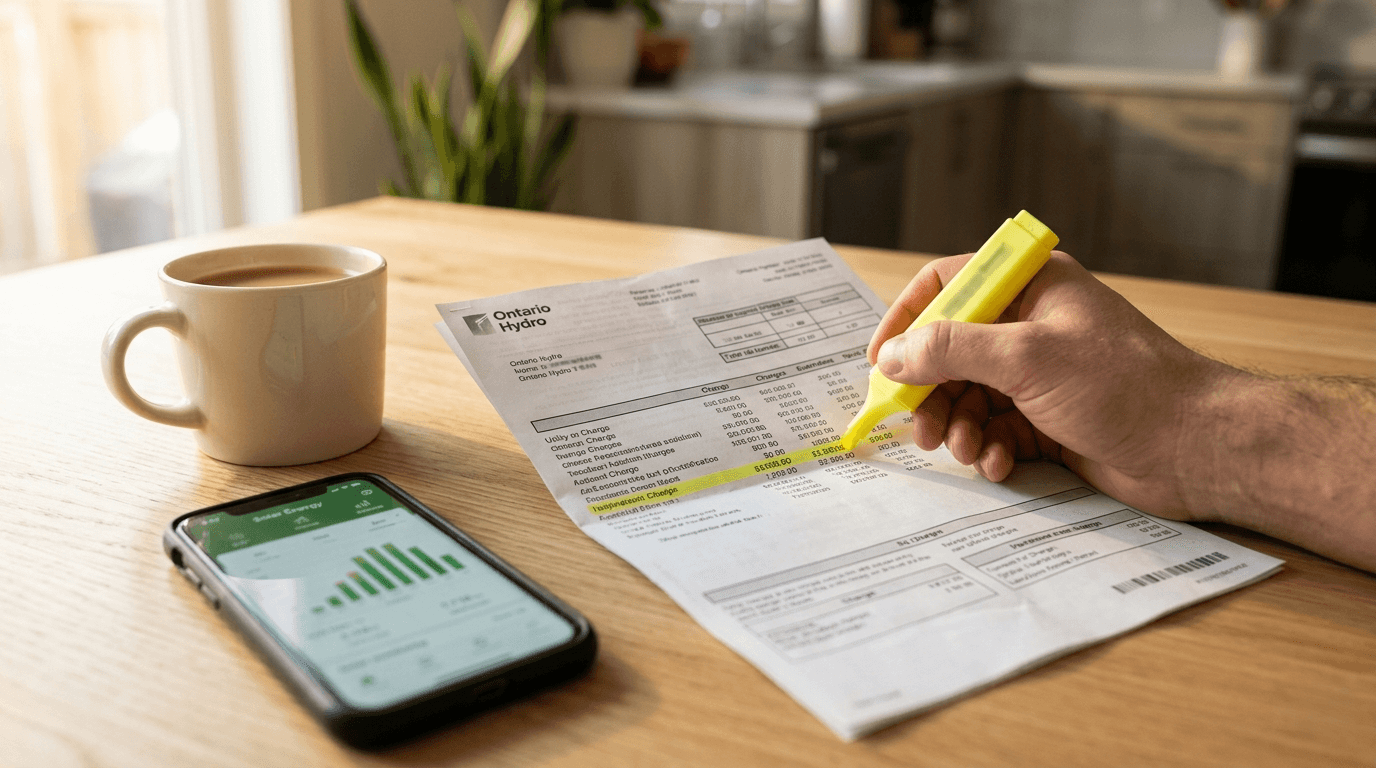
Quick answer: An Ontario hydro bill has five main sections: electricity charges (the per-kWh rate under TOU, Tiered, or ULO pricing), delivery charges (set by your local utility), regulatory charges (province-wide grid administration), the Ontario Electricity Rebate (a 23.5% credit applied before tax), and HST at 13%. Electricity charges make up about 35 to 45% of the total. Delivery charges account for 25 to 30%.
Most of your hydro bill is not the electricity itself
Electricity charges are only 35-45% of the typical Ontario bill. Delivery is another 25-30%, regulatory another 3-5%, and the rest is HST minus the 23.5% Ontario Electricity Rebate. Solar primarily reduces the electricity charge and the variable portion of delivery, but the fixed monthly delivery charge (around $40-$51) stays as long as you remain grid-connected.
Per-kWh cost under TOU, Tiered, or ULO. Solar eliminates most of this.
Fixed + variable. Solar cuts the variable portion; fixed stays.
Automatic. Applied to the subtotal before HST. Raised Nov 1, 2025.
Most Ontario homeowners look at the total on their hydro bill, wince, and file it away. But if you do not understand the individual line items, you cannot tell whether a higher bill is caused by increased usage, a rate change, a delivery charge hike, or something else entirely.
This guide walks through a standard Ontario hydro bill line by line. Whether your bill comes from Toronto Hydro, Hydro One, Alectra, Hydro Ottawa, or any of Ontario's 58 electricity distributors, the structure is the same because all are regulated by the Ontario Energy Board (OEB). By the end, you will know exactly what each charge means, which ones you can control, and which ones solar panels eliminate or reduce.
Your Bill at a Glance: The Summary Box
The top of every Ontario hydro bill shows a summary box. This section contains four pieces of information you should check every month.
- Billing period. The start and end dates for this bill. A normal billing period is about 30 days. If your bill seems unusually high, check whether the billing period is longer than normal (some periods span 35 or even 45 days due to meter read schedules).
- Previous balance and payments. What you owed last time and what you paid. If the previous balance was not fully paid, your current bill includes the outstanding amount plus any late payment charges.
- New charges. The total charges for this billing period before HST and rebates. This is the number you want to compare month to month.
- Total amount due and due date. The final amount after all charges, rebates, and tax. Late payment charges in Ontario are typically 1.5% per month (19.56% annualized), so paying on time matters.
1. Electricity Charges (35 to 45% of Your Bill)
The electricity charge is the cost of the actual electricity you consumed, measured in kilowatt-hours (kWh). This is the line most people think is their entire bill, but it is actually less than half. The rate you pay depends on which of the three OEB-regulated pricing plans you are on.
| Rate plan | Off-peak / Tier 1 | Mid / Tier 2 | On-peak |
|---|---|---|---|
| Time-of-Use (TOU) | 9.8¢ / kWh | 15.7¢ / kWh | 20.3¢ / kWh |
| Tiered | 12.0¢ / kWh (up to 1,000 winter / 600 summer) | 14.2¢ / kWh (above threshold) | n/a |
| Ultra-Low Overnight (ULO) | 3.9¢ / kWh overnight | 9.8¢ weekend / 15.7¢ mid-peak | 39.1¢ / kWh |
TOU is the default plan for most Ontario homes. Off-peak hours are weekday evenings (7 PM to 7 AM) and all weekend, mid-peak is daytime shoulder hours, and on-peak is weekday middays/early evenings depending on season. Tiered is a flat rate that bumps up after you cross a monthly threshold (1,000 kWh winter / 600 kWh summer). ULO is designed for households that can shift heavy usage to overnight hours, ideal for homes with EVs, heat pumps, or battery storage.
These rates are set by the OEB and apply to all 58 Ontario electricity distributors. They do not vary by utility. For a deeper breakdown of each plan and which one saves you the most, see our Ontario Electricity Rates Explained (2026) guide.
Source: OEB Newsroom, October 17, 2025
2. Delivery Charges (25 to 30% of Your Bill)
Delivery charges are the cost of transporting electricity from the generating station to your home through transmission lines, local distribution wires, and transformers. This is the line that frustrates homeowners most because you pay it whether you use a lot of electricity or a little. Delivery charges have three components.
- Fixed monthly charge. Every Ontario household pays a base charge just to be connected to the grid. This amount does not change based on how much electricity you use. For Toronto Hydro residential customers it is $51.18 per 30-day billing period as of January 1, 2026. Hydro One caps this at $42.88 per month for rural and suburban customers through the Distribution Rate Protection program.
- Variable delivery charge. A per-kilowatt-hour charge that increases with your consumption. This covers distribution costs and transmission charges. For Toronto Hydro, the transmission charge is $0.02241 per kWh effective January 1, 2026.
- Line losses. Your bill also includes a small charge for electricity lost as heat during transmission through wires. Hydro Ottawa uses an OEB-approved loss factor of 3.38%.
Delivery charges vary significantly between utilities. This is why two households using the same amount of electricity can have very different bills depending on whether they are served by Toronto Hydro, Hydro One, Alectra, or a smaller municipal utility. For specific delivery charge comparisons by utility, see our OEB Rate Decisions 2026 guide.
Why this matters for solar
Delivery charges are based partly on how much electricity you draw from the grid. When your solar panels generate electricity on-site, you reduce the kWh delivered from the grid, which reduces the variable portion of your delivery charges. The fixed monthly charge remains regardless of solar, because you stay connected to the grid for net metering.
3. Regulatory Charges (About 3 to 5% of Your Bill)
Regulatory charges fund the operation of Ontario's wholesale electricity market and provincial grid reliability programs. These charges are set by the OEB and apply to all Ontario utilities at the same rate.
On your bill, this appears as a small per-kilowatt-hour charge. For most residential customers, regulatory charges add roughly $3 to $6 per month depending on consumption. The current regulatory charge rate is approximately 0.53 cents per kWh.
These charges cover the costs of the Independent Electricity System Operator (IESO), which manages the real-time electricity market and forecasts future supply needs, plus the OEB's own administrative costs for regulating all 58 electricity distributors.
4. The Global Adjustment (The Charge You Cannot See)
This is the largest single component of Ontario's electricity cost, and most homeowners have never heard of it. For residential customers on the Regulated Price Plan, the Global Adjustment is embedded inside your per-kWh electricity rate. It does not appear as a separate line on your bill.
The Global Adjustment covers the difference between the wholesale market price of electricity and the price Ontario actually pays its generators under long-term contracts. It funds nuclear generation contracts (including the Darlington and Pickering refurbishment programs), conservation programs, and renewable energy contracts signed under the former Feed-in Tariff program.
For large commercial and industrial customers who buy electricity at the wholesale market rate (called Class A customers), the Global Adjustment appears as a visible separate charge and can represent 60 to 70% of their total electricity cost. As a residential ratepayer, you pay the Global Adjustment through your per-kilowatt-hour rate without seeing it broken out. This is why Ontario's electricity rates are higher than the wholesale market price: the gap between the two is the Global Adjustment.
Why this matters for solar
When your solar panels generate electricity, you avoid paying the full per-kWh rate, which includes the embedded Global Adjustment. Every kWh your panels produce displaces a kWh that would have cost you the commodity rate plus the embedded Global Adjustment plus delivery charges. This is why the true value of solar-generated electricity is higher than just the commodity rate alone.
5. Ontario Electricity Rebate (23.5% Credit)
The Ontario Electricity Rebate (OER) is a government credit applied to your bill before HST is calculated. As of November 1, 2025, the OER is set at 23.5%, increased from 13.1% to help offset the 29 to 30% commodity rate increase.
The OER is applied to the subtotal of your electricity charges, delivery charges, and regulatory charges. For a typical household using 700 kWh per month, the OER credit is roughly $30 to $40 per month. It is automatic. You do not need to apply for it. It appears on every residential, small business, and farm electricity bill in Ontario.
Important: the OER is a provincial government policy, not an OEB decision. The government can change the percentage at any time. It was 17% before November 2019, dropped to 13.1%, and then jumped to 23.5% in November 2025. There is no guarantee it will stay at this level.
6. HST (13%)
The Harmonized Sales Tax of 13% (5% federal + 8% provincial) is applied to the total after the OER credit has been subtracted. The province of Ontario mandated HST on electricity bills effective July 1, 2010.
A quick math example for a $140 subtotal:
7. Why Your Bill Changed: The Three Hidden Drivers
When your bill goes up but your usage has not changed, one of three things happened.
- The OEB changed the per-kWh rates. The OEB adjusts commodity rates on November 1 each year. Seasonal structure changes (TOU peak hours and Tiered thresholds) take effect on May 1 and November 1. The most recent change was the 29 to 30% commodity increase on November 1, 2025.
- Your local utility raised delivery charges. Delivery charges are set by your individual utility and approved by the OEB through separate proceedings. On January 1, 2026, several Ontario utilities increased distribution rates. These increases are independent from the OEB commodity rate and add $2 to $5 per month for a typical household.
- You crossed a seasonal threshold. On May 1, the Tiered pricing threshold drops from 1,000 kWh to 600 kWh per month. TOU on-peak hours shift to 11 AM to 5 PM (midday, when air conditioning is running). Both changes increase your effective cost without an actual rate change.
8. How Solar Changes Your Hydro Bill
Once you install solar panels, your hydro bill looks different. Here is what changes and what stays the same.
What solar eliminates or reduces
- Your electricity charges drop dramatically. Every kWh your panels produce is a kWh you do not buy from the grid at the OEB rate. A properly sized 8 to 10 kW system in Ontario can offset 80 to 100% of a typical household's annual electricity consumption.
- Your variable delivery charges decrease. Fewer grid kWh means lower variable delivery and transmission charges.
- Under net metering, surplus electricity your panels export to the grid earns bill credits valued at the full retail rate (electricity + delivery + regulatory). These credits roll forward month to month and expire after 12 months.
What solar does not change
- Your fixed monthly delivery charge stays. You remain connected to the grid for net metering, so you still pay the fixed connection fee (around $40 to $51 per month depending on your utility).
- HST still applies to whatever charges remain on your bill.
A real before-and-after example
| Line item | Before solar | After 10 kW system (90% offset) |
|---|---|---|
| Electricity charges | ~$75 | ~$7 |
| Variable delivery | ~$20 | ~$3 |
| Fixed delivery (Toronto Hydro) | $51.18 | $51.18 (unchanged) |
| Regulatory + OER + HST (net) | ~$9 | ~$1 |
| Typical monthly total | ~$155 | ~$55-$75 |
A Toronto Hydro customer using 800 kWh per month on the TOU plan typically saves around $80 to $100 per month (or $960 to $1,200 per year) after installing a properly sized solar system. The remaining bill is mostly the fixed delivery fee.
To see what your specific bill would look like after solar, upload your usage data through Green Button or use our solar calculator for an instant estimate. For a detailed assessment, contact us for a free consultation. Solar X is an ESA-Licensed Electrical Contractor (Licence 7017538) with 10,000+ Ontario installations and full HRSP rebate management. For a related read, see how home insurance covers solar panels in Ontario.
See What Solar Removes From Your Bill
Upload your last hydro bill or 12 months of Green Button data. Solar X models the exact line-by-line reduction you would see after install, free of charge.
Frequently Asked Questions
What is the delivery charge on my Ontario hydro bill?
The delivery charge covers the cost of transporting electricity from the generating station to your home through transmission and distribution lines. It includes a fixed monthly charge (ranging from about $42 to $51 depending on your utility) plus a variable per-kWh charge. Delivery charges are set by your local utility and approved by the OEB. They make up roughly 25 to 30% of your total bill.
Why is my delivery charge so high even when I use less electricity?
A significant portion of the delivery charge is a fixed monthly fee that you pay regardless of consumption. For Toronto Hydro residential customers, this fixed charge is $51.18 per 30-day period. The only way to reduce the fixed portion is to disconnect from the grid entirely, which most Ontario homeowners do not do because grid connection is required for net metering.
What is the Global Adjustment on my Ontario hydro bill?
The Global Adjustment covers the cost difference between the wholesale market price of electricity and what Ontario pays generators under long-term contracts. For residential customers on the Regulated Price Plan, it is embedded in your per-kWh rate and does not appear as a separate line. For large commercial customers, it appears separately and can represent 60 to 70% of their electricity cost.
What is the Ontario Electricity Rebate (OER)?
The OER is a provincial government credit of 23.5% applied to the subtotal of your electricity, delivery, and regulatory charges before HST. It was increased from 13.1% on November 1, 2025 to offset the commodity rate increase. The rebate is automatic and requires no application.
Can I switch my rate plan from TOU to Tiered or ULO?
Yes. All Ontario residential customers on the Regulated Price Plan can switch between TOU, Tiered, and ULO at any time with no penalty. Contact your local utility and submit a Customer Choice Request Form. The switch takes up to 10 business days to process.
Why did my bill go up even though I used less electricity?
Three possible reasons: the OEB increased commodity rates (the most recent increase was 29 to 30% on November 1, 2025), your local utility raised delivery charges (several utilities increased rates on January 1, 2026), or a seasonal threshold changed (the Tiered threshold dropped from 1,000 to 600 kWh on May 1, 2026).
How much of my hydro bill can solar panels eliminate?
Solar panels primarily eliminate or reduce the electricity charge (35 to 45% of your bill) and the variable portion of delivery charges. The fixed monthly delivery charge stays because you remain connected to the grid. Most Ontario solar homeowners see total bill reductions of 50 to 70%, depending on system size and consumption.
What does my hydro bill look like after installing solar panels?
A typical Ontario homeowner paying $155 per month before solar sees their bill drop to roughly $55 to $75 per month after installing a properly sized system. The remaining charges are mostly the fixed delivery fee plus HST on a small residual balance. Net metering credits offset most or all electricity and variable delivery charges.
What is the line loss charge on my hydro bill?
Line losses account for small amounts of electricity lost as heat during transmission through power lines. Your utility applies an OEB-approved loss factor (for example, Hydro Ottawa uses 3.38%) to adjust for this. The charge is typically a few dollars per month and is included in your delivery charges.
How do I get Green Button data from my utility to calculate solar savings?
Most Ontario utilities (Toronto Hydro, Hydro One, Alectra, Hydro Ottawa) offer Green Button data downloads through your online account portal. Green Button provides your actual hourly or daily consumption history, which Solar X uses to design a system sized precisely to your usage patterns. Upload your data through our Green Button page for an accurate solar assessment based on 12 months of real consumption.
Related Reading
Ontario Electricity Rates Explained (2026)
TOU vs Tiered vs ULO. Which rate plan saves you the most.
OEB Rate Decisions 2026
How the Ontario Energy Board sets your hydro rates each year.
Why Ontario Hydro Bills Skyrocket in 2026
The 29-30% commodity increase, OPG's 72% nuclear request, and what comes next.
Green Button Data for Ontario Solar
How to download hourly consumption data and use it to size a solar system.