
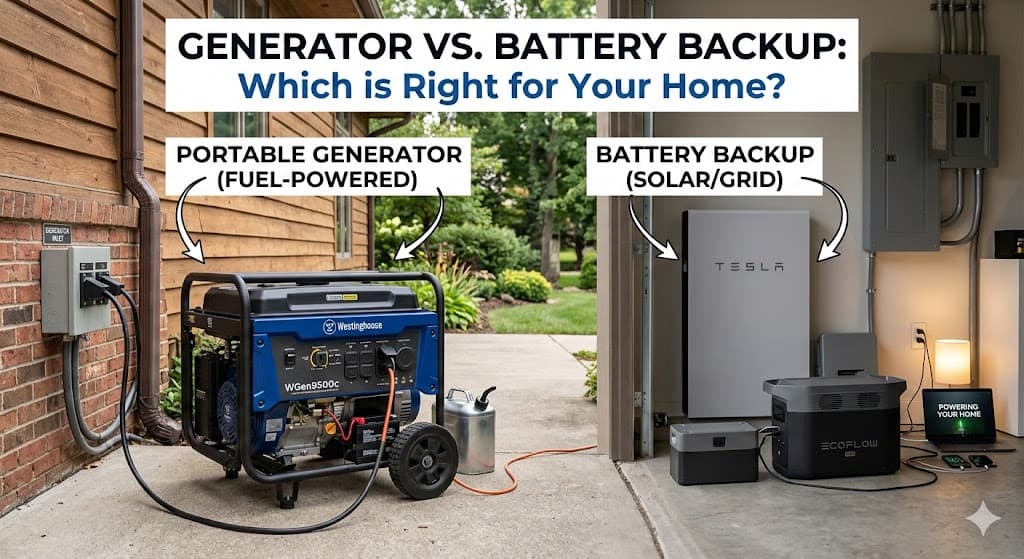
Generator vs Battery Backup:
What Ontario Homeowners Need to Know
Quick answer: For most Ontario homeowners, battery backup outperforms a generator. Generators cost $8,000–$18,000 with no rebate and ongoing fuel costs. Batteries cost $13,000–$21,000 but qualify for the $5,000 HRSP rebate and can save up to $1,100–$2,400/year via ULO arbitrage, depending on usage and rate plan.
The real question isn't which keeps the lights on — it's which one pays for itself
Both generators and batteries keep your home running during outages. But a battery backup paired with solar works every single day, generating up to $1,100–$2,400/year in energy savings on Ontario's ULO rate plan, depending on usage. A generator sits idle 99% of the time and earns nothing. Over 20 years, the battery ends up $15,000–$35,000 ahead.
Why Ontario Homeowners Are Thinking About Backup Power
Ontario's grid faces increasing stress from ice storms, wind events, and aging infrastructure. In March 2025, a single ice storm knocked out power to over 500,000 customers, with some areas dark for five or more days. Hydro One identified over 2,000 broken poles from that one event. From 2016 to 2020, wind contributed to more than half of all major outage events in Ontario.
If your home relies on electricity for heating (even a gas furnace needs power for the blower and thermostat), refrigeration, sump pumps, or medical equipment, a backup system isn't a luxury — it's risk management.
Generator vs Battery: Side-by-Side Comparison
| Category | Standby Generator | Battery Backup |
|---|---|---|
| Installed Cost | $8,000–$18,000 | $13,000–$21,000 (1 battery) |
| Ontario Rebate | None | HRSP: up to $5,000 |
| Net Cost After Rebate | $8,000–$18,000 | $8,000–$16,000 |
| Annual Maintenance | $300–$650/year | $0 (no moving parts) |
| Fuel Cost | $3–$8/hour during outage | $0 (solar recharges free) |
| Noise Level | 60–70 dB (loud conversation) | Silent operation |
| Switchover Speed | 10–30 seconds | < 1/50th of a second |
| Outage Duration | Unlimited (with fuel) | 12–36 hours (1–2 batteries) |
| Daily Savings | None — only runs in outage | $3–$9/day (rate arbitrage) |
| CO Risk | Yes — outdoor only, setbacks required | None |
| Lifespan | 15–20 years | 15+ years (warranty varies) |
| Permits Required | ESA + gas permit + municipal | ESA electrical permit |
The Cost Everyone Forgets: What Happens Between Outages
A standby generator sits idle 99% of the time. When the power is on, it costs you nothing — but it earns nothing either. You're paying for insurance that only activates during emergencies.
A battery backup paired with solar works every single day. On Ontario's ULO rate plan, a 13.5 kWh battery charges overnight at 3.9¢/kWh and discharges during on-peak at 39.1¢/kWh — a 35.2¢/kWh spread. That translates to $1,100–$2,400 per year in electricity savings, depending on your consumption and rate plan. On TOU, the savings are smaller but still meaningful: $600–$1,200 per year.
Over 15 years, a battery system on ULO can return $16,000–$36,000 in energy savings while also providing backup power.
A generator returns $0 in savings and adds $4,500–$9,750 in maintenance costs over the same period. A battery pays for itself. A generator is a pure expense. This is the single biggest difference and the one most comparisons miss.
20-Year Total Cost of Ownership
| Cost Category | Generator (20 kW) | Battery + Solar |
|---|---|---|
| Purchase + install | $12,000 | $35,000 (8kW solar + battery) |
| HRSP rebate | -$0 | -$10,000 |
| Net upfront | $12,000 | $25,000 |
| Maintenance (20 yr) | $8,000 | $0 |
| Fuel (20 yr, est. 200 hr) | $1,200 | $0 |
| Battery replacement (~yr 15) | n/a | $8,000 (estimated) |
| Total 20-Year Cost | $21,200 | $33,000 |
| Energy savings (20 yr, ULO) | $0 | -$28,000 to -$48,000 |
| Net Position After 20 Years | -$21,200 (pure cost) | +$15,000 to +$35,000 (net gain) |
The generator is cheaper upfront and cheaper in total hardware cost. But the battery system generates revenue every day. When you factor in energy savings, the battery ends up $15,000–$35,000 ahead over 20 years — even after paying for a replacement battery at year 15.
When a Generator Makes More Sense
Batteries aren't always the right answer. A generator may be the better choice if:
- You need multi-day backup for a large home (5,000+ sq ft with high electrical loads) — a single battery provides 12–24 hours, while a generator runs indefinitely with fuel
- Your home runs on natural gas for heating and cooking — a natural gas generator integrates with existing infrastructure at lower fuel cost
- You're in a rural area with frequent extended outages (3+ days) and limited solar production in winter
- Your budget is under $10,000 and you don't qualify for HRSP or don't plan to add solar
- You have critical medical equipment that cannot tolerate any gap in power, even the sub-second battery switchover
When a Battery Makes More Sense
A battery backup (especially paired with solar) is the stronger choice if:
- You want backup power AND daily energy savings — the battery works for you 365 days a year, not just during outages
- You're on or planning to switch to Ontario's ULO rate plan — the 35.2¢/kWh arbitrage makes the battery self-funding
- You want silent, emission-free backup — no exhaust, no noise complaints, no CO risk
- You're adding solar panels — battery storage maximizes your solar investment by storing excess generation for peak-rate use
- You qualify for HRSP — the $5,000 battery rebate (plus up to $5,000 for solar) dramatically reduces the cost gap
- You want automatic storm preparation — Tesla Powerwall's Storm Watch charges to 100% when severe weather is forecast
Safety: A Factor Most People Overlook
Carbon monoxide from generators is responsible for an estimated 300 deaths per year across Canada, including approximately 11 per year in Ontario alone. Generators must be installed outdoors with proper setbacks — minimum 6 metres (20 feet) from any door, window, or vent. During ice storms, when people are most tempted to run portable generators in garages or near open windows, the risk spikes.
Battery systems produce zero emissions. They install inside your garage or on an exterior wall. There is no combustion, no exhaust, and no carbon monoxide risk. For families with children, elderly residents, or anyone with respiratory conditions, this is a significant safety advantage.
Ontario-Specific Considerations
Permits and Inspections
Both options require ESA (Electrical Safety Authority) permits and inspections in Ontario. Generators additionally need a gas permit (TSSA — Technical Standards and Safety Authority) for the fuel connection. Municipal permits may also apply depending on your location. Solar X handles all ESA permitting and coordinates TSSA inspections when applicable.
HRSP Rebate (Battery Only)
Ontario's Home Renovation Savings Program provides up to $5,000 for battery storage ($300/kWh-DC, max $5,000) and up to $5,000 for solar panels ($1,000/kW-DC, max $5,000). Combined solar + battery projects can receive up to $10,000. There is no provincial rebate for standby generators. Pre-approval is required before purchase. The program is currently open, with no announced end date, and terms may change.
Winter Performance
Ontario winters mean shorter days and potential snow cover on solar panels. A battery charged from solar alone may not fully recharge during a multi-day winter outage. However, Powerwall's Storm Watch feature pre-charges to 100% before forecast storms. And during normal winter days (no outage), the battery still provides full rate arbitrage savings — ULO overnight charging doesn't depend on solar production.
Property Value
Solar + battery systems have been shown to increase Ontario home resale value by 3–4%. Generators do not meaningfully impact resale value and may need to be serviced or replaced at time of sale.
Find out what's right for your home
Get a side-by-side cost comparison customized to your home, rate plan, and outage risk. No pressure. No obligation.
Frequently Asked Questions
Can I have both a generator and a battery?
Yes. Some homeowners install a battery for daily savings and short outages, with a smaller generator as extended-outage insurance. This is less common because the battery handles most scenarios, but it's an option if you need multi-day backup for a large home.
How long will a Tesla Powerwall last during a winter outage?
A single Powerwall 3 (13.5 kWh) powers essential circuits — furnace, fridge, lights, Wi-Fi, sump pump — for 12–24 hours depending on load. Two Powerwalls extend this to 24–48 hours. If solar panels are clear of snow, daytime production can recharge the battery and extend backup indefinitely for essential loads.
What about portable generators?
Portable generators ($500–$3,000) are cheap but manual — you have to start them, refuel them, and run extension cords. They cannot power hardwired systems like your furnace. They also carry the highest carbon monoxide risk because people bring them too close to the home. For reliable whole-home backup, they are not a substitute for either a standby generator or a battery system.
Do batteries work if the grid is down and it's cloudy?
Yes — the battery stores energy regardless of conditions. If it was charged before the outage (Storm Watch does this automatically), it provides full backup power whether it's sunny, cloudy, or nighttime. Solar panels extend the battery during daylight, but the battery doesn't require solar to function as backup.
Is a battery worth it without solar?
On ULO, yes. A standalone battery can charge at 3.9¢/kWh overnight from the grid and discharge at 39.1¢/kWh during on-peak, can generate up to $1,100–$1,800/year in savings without any solar panels, depending on usage and rate plan. Adding solar increases total savings and provides the ability to recharge during grid outages.
Find Out What's Right for Your Home
The right backup system depends on your home size, electrical loads, rate plan, and how long you need to ride through outages. Solar X designs battery + solar systems that provide both daily savings and backup protection — and we handle HRSP pre-approval, ESA permits, and utility coordination from start to finish.
Book a free site assessment to get a side-by-side cost comparison customized to your home. Or use the Solar Calculator for a quick estimate based on your address and consumption. To see how many hours a specific battery would keep your fridge, furnace fan and sump pump running, try the Battery Backup Calculator.
Solar X is a Canadian residential and commercial solar installer. We install solar systems, Tesla Powerwall 3 battery storage, and EV charging equipment. All systems are installed by ESA-certified crews. Cost estimates, savings projections, and rebate amounts are approximate and depend on individual circumstances. HRSP rebate eligibility requires pre-approval. Program terms and funding availability are subject to change.