
By the Solar X Team. Published November 17, 2026. Updated November 17, 2026. Program rules and prices can change, so check the official pages linked below before you decide.
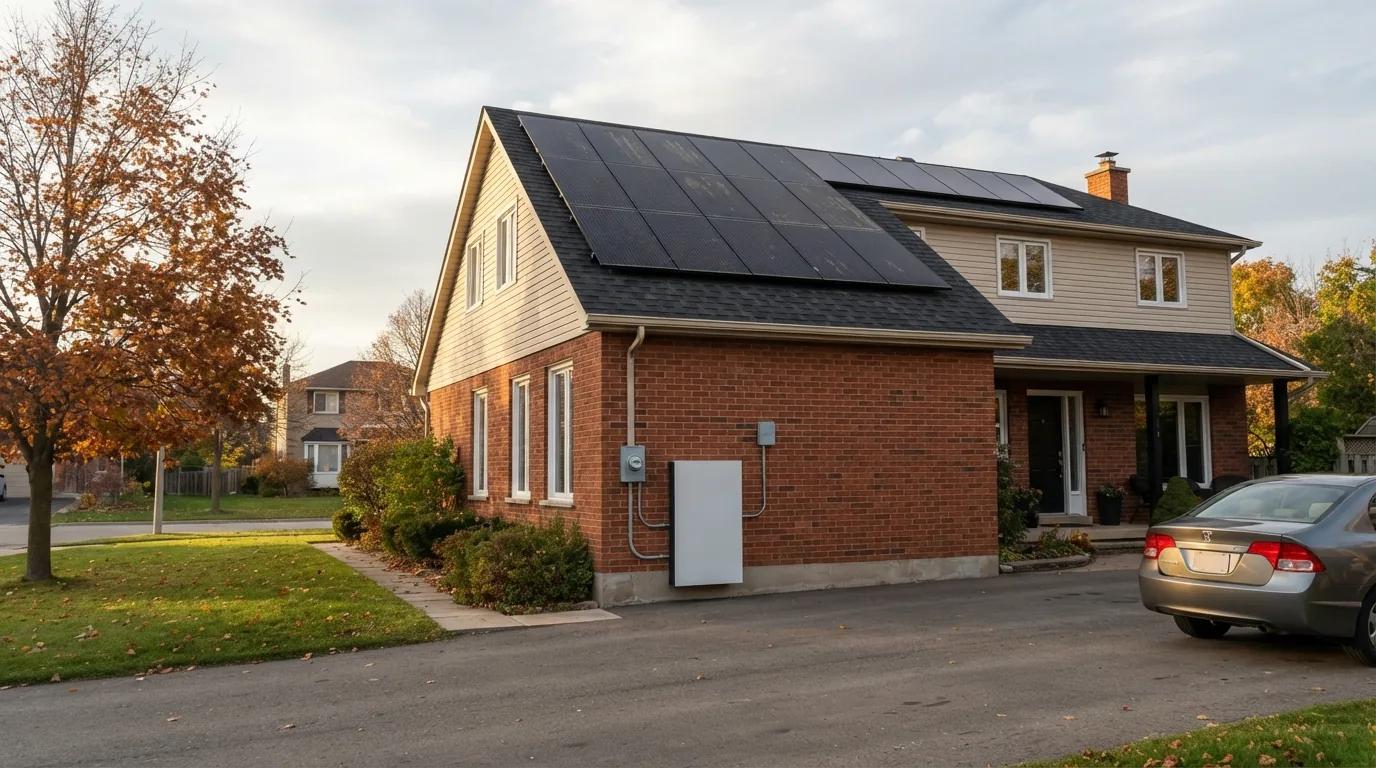
No. As of November 2026, Ontario's Home Renovation Savings (HRS) battery rebate applies only to homes that do not already have a solar or storage system, and the battery must be installed with a new solar system. If you already have panels, a battery added later qualifies for $0 in HRS rebate. You can still add one at full price.
Book a free battery assessment for your existing solar system
No obligation. We show you the numbers for your own usage.
Book a Free Assessment →Solar X is a Canadian residential solar installation company serving Ontario. We design and install solar and battery systems, and we hear this question often from homeowners who went solar a few years ago. Here is the straight answer, what you can still do, and the math on whether a battery is worth it without a rebate.
Why Doesn't a Battery Added to Existing Solar Qualify?
The rule comes straight from the program documents. The HRS Solar and Storage Stream Requirements (version dated October 2025) say an eligible home must not have an existing solar or storage system, limiting the rebate to "only first-time installations" (section 3.2(d)). The same document says rebated batteries must be paired with a new solar system and sized for it.
In plain terms, a battery added to panels you already own is not a first-time installation, and neither is a replacement system on a home that already had solar, so neither is covered. The HRS help and support page answers other common eligibility questions.
| HRS rule (as of November 2026) | What it means for you | Official source |
|---|---|---|
| Home must have no existing solar or storage | A battery added to current panels gets $0 | HRS Stream Requirements, section 3.2(d) |
| Battery must be paired with a new solar system | A battery on its own gets $0 | HRS Stream Requirements, section 3.3.2 |
| Battery rebate: $300 per kWh, up to $5,000, capped at 50% of eligible costs | Applies only on new solar plus battery projects | HRS Stream Requirements, section 2 |
| Preapproval required before purchase or install | Buying first disqualifies the project | HRS Stream Requirements, section 2.1.1 |
| Rebated systems cannot use net metering | HRS and net metering are alternatives, never combined | HRS Stream Requirements, sections 3.3.1(a) and 3.3.2 |
Source: Home Renovation Savings Solar and Storage Program Stream Requirements (version October 2025), checked November 17, 2026.
For the full rebate rules on new solar plus battery projects, see our Ontario battery rebate guide.
What Are Your Options If You Already Have Solar?
You have four realistic paths. None of them involve an HRS rebate on the house that already has panels.
| Option | HRS rebate | Best fit |
|---|---|---|
| Add a battery at full price | $0 | You want backup power and are on, or willing to switch to, ULO pricing |
| Keep your current system as is | Not applicable | Your main goal is bill savings and your evening use is low |
| Use low-interest municipal financing for the battery | $0 | Your city runs a program that lists battery storage as eligible |
| Go solar plus battery on a second property with no solar | Up to $5,000 solar plus up to $5,000 battery | You own a cottage or second home with no existing system |
Adding a Battery at Full Price
This is a market estimate, approximate only: a 13.5 kWh class battery such as the Tesla Powerwall 3 typically costs about $19,000 to $24,000 installed. That matches our Powerwall 3 cost breakdown. On a battery added to existing solar there is no HRS rebate to subtract, so the installed price is your real cost.
Your price moves with three things:
- whether your existing inverter works with the battery you choose
- whether your electrical panel needs an upgrade
- where the battery can be mounted
Your written quote states exactly what is included. For a side by side look at battery brands, see our home battery storage guide.
If Your System Is Net Metered or Under microFIT
A home with a microFIT or net metered system already has solar, so it falls outside the program's "only first-time installations" rule (section 3.2(d)), and a rebated system cannot be under a net metering agreement (section 3.3.1(a)). Your microFIT contract or net metering agreement has its own terms. Read it, and ask your local utility how a battery may be connected and charged under that agreement, before you buy anything.
Low-Interest Municipal Financing
Some Ontario municipalities run home energy loan programs repaid through your property tax bill. For example, as of November 2026, Better Homes Kingston lists solar panels and battery storage as eligible improvements. The program lends up to $50,000 or 20% of your home's value, whichever is less, at rates of 3.25% to 4.75% depending on the term. A $450 administration fee applies. Approval and funding are set by the program, not by us, so confirm eligibility before you commit.
How Much Can a Battery Save on Ultra Low Overnight Pricing?
The Ontario Energy Board set Ultra Low Overnight (ULO) prices effective November 1, 2026:
- 3.7¢ per kWh overnight, 11 p.m. to 7 a.m. every day
- 37.7¢ per kWh on peak, 4 p.m. to 9 p.m. on weekdays
Weekends and holidays have no on peak period. Because there is no HRS rebate in play, a battery added to existing solar can charge overnight and cover your weekday evening use. That price gap is where the savings come from.
Assumptions: ULO pricing, about 252 weekdays a year, charging at 3.7¢ and discharging at 37.7¢, and 90% round trip efficiency. The estimates are before HST and before the Ontario Electricity Rebate, which reduces the dollar value of any savings. They also ignore battery degradation and the delivery charges on the energy lost while charging, and assume prices stay the same. Every home is different.
| Evening use the battery covers (weekdays, 4 to 9 p.m.) | Estimated savings per year | Simple payback on $19,000 to $24,000 |
|---|---|---|
| 13.5 kWh (full battery every weekday) | about $1,140 | about 17 to 21 years |
| 8 kWh | about $680 | about 28 to 35 years |
| 5 kWh | about $420 | more than 40 years |
Source: Ontario Energy Board ULO prices effective November 1, 2026. Estimates by Solar X, not promises.
Here is how the first row works. Covering 13.5 kWh at 37.7¢ avoids about $5.09 of on peak power. Recharging it takes about 15 kWh at 3.7¢, or about $0.56. That nets about $4.53 per weekday, or about $1,140 a year over 252 weekdays. These are estimates, not promises.
The honest takeaway: on bill savings alone, a battery added to existing solar pays back slowly. For many homeowners, backup power during outages is the stronger reason to add one.
Get a battery quote with savings math for your own usage
No obligation. We show you the numbers for your own usage.
Get My Battery Quote →When Is Adding a Battery Not Worth It?
We would rather tell you now than have you regret it later. A battery added to existing solar is usually a weak fit if:
- Your evening use is low. If you use only a few kWh between 4 and 9 p.m. on weekdays, the savings shrink fast, as the table shows.
- You plan to stay on Time of Use pricing. As of November 2026, the OEB Time of Use gap is 9.1¢ off peak versus 18.9¢ on peak. That is much narrower than the ULO gap, so arbitrage savings are smaller.
- Your roof needs replacing soon. Plan the roof work first. Your panels will need to come off and go back on for a new roof, so it is simpler to plan the whole project together.
- Bill savings are your only goal. Paybacks of 17 years or more are hard to justify on savings alone.
If backup power matters to you (well pumps, sump pumps, medical devices, working from home), the case gets stronger, because that value does not show up in the table.
What Happens After You Book an Assessment?
Site assessment. We review your existing inverter, electrical panel, rate plan and usage.
Design and written quote. You get the battery size, the installed price and the savings assumptions in writing.
Contract. We only start once you have signed.
ESA permit and inspection. We file and coordinate these.
Local utility review, where your utility requires one.
Installation and commissioning.
Timelines depend on permit and utility review, which we do not control, so we do not promise dates.
What If You Don't Have Solar Yet?
If a home has no existing solar or storage, the HRS path is open as of November 2026. It pays $1,000 per kW of solar up to $5,000, plus $300 per kWh of storage up to $5,000. Each rebate is capped at 50% of eligible costs, and preapproval is required. The HRS solar page adds two conditions:
- The battery should be designed mainly to store your solar power, not grid power.
- The system cannot use net metering.
Bottom Line
You cannot get Ontario's HRS battery rebate on a home that already has solar. You can still add a battery at full price. Run the numbers on your actual evening use, check whether your city offers low-interest financing, and decide whether backup power is worth it to you.
Frequently Asked Questions
I have a microFIT contract. Can I still get the HRS rebate?
No. A home with a microFIT project already has a solar system, and the HRS Stream Requirements limit the rebate to homes without an existing solar or storage system, which the program calls only first-time installations. Your microFIT contract has its own terms, so review it, and talk to your local utility, before changing anything connected to that system.
What if I remove my old panels and install a brand new system?
That still does not qualify. The HRS Stream Requirements limit the rebate to homes without an existing solar or storage system, and describe it as only first-time installations, so replacing or adding to an existing system is not covered. Confirm your situation with the program before you buy anything, because preapproval is required.
Can a cottage or second home get the rebate?
Yes, if that property meets the rules on its own. The HRS FAQ says both primary and secondary homes are eligible, and the rebate limit applies per eligible home. The cottage needs a residential hydro account with a local utility on Ontario's grid (Cornwall Electric customers are excluded), must be an eligible home type, must have no existing solar or storage, and must receive preapproval before purchase.
Can I get a rebate on a battery without any solar?
No. The HRS Stream Requirements say a rebated battery must be paired with a new solar system and sized for it, and the program's solar page says the battery should be designed mainly to store solar power, not grid power. A standalone battery can still be installed at full price; it simply earns no HRS rebate.
Can I combine the HRS rebate with net metering?
No. They are alternatives. A system that takes the HRS solar or battery rebate must be designed for load displacement, meaning its power is used in your home, and the program says participants must not enter into a net metering agreement for those systems. If you want net metering, you skip the HRS rebate.
Book a Free Battery Assessment With Solar X
We check your existing inverter, panel and usage, and show you the real numbers, including when a battery is not worth it.
Sources
- 1HRS Solar and Storage Program Stream Requirements (version October 2025)homerenovationsavings.ca
- 2Home Renovation Savings, help and support (FAQ)homerenovationsavings.ca
- 3Home Renovation Savings, solar panels and battery storagehomerenovationsavings.ca
- 4
- 5City of Kingston, Better Homes Kingstoncityofkingston.ca
This article is for general information only and reflects program details and prices checked on November 17, 2026. Program terms, rebates, and eligibility are set by the program administrators and can change. Solar X is a solar installer, not a lender or program administrator, and does not approve or guarantee financing or rebates. Prices and savings are estimates, not quotes. Last updated: November 17, 2026.
Solar X Canada · ESA/ECRA Licensed · 955 Bay Street, Suite 2307, Toronto, ON M5S 0C6 · 1-833-376-5279 · info@solar-x.ca