
Bidirectional EV Charging in Canada 2026: Tesla Powershare vs Sigenergy SigenStor
If you're trying to choose between Tesla Powershare and Sigenergy SigenStor for your Ontario home, this is the side-by-side you've been looking for. Verified specs, real Canadian install pricing, actual warranty numbers, and which EVs can do V2H today.
⚡ Quick Answer
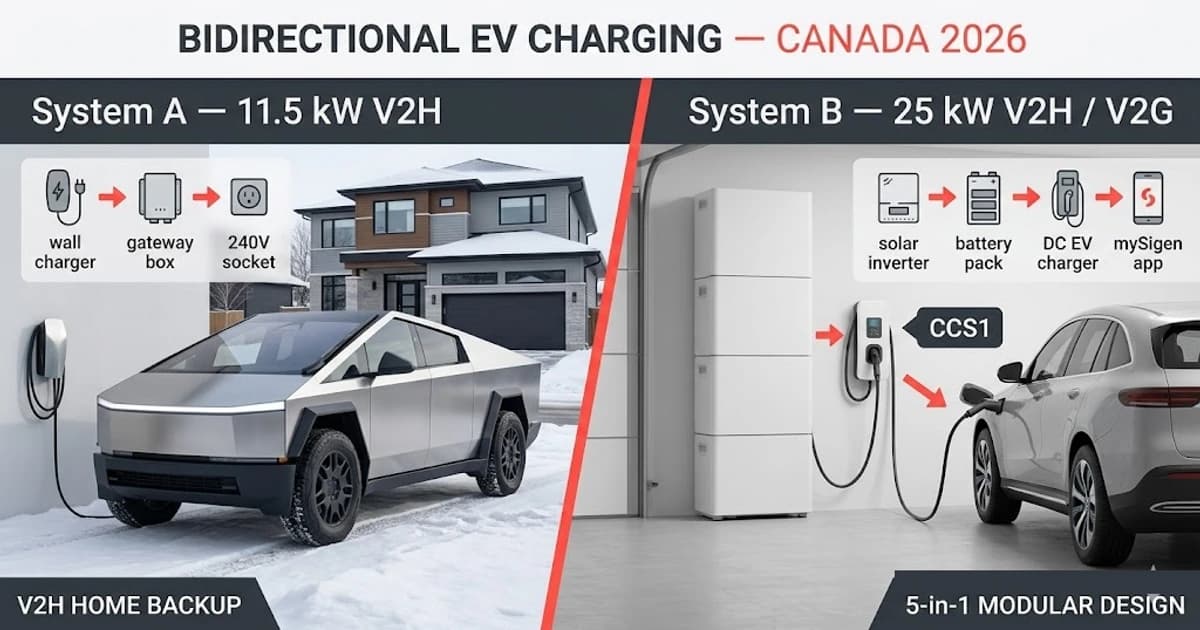
Two bidirectional EV chargers are actually shipping in Canada right now. Tesla Powershare turns a Cybertruck into an 11.5 kW home backup through the NACS charge port. It's polished, it's well-tested, and today it only works with one Tesla: the Cybertruck. The 2026 Model Y Performance gets V2L outlets, not V2H. Everyone else in the Tesla lineup is still a one-way drinker.
Sigenergy's Sigen EV DC Charging Module takes the opposite approach: 25 kW bidirectional DC, sold as a CCS1 or NACS variant, dropped into the SigenStor 5-in-1 cabinet alongside solar, battery, and an energy management system. More power, more vehicles, more architectural flexibility. Newer brand in Canada, bigger install footprint.
Bottom line: if you drive a Cybertruck and you're all-in on Tesla, buy Powershare. If you drive anything else, or you want one cabinet to run your whole home energy stack, buy Sigenergy.
Key Takeaways
- Tesla Powershare V2H is Cybertruck-only. The 2026 Model Y Performance supports V2L outlets, not V2H home backup.
- Sigenergy's Sigen EV DC Charging Module delivers 25 kW, more than double Tesla's 11.5 kW. That's enough to run a whole Canadian home during an outage without load juggling.
- Sigenergy's community-tested V2X list covers Ford Lightning, Mach-E, Hyundai Ioniq 5/6, Kia EV6/EV9, VW ID.4, Rivian R1T/R1S, and Tesla Model 3/Y (via NACS). Tesla Powershare covers only the Cybertruck.
- Both systems require manufacturer certification (Tesla Powerwall Certified for Powershare, Sigenergy-certified for SigenStor) on top of a Licensed Electrical Contractor for the Ontario panel work.
- Warranty (published): Tesla Universal Wall Connector 4 yr residential. Sigenergy battery + Energy Controller 10 yr (to 15 extended). Sigen EV DC Module 3 yr.
- Both products are UL 1741 / UL 9540 certified and cUL-accepted for use in Canada. Both must be installed by an ESA-Licensed Electrical Contractor in Ontario.
- Ontario ULO arbitrage (39.1¢ peak vs 3.9¢ overnight) is a 10× spread a V2H-capable EV can capture every day it is plugged in at home.
Why This Matters in 2026
Most Ontario homes have a stationary battery somewhere between 10 and 15 kWh. The EV parked in the driveway holds 60 to 150 kWh. For years that car-sized battery just sat there doing nothing after the daily commute, because power only flowed one way: grid in, wheels out.
Bidirectional charging flips the valve. The EV can now push power back into your home when the grid drops out (V2H), or sell it back to the grid (V2G) if your utility ever pays you to do that. Both hardware stacks in this comparison are UL 1741 and UL 9540 listed, cUL-accepted in Canada, and being installed in Ontario homes this year. No demos, no waitlists.
In early 2026 the market really is two choices for a Canadian buyer: Tesla Powershare or Sigenergy's SigenStor stack. Ford was first to the party south of the border with the F-150 Lightning's Intelligent Backup Power kit, but Ford never certified that setup for Canada, the required Charge Station Pro has been discontinued, and the program is winding down in the US as well. A Canadian Lightning owner who wants V2H today is buying third-party hardware, which in practice means Sigenergy.
Below you'll find what each system actually does, where they diverge in architecture and flexibility, and how to pick the right one without getting pulled into whichever brand your installer happens to carry.
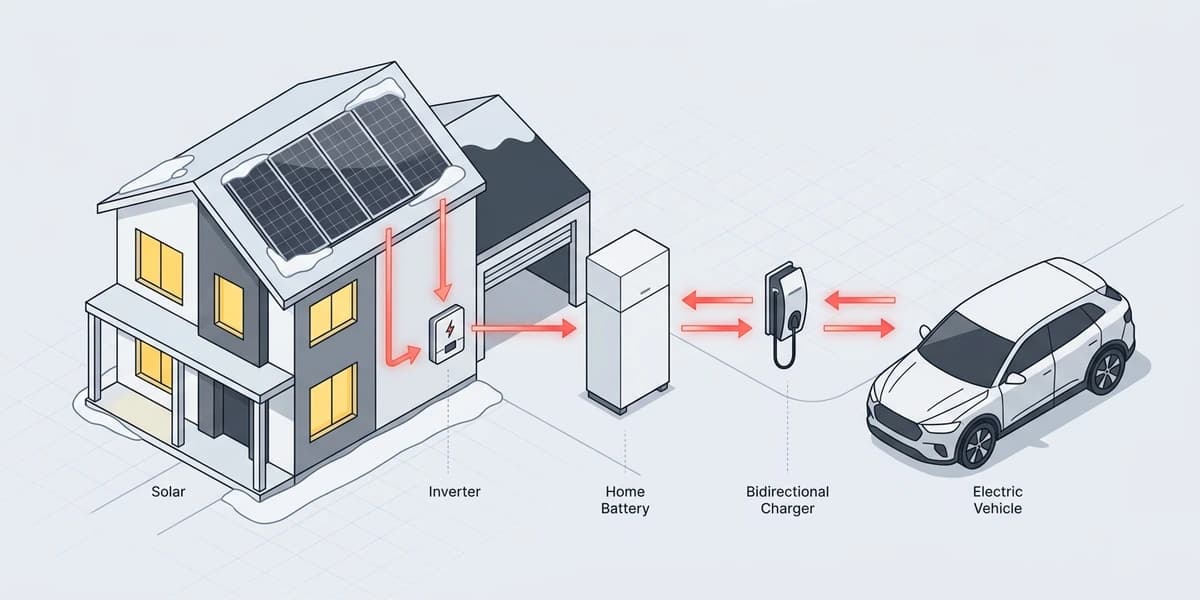
How Each System Works
Tesla Powershare
The Powershare kit is three pieces working together: a Cybertruck with the built-in bidirectional onboard charger, a Powershare Gateway bolted to your electrical panel, and the Universal Wall Connector on the garage wall. When the grid fails, the Gateway senses it and cuts the house over to the truck in about a minute, according to Tesla's Home Backup datasheet. A Powerwall does the same handover in sub-second time, so there's a noticeable lag you wouldn't have with a dedicated stationary battery.
Peak output is 11.5 kW continuous at 240V and 48A, flowing out of the Cybertruck's NACS charge port. The 9.6 kW of bed and cabin outlets are a separate circuit on the truck and can run at the same time if you need them.
The hard constraint is vehicle compatibility. Today V2H is a Cybertruck-only feature. The 2026 Model Y Performance adds vehicle-to-load outlets, which are useful for a camping fridge but won't power your house. Older Model S, 3, X and Y vehicles don't have the onboard bidirectional hardware at all, and no over-the-air update will change that.
Sigenergy SigenStor
Sigenergy takes a different design philosophy. Instead of bolting a charger to a garage wall and a gateway to a panel, the SigenStor is a single stackable cabinet that holds the solar inverter, the battery PCS, the battery modules themselves, the bidirectional DC EV charger, and an energy management system. They call it 5-in-1, and that's basically accurate. (AC charging is sold separately as the Sigen AC charger, so don't count that in the 5.)
The part that matters for this article is the Sigen EV DC Charging Module, a 25 kW bidirectional DC charger with a 150V to 1000V operating window. Because it works at the pack level instead of going through the car's onboard AC charger, it can push or pull far more power than any Level 2 setup. Sigenergy sells it in two SKUs: CCS1 (11080031) for most non-Tesla EVs in North America, and NACS (11080032) for Tesla vehicles. You pick the connector that fits your driveway.
The DC-coupled architecture is also what opens up compatibility. Sigenergy publishes a community-tested V2X list that currently covers the Ford F-150 Lightning and Mustang Mach-E, Hyundai Ioniq 5 and 6, Kia EV6 and EV9, VW ID.4, Rivian R1T and R1S, and Tesla Model 3 and Y via NACS. None of those are OEM-certified V2H pairings, so bidirectional discharge can have warranty implications with your automaker. Ask before you plug in.
Head-to-Head: Tesla Powershare vs Sigenergy SigenStor
Pulled directly from current manufacturer datasheets and the published warranty documents as of May 2026. Your installer can pressure-test any line in this table against your site-specific quote.
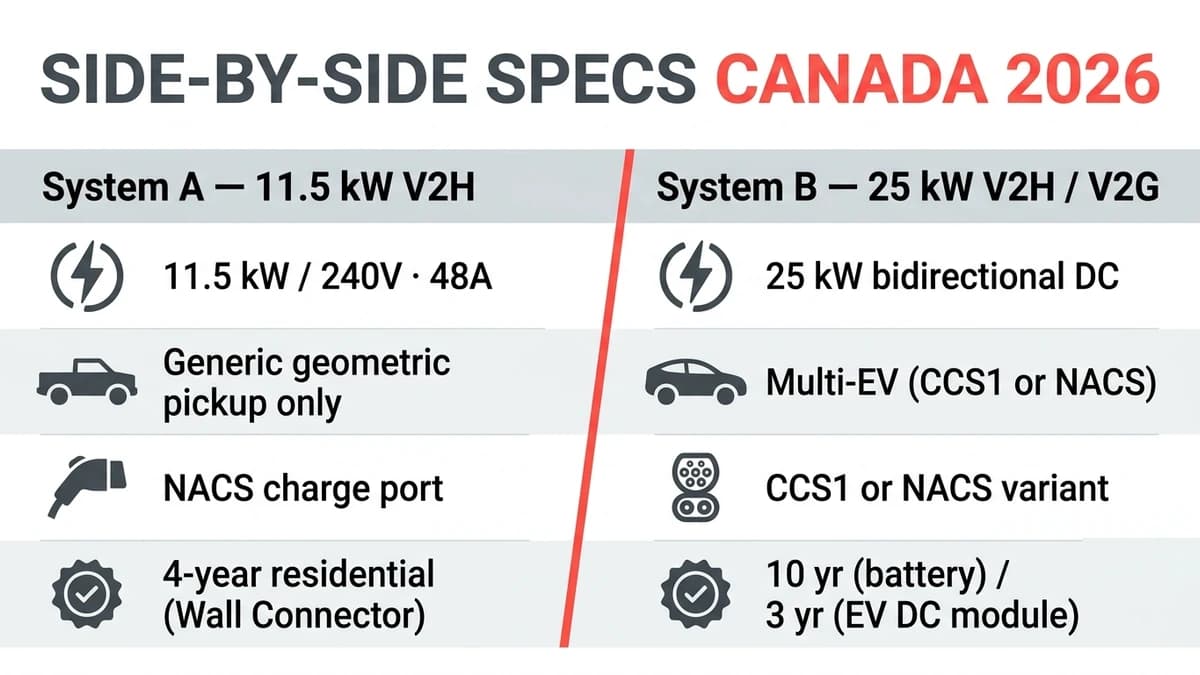
| Spec | Tesla Powershare | Sigenergy Sigen EV DC Charging Module |
|---|---|---|
| Bidirectional output | 11.5 kW continuous (240V/48A via Cybertruck NACS port) | 25 kW bidirectional DC |
| V2H vehicle compatibility | Cybertruck only | Community-tested: Ford Lightning / Mach-E, Hyundai Ioniq 5/6, Kia EV6/EV9, VW ID.4, Rivian R1T/R1S, Tesla M3/Y (NACS) |
| Architecture | Closed Tesla ecosystem, AC-coupled | Open DC-coupled, multi-vehicle (CCS1 or NACS variant) |
| Home battery integration | Powerwall 3 (delayed to mid-2026) | Built-in stackable SigenStor battery modules |
| Solar integration | Via Tesla Solar Inverter / Powerwall 3 | Built into the same 5-in-1 cabinet |
| Outage switchover | ~1 minute (Home Backup datasheet) | Automatic, comparable timing |
| App / monitoring | Tesla app | mySigen (includes Sigen AI Assistant, GPT-4o-powered) |
| Warranty (published) | Universal Wall Connector 4-yr residential; Gateway / Powerwall terms separate | Battery + Energy Controller 10 yr (15 extended). EV DC Module 3 yr. |
| Best for | Cybertruck owners who value the Tesla ecosystem | Multi-EV households or buyers who want open architecture and future flexibility |
Strip out the marketing: if you drive a Cybertruck and you're sticking with Tesla long-term, Powershare is the simpler buy. For every other buyer, or anyone who wants a single cabinet running solar, battery, EV and EMS, Sigenergy is the stronger product.
Why Certification Matters (and Why Most Ontario Installers Can Only Quote One)
This part of the buying process usually doesn't come up until you start collecting quotes and realize every installer happens to recommend whichever brand they're trained on.
Tesla and Sigenergy each run their own certification track before an installer can quote, install, commission, or warranty their products. Tesla has the Powerwall and Powershare Certified Installer programs. Sigenergy has a four-tier system (Certified, Silver, Gold, Platinum). The trainings don't overlap, and most shops only go through one of them.
On top of that, every wire, panel connection, and interconnect on a residential bidirectional EV install in Ontario has to pass inspection by the Electrical Safety Authority, and the electrical work itself has to be performed by a Licensed Electrical Contractor. That's not negotiable, and it's why some installers sub-contract the electrical side to a third party.
The practical result for a buyer is that shopping Tesla vs Sigenergy usually means calling two different installers, getting two different pitches, and having no one who can sit across the kitchen table and tell you honestly which one suits your house.
Solar X is an ESA-Licensed Electrical Contractor, a Tesla Powerwall Certified Installer, and a Sigenergy-certified partner. That means we can walk through a genuine head-to-head quote on your specific home, without a preferred-brand bias baked into the numbers. Sigenergy publishes a public installer map where you can verify any Ontario installer's certification status.
How to Choose: A Five-Question Decision Flow
Work through these in order. They get you to the right answer.
Q1. What do you drive, and what will you drive in 5 years?
If you own a Cybertruck and expect to stay in the Tesla ecosystem for the next decade, Tesla Powershare is the natural fit. If you own any other EV, Tesla Powershare does not work for V2H today, so Sigenergy is the real option. If you are planning to buy an EV in the next year or two, Sigenergy gives you more flexibility because the EV side is vehicle-agnostic.
Q2. Do you already have solar, or are you installing fresh?
If you are installing fresh, Sigenergy's 5-in-1 has the integration advantage: one cabinet, one commissioning pass, and one warranty umbrella across solar, battery, charger, and EMS. If you already have solar, either system can retrofit, but compatibility needs to be audited first.
Q3. How much power do you need during an outage?
If your critical loads (fridge, furnace fan, lights, Wi-Fi, one EV charger) are under 8 kW, both systems easily cover it. If you want whole-home backup (central AC, pool pump, EV charger, oven, dryer all running), you need Sigenergy's 25 kW. Tesla's 11.5 kW requires load management during outages: some appliances turn off when others turn on.
Q4. "One brand does everything" or "mix and match"?
If simplicity and one-vendor support are your priorities, Tesla. The tradeoff is lock-in for the life of the hardware. If you want the option to swap one component in year 8 without replacing the whole system, Sigenergy is more flexible, especially on the EV side. Your next EV might not be a Tesla. Sigenergy doesn't care.
Q5. How fast do you want to be up and running?
Tesla Powershare typically installs in 1 to 2 days when the panel is already capable. Sigenergy SigenStor is a 2 to 4 day install because there are more components, and most customers bundle solar and batteries into the same project. Add permit and ESA inspection time on top of either. Neither is guaranteed until the paperwork is in hand.
What About V2G (Selling Back to the Grid)?
The hardware can do it. The question is whether anybody in Canada will pay you for it yet.
Tesla turned on a Powershare Grid Support pilot in Texas (ERCOT, through CenterPoint and Oncor) in February 2026, and expanded it to PG&E in California in April. Cybertruck owners in those zones get bill credits for exporting during peak demand windows. There's nothing equivalent live in Ontario or the rest of Canada as of May 2026, although a handful of local distribution companies have V2X pilots in internal discussion.
The bigger earn-back for a Canadian homeowner in 2026 isn't V2G at all. It's time-of-use arbitrage. Ontario's ULO rate plan charges 39.1¢/kWh between 4pm and 9pm and 3.9¢/kWh overnight. Cover the peak with the EV pack, recharge when rates drop, and that's a 10-to-1 spread available every day the car is home in the evening.
How much does that actually add up to? It depends on how often you're home during peak hours, how much of the house runs off the pack, your ULO signup status, and the battery in your EV. Your installer can model it against your real consumption data before you commit to hardware.
The ULO rates quoted above are the Ontario Energy Board figures in effect from November 1, 2025 through April 30, 2026. If you're reading this after that, double-check the current rate schedule before running the numbers on your own payback.
Where Both Systems Fall Short
Marketing pages won't tell you any of this. These are the real-world limits we've seen from installing both platforms across Ontario homes.
Neither is a supervisory energy management system.
Both handle EV charging and basic backup automation. Neither runs predictive market arbitrage against live IESO wholesale prices, active load-shedding across circuits during extended outages, or open-architecture control across third-party inverters and batteries. For that layer, you would add a supervisory platform on top of this hardware, not replace it.
Cold weather affects both, more than you'd think.
EV batteries lose capacity in cold. CAA's 2025 Canadian winter road test recorded 14–39% range losses versus NRCan ratings at -7°C to -15°C, and deep-cold losses of 20–40% are common depending on model. Any V2H capacity estimate needs to reflect your actual winter conditions, not the EV's rated kWh figure.
Installation complexity is real.
Bidirectional hardware needs a certified electrician who has installed this specific product before. This isn't standard EV charger work. Many electricians in Canada have not yet done one of these installs. Ask for references. Ask to see past installs. Don't be the first customer a new electrician tries this on.
Panel capacity is table stakes.
Under the Ontario Building Code, homes built since January 2018 must have a 200-amp service with EV rough-in. Homes built before 1990 are commonly wired at 60–100 amps and often need a panel upgrade before a bidirectional EV system can safely integrate. The panel upgrade is not part of the quoted charger price, so get the electrical audit first.
Frequently Asked Questions
Can I do V2H in Canada right now, or is this still future tech?
Yes, right now, in 2026. Tesla Powershare (Cybertruck only) and Sigenergy's Sigen EV DC Charging Module are both UL 1741 / UL 9540 certified, cUL-accepted for use in Canada, and are being installed in Canadian homes today. This is no longer a pilot or demo. It is a shipping product category.
What EV do I need for bidirectional charging in Canada?
For Tesla Powershare, you need a Cybertruck. The 2026 Model Y Performance supports vehicle-to-load (V2L, outlets only), not V2H home backup. No other Tesla currently supports V2H. For Sigenergy's 25 kW bidirectional module, community-tested V2X vehicles include the Ford F-150 Lightning, Ford Mustang Mach-E, Hyundai Ioniq 5/6, Kia EV6/EV9, VW ID.4, Rivian R1T/R1S, and Tesla Model 3/Y (via NACS). These are Sigenergy test results, not OEM-certified V2H, and bidirectional use may affect your vehicle warranty, so confirm with your automaker before installing.
How much can I actually save with V2H in Ontario?
The larger recurring saving comes from time-of-use arbitrage, not backup. Using your EV battery to cover Ontario's 39.1¢/kWh ULO peak and recharging at 3.9¢/kWh overnight can meaningfully reduce your hydro bill. The actual saving depends on your ULO utilization, household draw, EV battery size, and how often the vehicle is plugged in during peak hours. Backup value is separate and harder to monetize: resilience, not cash flow.
Is Tesla Powershare compatible with the Powerwall 3?
Not yet. Tesla announced Powershare + Powerwall 3 integration and has publicly confirmed the launch is delayed to mid-2026. Until that ships, Powershare backs up the home directly from the Cybertruck through the Powershare Gateway and Universal Wall Connector, with no Powerwall 3 in the loop.
Can Sigenergy's charger work with a Tesla vehicle?
Yes, for charging. Sigenergy's Sigen EV DC Charging Module is sold in two variants: CCS1 (SKU 11080031) and NACS (SKU 11080032). The NACS variant works natively with Tesla vehicles. For bidirectional operation, Sigenergy's community-tested list includes Tesla Model 3 and Model Y via the NACS module. The Cybertruck's V2H capability is currently tied to Tesla's own Powershare system.
Which has better cold-weather performance in Canada?
Both systems are rated for Canadian climate. The real variable is the EV battery. CAA's 2025 Canadian winter road test recorded 14–39% range loss versus NRCan ratings at -7°C to -15°C, and losses can reach 20–40% in deep cold depending on model. Any V2H backup capacity estimate needs to account for your actual winter temperatures and driving patterns, not the EV's rated kWh figure.
How long does a typical install take?
Tesla Powershare: typically 1 to 2 days when the electrical panel is already capable. Sigenergy SigenStor: 2 to 4 days, because there are more components and the install often includes solar panels and batteries in the same stack. Add additional time for any required panel upgrade, ESA inspection, and utility interconnection approval. None of those approvals are guaranteed until they are physically in hand.
What happens to V2H during a multi-day outage?
Battery capacity determines runtime. A Tesla Cybertruck has a 123 kWh pack and can run essential loads in a typical Canadian home for roughly 5 to 8 days on a full charge. EVs with 60 to 80 kWh packs typically give 2 to 4 days on critical loads. With Sigenergy, a paired SigenStor battery stack extends runtime further because the EV does not have to carry the whole load. If extended outages are common where you live, pair the EV with a substantial stationary battery.
Can I get rebates or incentives for bidirectional charging in Canada?
Programs vary by province and utility, and they change. As of early 2026, some Ontario local distribution companies are piloting managed-charging programs that touch V2X, but dedicated rebates for bidirectional chargers are not yet a standard Canadian offering. The federal iZEV program covers eligible EV purchases, not the bidirectional charger hardware. Always confirm current rebate availability with your installer. Rebates are never guaranteed until approvals are in hand. For broader Ontario solar and battery incentives, see the Home Renovation Savings Program and Solar X's current rebate overview.
What are the actual warranties on each system?
Tesla: the Universal Wall Connector carries a 4-year residential limited warranty per Tesla's published Charging Equipment Limited Warranty. Powershare Gateway and Powerwall components have their own separate warranty terms, so review your installation paperwork for specifics. Sigenergy: the SigenStor battery pack and Energy Controller carry a 10-year standard warranty, extendable to 15 years on qualifying configurations. The Sigen EV DC Charging Module carries a 3-year warranty. EV traction batteries carry their own warranty through the vehicle manufacturer (typically 8 years for the high-voltage pack).
How do I know if my home is ready for bidirectional charging?
Three things must be in place. First, adequate service capacity: under the Ontario Building Code, homes built since January 2018 must have a 200-amp service with EV rough-in, but homes built before 1990 are commonly wired at 60 to 100 amps and often need a panel upgrade first. Second, a clear 240V circuit route to the garage or driveway with appropriate conduit and grounding. Third, an ESA-Licensed Electrical Contractor who holds manufacturer certification for the specific system being installed and has completed previous V2H installations. A pre-install electrical audit catches panel balance, feeder sizing, and grounding issues before quoting.
The Solar X Recommendation
If you drive a Cybertruck
Go with Tesla Powershare. 11.5 kW of V2H through the NACS port, the cleanest install we've done, and the tightest EV-to-home-battery integration once the Powerwall 3 link turns on later this year. The cost of entry is living inside the Tesla ecosystem for the next decade, which Cybertruck owners are usually fine with.
If you drive anything else (or haven't decided yet)
Go with Sigenergy SigenStor. You get 25 kW bidirectional, roughly double what Tesla delivers, and a single cabinet that handles solar, battery, DC EV charging, and the energy management software. Fifteen years from now you can swap your EV, your battery modules, or your solar panels without rebuilding the stack. The brand is newer in Canada, and the install footprint is bigger. That's the trade.
If multi-day outages are a thing where you live
Pair whichever system you pick with a proper stationary battery. A Cybertruck's 123 kWh pack can cover essentials for five to eight days on its own, but a 60–80 kWh mid-size EV only gives you two to four. Stationary storage stretches that window and means you can still drive the car out for supplies when you need to.
Why Solar X
Ontario Installation Coverage
Solar X installs bidirectional EV charging systems across Ontario. Our installation teams are active in the following regions:
Greater Toronto Area
Toronto, Mississauga, Brampton, Markham, Richmond Hill, Vaughan, Oakville, Burlington, Pickering, Ajax, Whitby, Oshawa, Newmarket, Aurora, King City.
Ottawa & Eastern Ontario
Ottawa, Kingston, Peterborough, Belleville, Cornwall, Brockville, and surrounding communities.
Hamilton & Niagara
Hamilton, St. Catharines, Niagara Falls, Welland, Grimsby, and surrounding areas.
Southwestern Ontario
London, Kitchener, Waterloo, Cambridge, Guelph, Woodstock, and surrounding communities.
If your city is not listed, contact us. Our Ontario coverage continues to expand.
Want a real head-to-head quote for your house?
Solar X is certified on both Tesla Powershare and Sigenergy SigenStor, which makes us one of the few Ontario installers who can actually price both on the same visit. Book a consult and we'll walk your panel, pull your consumption data, and send back two honest quotes for your specific home, EV, and driveway. Permits and utility approvals never happen on a guaranteed timeline, and we'll tell you that upfront.
Reviewed by Solar X Engineering Team · ESA-Licensed Electrical Contractor (Ontario) · Tesla Powerwall Certified Installer.