
Quick answer
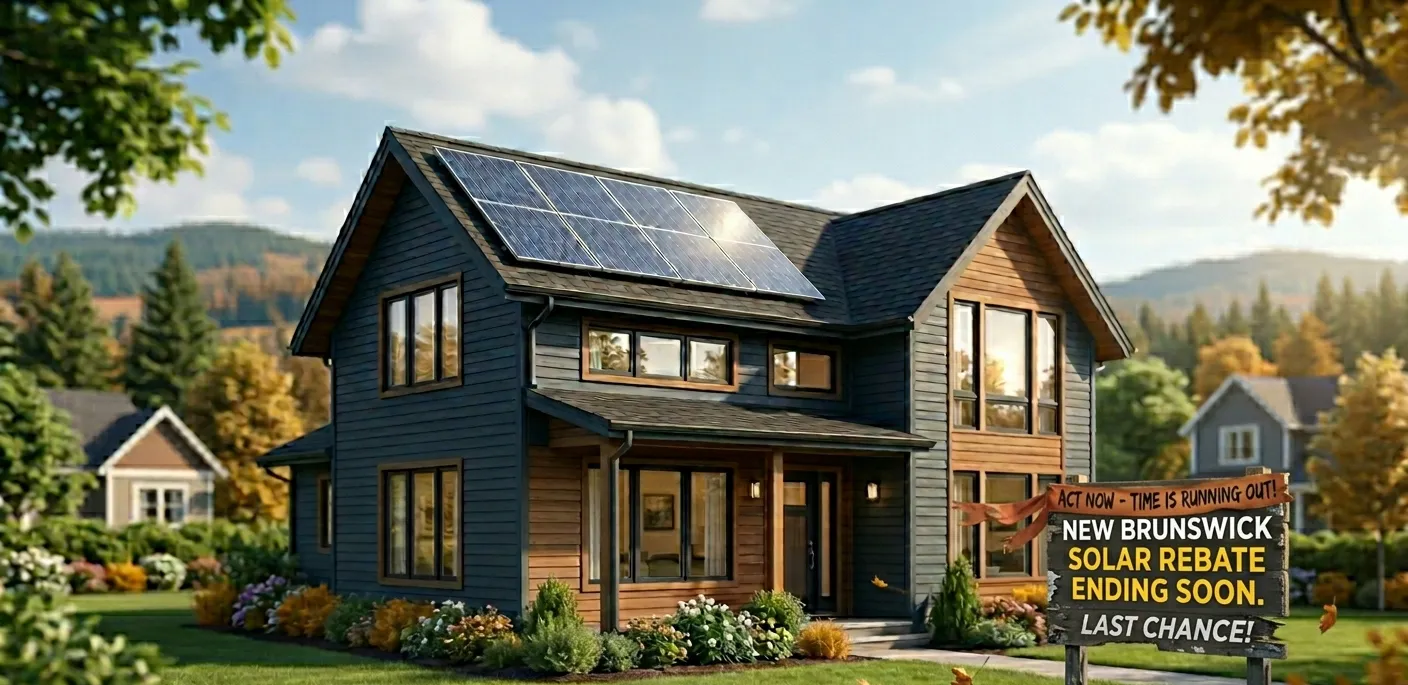
Registration for New Brunswick's provincial solar rebate closes on May 27, 2026. Installations and final paperwork must be complete by January 31, 2027. The residential Total Home Energy Savings Program pays about $200 per kW, up to $3,000; the Business Rebate Program covers up to 25% of project cost, capped at $250,000. NB Power net metering (1-to-1 retail credit, up to 100 kW) and the federal 30% Clean Technology Investment Tax Credit are unaffected. The current NB Power residential rate is 15.39¢/kWh, effective April 14, 2026 after a 4.29% increase - every hike makes solar production worth more.
Reviewed by the Solar X Engineering Team. ESA/ECRA Licensed Electrical Contractor (Licence 7017538). Active NB Power Net Metering registered contractor. Save Energy NB Total Home Energy Savings Program participating installer.
Last verified: May 11, 2026 against current NB Power, Save Energy NB, and CRA documentation. Audience: New Brunswick homeowners, businesses, and farms considering solar in 2026.
If you have been thinking about solar in New Brunswick, there is a piece of news worth paying attention to. NB Power is closing the door on the solar PV rebate that has helped fund residential and commercial systems across the province for years. The registration deadline is May 27, 2026. After that, the provincial cash incentive for going solar is off the table.
A lot of articles about this lean hard on urgency, and we get why. But we run installs across Atlantic Canada every week, and we want to give you something more useful than “act now before it's gone.” Here is the real picture of what is changing, what is not, and what it actually means for the economics of solar in New Brunswick.
Registration deadline
May 27, 2026
Installation deadline
January 31, 2027
Residential rebate
$200/kW · up to $3,000
Commercial rebate
25% · up to $250,000
Net metering
Unchanged · 1-to-1 retail
Federal Clean Tech ITC
Unchanged · 30% (business)
Current NB Power rate
15.39¢/kWh · since Apr 14, 2026
Rate trend
+34.9% since Apr 2023
Min / max system (rebate)
1 kW – 15 kW
Typical home system
8–11 kW
The short version
NB Power and Save Energy NB are restructuring their incentive programs. The solar PV portion of two key programs is being retired:
- The Total Home Energy Savings Program (residential) is dropping its solar rebate stream.
- The Business Rebate Program is dropping its solar PV funding.
Both close to new registrations on May 27, 2026. If your application is in before that date, you still have until January 31, 2027 to complete the install and receive payment.
The rest of those programs (insulation, heat pumps, air sealing, weatherization) continue running. NB Power is shifting its money toward energy-efficiency upgrades it believes deliver broader benefit per dollar spent. You can read the registration notice on the NB Power Net Metering page.
What you'd be giving up if you miss the deadline
For homeowners, the Total Home Energy Savings Program currently pays out around $200 for every kilowatt of solar capacity you install, with a maximum of $3,000. That maxes out around 15 kW of panels, which is more than most homes need. On a standard residential system of 8 to 10 kW, you are looking at roughly $1,600 to $2,000 in rebate money.
For businesses, the Business Rebate Program is more substantial. It covers up to 25 percent of eligible solar project costs, capped at $250,000 per site. On a mid-size commercial install, that is real money.
Both rebates require you to register first, get a Home Energy Evaluation done by a Certified Energy Advisor, install the system, then complete a final evaluation. The timeline is not fast. Booking the energy-advisor visit alone can take a few weeks. That is why the May 27 date matters more than the January install deadline - you need time to move through the process.
What's not changing
This is the part most articles skip over, and it matters more than the rebate itself.
Net metering stays
NB Power's net metering program is not being touched. You can still install a solar system up to 100 kW and earn 1-to-1 credit at the retail electricity rate for every kilowatt-hour you send to the grid. Credits reconcile annually on March 31. The full program details are on the NB Power net metering FAQ page. For most homeowners, net metering is the bigger financial lever anyway: a typical residential system in New Brunswick generates somewhere around 10,000 kWh per year, which at the current retail rate of 15.39¢/kWh (effective April 14, 2026) is roughly $1,585 in annual electricity savings, every year, for 25 to 30 years. The rebate is a one-time bonus. Net metering is the ongoing return. (Note: Saint John Energy and Edmundston Energy are separate municipal utilities with their own net-metering rules - see the by-city table below.)
Federal clean-technology credit stays
If you are a business, a farm, or an incorporated entity, the federal Clean Technology Investment Tax Credit is still very much in play. It is a refundable 30 percent tax credit on eligible solar and battery storage equipment, available through 2033 before stepping down. It does not apply to individual homeowners.
NB Power rates keep climbing
This is not an incentive, but it is the most underrated reason solar in New Brunswick has gotten more attractive over the last few years, not less. Per CBC News reporting, NB Power rates have risen roughly 34.9 percent since April 2023 - two annual hikes near 10 percent in 2024 and 2025, plus a separate 3 percent variance rider. The most recent increase of 4.29 percent took effect April 14, 2026, taking the residential rate from 14.76¢/kWh to 15.39¢/kWh (see NB Power's official rate page). NB Power has also publicly forecast further 6.5 percent rate-increase requests in each of the next two fiscal years. Every rate increase makes your existing solar production more valuable, because you are avoiding more expensive grid power.
The honest math on losing the rebate
Let's run actual numbers on a typical 9 kW residential install - the kind we'd quote for a New Brunswick home using around 10,000 kWh per year, at the current 15.39¢/kWh retail rate. These are illustrative figures; your quote will reflect your roof, shading, and utility rate.
| Line item | With rebate | Without rebate |
|---|---|---|
| System cost (9 kW) | $22,500 | $22,500 |
| THESP rebate | − $1,800 | $0 |
| Your net cost | $24,000 | $22,500 |
| Annual generation | ≈ 10,300 kWh | ≈ 10,300 kWh |
| Annual savings (at 15.39¢/kWh) | ≈ $1,585 | ≈ $1,585 |
| Estimated payback | ≈ 10.1 years | ≈ 11.2 years |
Losing the rebate adds about 13 months to your payback period on a system that will keep producing electricity for 25 to 30 years. It is a real cost, but it is not the difference between solar making sense and not making sense.
What is actually moving the payback math more than the rebate is the rate hikes. If NB Power's forecast 6.5 percent increases come through in 2027 and 2028, that 11.2-year payback gets pulled back closer to 10. Run the same math forward with compounding rate inflation and the rebate becomes a rounding error next to the long-term savings curve. The structural case for solar in New Brunswick has very little to do with the rebate. It has to do with NB Power's pricing trajectory - you can dig into the full ROI logic in our New Brunswick solar guide.
Why NB Power is making this change
Worth understanding the why, because it tells you something about whether this is likely to come back.
Solar rebates have historically gone to homeowners with money, the right kind of roof, and a south-facing aspect. That is a narrow group. Insulation, heat pumps, and air sealing reach renters, low-income households, older homes, and apartments. From a utility's perspective, those upgrades cut grid demand more broadly per dollar spent, and they help the people who are struggling with bills the most - which matters in a province with the second-highest energy-poverty rate in Canada, around 25.6 percent of households, per the Human Development Council's New Brunswick energy-poverty reporting.
That is the policy logic. It is defensible. It also means a successor solar program is unlikely to appear quickly. Plan around the rebate going away and treat anything that comes back later as a bonus.
Solar by city in New Brunswick
Solar economics vary slightly across the province depending on your local utility and solar irradiance. Here is a quick reference for the cities we serve. Yield figures are typical annual generation per installed kilowatt; your quote will reflect your actual roof and address.
| City | Utility | Annual yield (kWh/kW) | Notes |
|---|---|---|---|
| Moncton | NB Power | ≈ 1,180 | Highest yield in the province |
| Dieppe | NB Power | ≈ 1,180 | Same micro-region as Moncton |
| Riverview | NB Power | ≈ 1,170 | Strong residential market |
| Fredericton | NB Power | ≈ 1,150 | Capital region, good roof stock |
| Oromocto | NB Power | ≈ 1,150 | Near Fredericton |
| Quispamsis | NB Power | ≈ 1,145 | Suburban, large lot sizes |
| Sussex | NB Power | ≈ 1,150 | Rural, larger systems common |
| Saint John | Saint John Energy | ≈ 1,140 | Municipal utility - different rules; can pay cash for excess |
| Miramichi | NB Power | ≈ 1,140 | Central-east NB |
| Bathurst | NB Power | ≈ 1,130 | Northern NB, slightly lower winter yield |
| Edmundston | Edmundston Energy | ≈ 1,115 | Municipal utility - confirm local interconnection rules |
Saint John customers
Saint John Energy is a municipally owned utility and runs a different program than NB Power. Excess solar generation can earn a cash payment at year-end rather than rolling 1-to-1 credit, which slightly favours oversizing your system - the opposite of the NB Power rule. Work with an installer who understands the difference.
Edmundston customers
Edmundston Energy runs its own net-metering program. Always confirm your local interconnection rules before sizing your system.
What to do if you're a homeowner
If you have been seriously considering solar, the next two to three weeks matter. Here is the sequence we'd recommend:
- 1
Get a real quote this week
Not a back-of-napkin estimate. You need a confirmed system size in kilowatts, because that is what goes on the rebate paperwork. Request a free Solar X assessment here.
- 2
Book the NB Power Home Energy Evaluation
Call 1-800-663-6272 or apply through Save Energy NB. This is required for the rebate.
- 3
Submit registration before May 27, 2026
We handle this paperwork for clients, but you can also do it yourself through Save Energy NB.
- 4
Schedule your install for summer or fall
You have until January 31, 2027, but installer calendars in Atlantic Canada fill up after late August. Don't leave it.
If you are not sure solar is right for your home, that is fine. Don't rush a $20,000 decision because of an $1,800 rebate. Get the assessment done, look at your actual numbers, and decide on the merits.
What to do if you're a business or farm
The math here is different and the stakes are higher. A commercial install with the Business Rebate Program stacked on the 30 percent federal ITC can knock more than half off your project cost. That window is closing on the provincial side.
- 1
Get a commercial site assessment now
Commercial registrations have more moving parts. See our New Brunswick service page or our commercial solar & storage page.
- 2
Talk to your accountant about CCA Class 43.2
Eligible solar equipment can be expensed quickly for tax purposes. Stacked with the ITC, it is a meaningful cash-flow benefit.
- 3
Watch the domestic-content rules
The federal government is consulting on adding domestic-content requirements to the ITC. If those come in, the 30 percent rate could be reduced for systems using non-Canadian equipment. We track this for our commercial clients.
- 4
Submit Business Rebate Program registration before May 27, 2026
Don't leave this to the last week.
A note on what to ignore
You will see a lot of “exclusive rebate” claims from installers over the next few weeks. Some are real, some are marketing. Anyone offering a private rebate that exactly replaces the public one is almost always just discounting their margin and calling it something fancier. Ask any installer this: “If the government rebate didn't exist, would your price still be this?” If the answer involves footwork, move on.
The honest version is simple: the provincial rebate is closing. Net metering remains. NB Power rates keep climbing. Solar still works in New Brunswick - it just works a little slower without the $1,800 head start.
Beat the May 27 deadline
Solar X is an ESA/ECRA Licensed Electrical Contractor and a registered NB Power Net Metering contractor with 10,000+ installations across Canada. We'll size your system, confirm the kilowatt figure the rebate paperwork needs, and handle the Save Energy NB registration on your behalf - before the window closes.
Serving Moncton, Fredericton, Saint John, Dieppe, Riverview, Quispamsis, Bathurst, Miramichi, and Edmundston.
Frequently asked questions
When exactly does the New Brunswick solar rebate end?+
Registration for solar PV under NB Power's Total Home Energy Savings Program (residential) and Business Rebate Program (commercial) closes on May 27, 2026. Final installations, energy evaluations, and rebate paperwork must be completed by January 31, 2027 for anyone registered before the May deadline.
How much is the NB Power solar rebate worth?+
Homeowners receive roughly $200 per kilowatt of installed solar capacity, up to a maximum of $3,000, through the Total Home Energy Savings Program. On a typical 8 to 10 kW residential system that is about $1,600 to $2,000. Businesses can receive up to $250,000, or 25 percent of eligible project costs, through the Business Rebate Program.
Does my solar system need to be installed by May 27, 2026?+
No. Only your registration needs to be submitted by May 27, 2026. You have until January 31, 2027 to complete the physical installation, the post-retrofit energy evaluation, and the rebate paperwork. Because booking the required Certified Energy Advisor evaluation can take a few weeks, the May registration date is the one that matters.
Is NB Power net metering also ending?+
No. Net metering is a separate program and is not affected by the rebate sunset. Grid-tied solar systems up to 100 kW continue to earn 1-to-1 credit at the retail electricity rate, with annual reconciliation on March 31. For most homeowners, net metering is a bigger financial lever than the one-time rebate. Note that Saint John Energy and Edmundston Energy are separate municipal utilities with their own net-metering rules.
What is the current NB Power residential electricity rate?+
The NB Power residential electricity rate is 15.39 cents per kilowatt-hour as of April 14, 2026, following a 4.29 percent increase approved by the New Brunswick Energy and Utilities Board (up from 14.76 cents). NB Power has publicly forecast further rate-increase requests of around 6.5 percent in each of the next two fiscal years, and rates have risen roughly 34.9 percent since April 2023.
Can homeowners still get a federal rebate for solar in Canada?+
Not currently. The Canada Greener Homes Grant closed in 2024 and the Greener Homes Loan portal closed October 1, 2025. The federal Clean Technology Investment Tax Credit at 30 percent is available only to businesses, farms, and incorporated entities through 2033 - not to individual homeowners.
What happens if I miss the May 27, 2026 deadline?+
You lose access to the provincial rebate worth up to $3,000 for homeowners or up to $250,000 for businesses. Solar still pays back through net metering and continued NB Power rate increases - payback periods typically extend by roughly 12 to 18 months without the rebate, on a system that produces electricity for 25 to 30 years.
Will the New Brunswick solar rebate return after 2026?+
NB Power has not announced any plans to bring the solar PV rebate back. The utility is reallocating funds toward insulation, heat pumps, and weatherization, which reach a broader range of households per dollar spent. Plan as if the solar rebate is not returning, and treat anything that comes back later as a bonus.
Can I stack the NB solar rebate with battery storage offers?+
Yes. The provincial rebate covers solar PV. Battery storage incentives such as the Tesla Powerwall 3 rebate (roughly $700 to $1,400 via virtual Visa) run separately and can be combined with the solar rebate.
What size solar system qualifies for the New Brunswick rebate?+
The minimum eligible system size is 1 kW, and the maximum capacity used for rebate calculation is 15 kW. Most New Brunswick homes install systems in the 8 to 11 kW range based on typical annual electricity consumption of roughly 9,000 to 13,000 kWh.
Can a business stack the Business Rebate Program with the federal Clean Technology ITC?+
Yes. A New Brunswick business that registers before May 27, 2026 can claim up to 25 percent of project costs through the Business Rebate Program and an additional 30 percent refundable tax credit through the federal Clean Technology ITC. Stacked, that can offset more than half of total commercial solar project costs, and CCA Class 43.2 accelerated depreciation can be layered on top.
Is solar worth it in Moncton, Fredericton, or Saint John?+
Yes. All three cities receive between roughly 1,140 and 1,180 kilowatt-hours of generation per installed kilowatt of solar capacity per year. With NB Power retail rates at 15.39 cents per kilowatt-hour and rising, payback periods for a typical 9 to 10 kW system in these cities run about 10 to 12 years, on equipment that produces for 25 to 30 years. Saint John is served by Saint John Energy, which has different net-metering rules than NB Power.
Service areas across New Brunswick
Solar X installs residential and commercial solar, battery storage, and net-metering connections across New Brunswick. Each city has its own combination of local utility rules, building-code considerations, and roof stock - we quote based on your actual address.
Greater Moncton
Moncton · Dieppe · Riverview
Capital Region
Fredericton · Oromocto
Saint John Region
Saint John · Quispamsis · Rothesay
Northern NB
Bathurst · Miramichi · Campbellton
Western NB
Edmundston · Grand Falls · Woodstock
Southern NB
Sussex · St. Stephen
Contact Solar X
Solar X - New Brunswick Solar Installation
- 1-833-376-5279
- solar-x.ca/contact
- solar-x.ca/provinces/new-brunswick
- ESA/ECRA Licensed Electrical Contractor - Licence 7017538
About the author
Solar X Engineering Team. ESA/ECRA Licensed Electrical Contractor (Licence 7017538). We have completed 10,000+ residential and commercial installations across Ontario, New Brunswick, Nova Scotia, Alberta, and beyond. Our New Brunswick installations are performed in compliance with the NB Department of Public Safety, Technical Inspection Services, as required under the New Brunswick Electrical Installation and Inspection Act. We are a registered participating contractor with NB Power Net Metering and the Save Energy NB Total Home Energy Savings Program, and a Tesla Powerwall Certified Installer. This article was reviewed against current NB Power, Save Energy NB, and CRA documentation. Last verified May 11, 2026.
Related Solar X resources
- New Brunswick Solar Guide: Incentives, Costs & Net Metering
- Federal Clean Technology Investment Tax Credit - Complete Guide
- Federal ITC for Solar in Canada
- Canadian Solar Rebates & Incentives Guide 2026
- Is Solar Power Worth It in Canada in 2026?
- New Brunswick Solar Service Page
Sources and further reading
Primary sources (government and utility)
- NB Power - Net Metering Program (official registration notice)
- NB Power - Net Metering FAQ
- NB Power - Rate Application and 2026 Increase
- Save Energy NB - Total Home Energy Savings Program
- Save Energy NB - Add-On Incentives (Solar PV)
- Canada Revenue Agency - Clean Economy Investment Tax Credits
- Department of Finance Canada - Domestic Content Consultation (February 2026)
- Government of New Brunswick - Department of Public Safety, Technical Inspection Services (Electrical)
- Saint John Energy - Solar / Net Metering
- Edmundston Energy
News reporting (rate increases & energy poverty)
- CBC News - NB Power rate increase of 4.29% approved (April 2026)
- CBC News - NB Power forecasts further ~6.5% rate-increase requests (March 2026)
- NB Media Co-op - Human Development Council on New Brunswick energy poverty (March 2026)
Reviewed by the Solar X Engineering Team. Solar X is an ESA/ECRA Licensed Electrical Contractor (Licence 7017538), a registered NB Power Net Metering contractor, a Save Energy NB Total Home Energy Savings Program participating installer, and a Tesla Powerwall Certified Installer. Article published May 11, 2026 and will be updated as NB Power and Save Energy NB program details change. All program figures cited are verified against primary sources at nbpower.com, saveenergynb.ca, and canada.ca as of May 11, 2026. The NB Power residential rate of 15.39 cents per kilowatt-hour reflects the 4.29 percent increase that took effect April 14, 2026. Always confirm current program rules and rates directly with NB Power, Saint John Energy, Edmundston Energy, and Save Energy NB before making a purchase decision.