
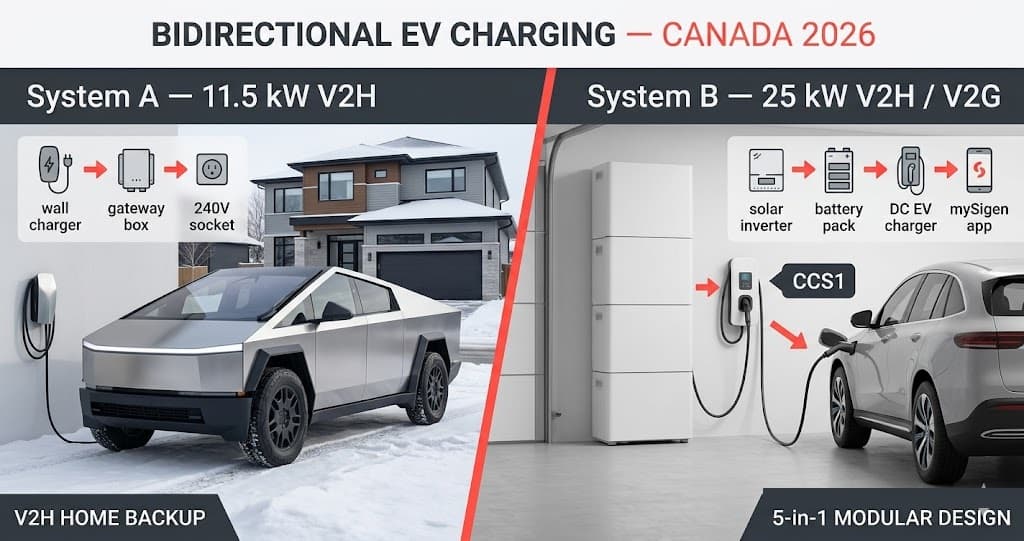
Canadian homeowners can power their electric vehicles with solar panels by adding 6–8 additional 400W panels to offset the 3,000–4,000 kWh EVs consume annually, achieving a 5–7 year payback when combined with net metering and federal incentives. V2H bidirectional charging lets EV owners use their vehicle battery as home backup storage, while Level 2 smart chargers with solar-matching features maximize self-consumption during peak solar production hours of 10 AM to 4 PM.
EV Charging with Solar: Complete Guide for Canadian Homeowners
Last verified: March 4, 2026
Combining solar panels with electric vehicle (EV) charging is the ultimate sustainable transportation solution. Canadian homeowners can now power their EVs with clean, renewable energy while eliminating both gas station visits and electricity bills. This comprehensive guide explains everything you need to know about solar-powered EV charging, from system sizing and costs to incentives and real-world savings.
Why Combine Solar Panels with EV Charging?
Electric vehicles and solar energy are a perfect match. EVs require significant electricity to charge—typically 3,000-4,000 kWh annually for average Canadian drivers. Solar panels can produce this energy cleanly and cost-effectively, creating a truly zero-emission transportation solution.
Key Benefits
- Cost Savings: Solar electricity costs $0.02-$0.04 per kWh over 25 years, compared to $0.10-$0.20 per kWh from the grid. This can save up to $800-$1,200 annually on EV charging, depending on usage and rate plan.
- Energy Independence: Generate your own transportation fuel at home, immune to gas price fluctuations and electricity rate increases.
- Environmental Impact: Achieve true zero-emission driving. A solar-powered EV produces no greenhouse gases from well-to-wheel.
- Increased Home Value: Homes with solar + EV charging infrastructure sell for 4-5% more than comparable homes.
- Federal Incentives: Canada offers 30% tax credits on solar installations and up to $5,000 in EV charger rebates.
How Much Solar Do You Need for EV Charging?
Sizing your solar system for EV charging depends on your driving habits, EV model efficiency, and local solar production. Here's how to calculate your needs:
Step 1: Calculate Annual EV Energy Consumption
Most EVs consume 15-20 kWh per 100 km. For 20,000 km of annual driving:
- Tesla Model 3: 16 kWh/100km = 3,200 kWh/year
- Chevrolet Bolt: 17 kWh/100km = 3,400 kWh/year
- Ford F-150 Lightning: 25 kWh/100km = 5,000 kWh/year (larger vehicle)
Step 2: Determine Required Solar Capacity
In Canada, a 1 kW solar system produces approximately 1,100-1,400 kWh annually depending on location:
- Southern Ontario: 1,200 kWh per kW installed
- Alberta: 1,300 kWh per kW installed
- British Columbia: 1,100 kWh per kW installed (coastal)
- Nova Scotia: 1,150 kWh per kW installed
For a typical EV requiring 3,500 kWh annually in Ontario:
Required System Size = 3,500 kWh ÷ 1,200 kWh/kW = 2.9 kW (7-8 solar panels)
Recommended Solar System Sizes
- Compact EV (Tesla Model 3, Nissan Leaf): 2.4-2.8 kW (6-7 panels of 400W each)
- Mid-Size EV (Hyundai Ioniq 5, VW ID.4): 2.8-3.2 kW (7-8 panels)
- Large EV/Truck (F-150 Lightning, Rivian R1T): 4.0-4.8 kW (10-12 panels)
EV Charger Options for Solar Homes
Level 1 Charging (120V)
Standard household outlet providing 1.4 kW (5-8 km of range per hour). Best for plug-in hybrids or low-mileage drivers. No special installation required, but very slow for full EVs.
Level 2 Charging (240V) - Recommended
Dedicated 240V circuit providing 7.2-19.2 kW (30-80 km of range per hour). This is the sweet spot for home solar charging:
- ChargePoint Home Flex: $799, WiFi enabled, adjustable amperage (16-50A), works with all EVs
- JuiceBox 40: $699, smart scheduling to maximize solar usage, 40A output
- Tesla Wall Connector: $550, optimized for Tesla vehicles, 48A output, sleek design
- Flo Home X5: $899, Canadian company, extreme weather rated, 40A output
Solar-Smart Charging Features
Modern Level 2 chargers offer solar optimization features:
- Scheduled Charging: Program your EV to charge during peak solar production hours (10 AM - 4 PM)
- Solar Matching: Some chargers can communicate with solar inverters to charge only when excess solar is available
- Load Balancing: Automatically adjusts charging rate based on home energy consumption and solar production
Costs and Savings Analysis
Installation Costs (2025 Pricing)
Solar Panel System for EV (3 kW system):
- Equipment and installation: $6,000-$8,000
- Less: Federal Clean Technology ITC (30%): -$1,800-$2,400
- Less: Provincial incentives (varies): -$0-$1,000
- Net Cost: $4,200-$5,600
Level 2 EV Charger:
- Charger unit: $550-$900
- Electrical installation (240V circuit + panel upgrade if needed): $500-$1,500
- Total: $1,050-$2,400
- Less: Zero Emission Vehicle Infrastructure Program (ZEVIP) rebate: up to $5,000 for home chargers in some provinces
Annual Savings Breakdown
Compared to Grid Charging:
- Grid electricity cost (3,500 kWh @ $0.15/kWh): $525/year
- Solar electricity cost (maintenance only): $50/year
- Annual Savings: $475/year
Compared to Gasoline Vehicle:
- Gas cost (20,000 km @ 8L/100km, $1.60/L): $2,560/year
- Solar EV charging cost: $50/year
- Annual Savings: $2,510/year
Return on Investment
Solar System ROI (EV charging only): Net cost of $5,000 ÷ $475 annual savings = 10.5-year payback. However, when combined with home energy offset, payback drops to 6-8 years.
Total EV + Solar Savings (25 years): Gas savings ($2,510/year) × 25 years = $62,750. Minus system costs ($7,000) = $55,750 net savings over vehicle lifetime.
Solar EV Charging with Battery Storage
Adding battery storage enables 24/7 solar-powered EV charging, even at night or during cloudy weather. This creates complete energy independence for both your home and vehicle.
Recommended Battery Systems
- Tesla Powerwall 3: 13.5 kWh capacity, integrated inverter, $13,000-$15,000 installed. Can fully charge a Tesla Model 3 (50 kWh battery) in 3-4 nights.
- Enphase IQ Battery 5P: Modular system, 5 kWh per battery, stackable up to 60 kWh. $9,000-$11,000 for two batteries (10 kWh total).
- Growatt APX 10.0-H1: 10 kWh capacity, budget-friendly option at $8,000-$10,000 installed.
Battery Sizing for EV Charging
Daily EV charging needs: 3,500 kWh ÷ 365 days = 9.6 kWh per day average. Consider a battery system that provides:
- 10-15 kWh usable capacity: Supports overnight EV charging plus essential home loads
- 15-20 kWh usable capacity: Provides 2-3 days of EV charging backup and full home backup
Provincial Incentives for Solar EV Charging
Federal Programs
- Clean Technology Investment Tax Credit: 30% refundable tax credit on solar panel systems, applicable to systems installed after March 2023
- Canada Greener Homes Grant (closed to new applicants): Up to $5,000 for solar installations
Ontario
- Net Metering: Bank excess solar credits at retail rate ($0.10-$0.20/kWh) for use during evening EV charging
- EV Charging Incentive: Up to $1,000 for Level 2 home charger installation through various municipal programs
British Columbia
- CleanBC Go Electric Program: Up to $350 for Level 2 home charging station
- BC Hydro Net Metering: Annual true-up at $0.0994/kWh (about 80% of retail rate)
Alberta
- Municipal Solar Programs: City of Calgary and Edmonton offer property tax exemptions for solar installations
- Micro-generation Regulation: Sell excess solar power back to grid at retail rate
Nova Scotia
- Enhanced Net Metering: Receive retail rate credit for all excess solar generation, perfect for EV charging offset
- Solar Electricity for Community Buildings: Incentives for community solar projects
Frequently Asked Questions
How many solar panels do I need to charge an electric vehicle?
An average EV driver in Canada needs 6-8 additional solar panels (each 400W) to fully offset EV charging. A typical EV requires 3,000-4,000 kWh annually for 20,000 km of driving. This translates to a 2.4-3.2 kW solar array, considering Canadian solar production rates.
Can I charge my EV directly from solar panels?
Yes, but it requires specific equipment. You can charge directly during daylight hours using a grid-tied solar system, or install a battery storage system for 24/7 solar-powered EV charging. Most homeowners use net metering to bank solar credits during the day and charge their EV at night.
How much does it cost to install solar panels for EV charging?
A dedicated 3 kW solar array for EV charging costs $6,000-$8,000 before incentives in Canada. After federal tax credits (30%) and provincial rebates, net costs range from $4,200-$5,600. Adding a Level 2 EV charger costs an additional $800-$2,000 installed.
What are the savings of charging an EV with solar power?
Solar-powered EV charging can save up to $800-$1,200 annually compared to grid charging in Canada, depending on usage and rate plan. Over 25 years, total savings can reach up to $20,000-$30,000, including avoided fuel costs of $30,000+ compared to gas vehicles. Payback period is typically 5-7 years.
Ready to Power Your EV with Solar?
Get a custom solar + EV charging system design and savings estimate for your home.